A startup pitch has an address before it has a valuation. Somebody has to hear it. Somebody has to know whom to call. Neeraj Tyagi spent much of his investment career working on that preliminary problem: how a promising business could find its way into a useful conversation. At We Founder Circle, which he co-founded in 2020, he helped build a community of entrepreneurs and strategic investors. The first cheque mattered. So did the experience, introductions and business support that could travel with it.
By early 2023, he was describing an ambition to help build 100 startup cities in India. It was an expansive way to think about an investment platform. A portfolio contains companies; a map contains places where the next company might begin. Tyagi’s work moved between the two, drawing established founders, corporate executives and local business owners into the orbit of young ventures. His career invites a question that is easy to overlook when funding announcements arrive: how did these people find one another?
Before the cheque, an audience
Tyagi came to investing with a background in making things for audiences. Earlier in his career, he ran a content production business whose clients included Microsoft, Google, Network18 and Whirlpool. His professional experience covered television, advertising and the web. The work placed him close to the business of presenting ideas, a useful background for a later career spent listening to entrepreneurs explain theirs.
His public writing had a practical streak. In 2015, he published an article about free or affordable startup tools and another about the TechSparks conference. In 2017, he returned to productivity tools for young entrepreneurs. These were subjects from the working day: teams, tasks, resources, getting something done. His LinkedIn profile also records executive education at MIT Sloan in 2017.
At Venture Catalysts, he became managing partner and worked on global alliances. He helped extend the angel network to Dubai, Singapore and London, and created a network of 150 corporate executives. Its members included people from Accenture, P&G, KPMG, SAP and Nestle. Here was another audience, assembled for a different purpose: experienced professionals who could engage with startups as investors. The names on a network were potentially people a founder could learn from.
A circle with a working purpose
We Founder Circle began during the pandemic, with Tyagi among its co-founders. The proposition was unusually legible in an industry fond of giving ordinary activities elaborate names. Established founders and strategic angels would back younger entrepreneurs. The community would offer seed funding, business development and international connections. A founder who had already wrestled with a problem might be useful to someone meeting it for the first time.
“Therefore, our platform is weaved around the concept of founders backing founders.”
Neeraj Tyagi, 2022 interview
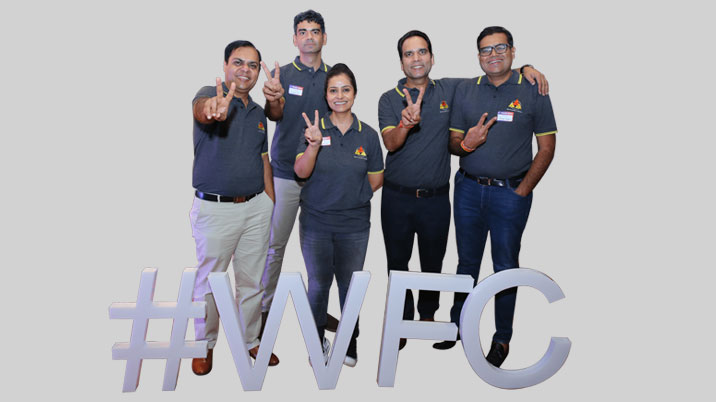
The founding group included Gaurav VK Singhvi, Bhawna Bhatnagar, Vikas Aggarwal and Deo Saurabh alongside Tyagi. Their photograph is suitably collective: five people in WFC shirts, a large hashtag at their feet, several victory signs raised. The public image matches the proposition. This was a business that sold the usefulness of belonging to a group.
The group also had to turn its premise into activity. WFC reported 71 deals across 53 startups during 2022. The distinction matters: a company can receive more than one investment, so deals and businesses count different things. For 2023, the platform reported 103 deals across 82 startups. These figures describe the platform’s annual work, rather than Tyagi’s personal investment record.
53 startups in 2022 · 82 startups in 2023
Annual platform figures. Deal counts include repeat investments.
The next investor might live in Kota
Tyagi’s smaller-city interest extended to both sides of the table. Entrepreneurs needed access to investors; people running established local businesses could themselves become angels. At the TiE Global Summit in Hyderabad in late 2022, WFC discussed partnerships with local startup ecosystems, including T-Hub. Singhvi described investor education events in towns such as Kota. The effort involved going where people already worked, rather than waiting for everyone to arrive in a familiar startup hub.
By 2024, Tyagi said WFC had added nearly 4,000 investors over the preceding year, about 2,500 of them from tier II and III cities. He connected this change to smaller-city business owners’ adoption of digital transactions, customer acquisition and business management during the pandemic. Using technology in an existing business had made the startup world more interesting to them.
There was still a knowledge gap to address. Years of experience running a business did not automatically provide familiarity with newer technology business models. WFC’s roadshows were intended to explain that world and invite local professionals and business owners into it. The community proposition therefore required patient translation. An introduction was useful; understanding what one was being introduced to was useful as well.
The ambition Tyagi described for India, rather than a count of cities already built.
Enthusiasm had to survive the questions
Tyagi’s public advice to entrepreneurs was direct. Know the industry. Understand the business model. Arrive with a clear pitch. He looked for commitment and resourcefulness, but also for a willingness to listen and improvise. Product quality, a loss of direction and a failure to progress were warning signs. His interest in the person building a business came with questions about what that person was actually building.
“Always focus on your pitch and business model.”
Neeraj Tyagi, January 2022
That combination appears in his recollection of WFC’s investment in Seekho. In a public comment on co-founder Rohit Choudhary’s post, Tyagi remembered investors wondering why Indians would pay for educational content when videos were available free on YouTube. It was an intelligible objection. A subscription business has to explain why somebody should subscribe.
Tyagi said the team went ahead because it believed in the founders’ conviction that trust would distinguish their offering. The episode gives substance to the idea of backing a founder. There was a specific uncertainty, and a specific reason to take the entrepreneur’s answer seriously. His account described judgment under disagreement. Even a circle contains people facing different directions.
Different doors into early-stage investing
As WFC developed, the work acquired several connected forms. Invstt offered a technology platform for startup investing and networking. EvolveX worked with pre-seed and seed-stage businesses, combining funding with mentoring and business support. Avinya Ventures added a venture fund to the group’s activities, with Tyagi as a co-founder and partner. Each addressed a different part of the journey between a new business and the people prepared to support it.
In 2023, when discussing EvolveX, Tyagi emphasised giving entrepreneurs visibility over funding from pre-seed through angel rounds. That word, visibility, is telling. An early-stage founder is trying to build a company while also working out what the next financing step might look like. A programme with mentoring and business support could make some of that route easier to understand.
He also discussed WFC’s participation in Series A and B rounds, alongside its earlier-stage investments. The approach offered investors businesses at different stages of development. By then, his public priorities included SaaS, climate technology, AI and fintech. The community was accumulating more ways to participate, while continuing to depend on the original task of connecting people and companies.
Across borders, still in conversation
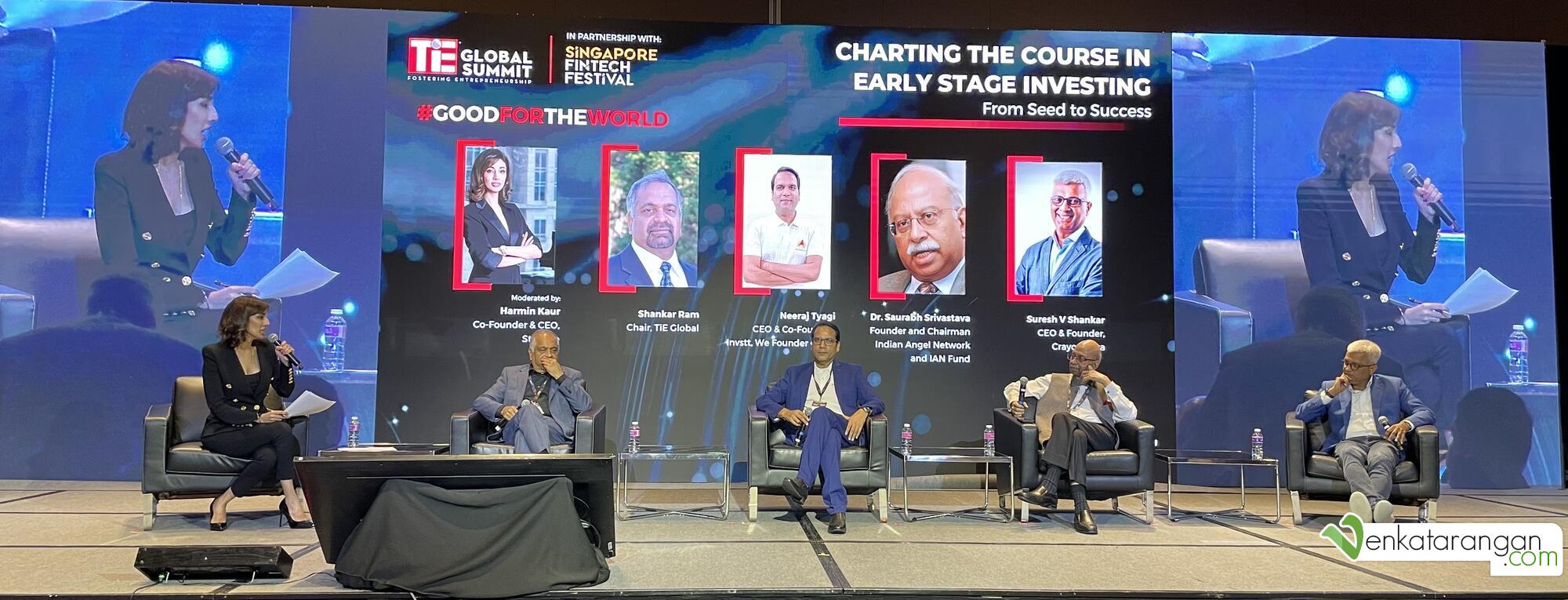
The international thread from Venture Catalysts continued. In November 2023, Tyagi appeared on an early-stage investing panel at the TiE Global Summit in Singapore. Moderator Harmin Kaur brought him together with TiE Global chair Shankar Ram, Indian Angel Network founder Saurabh Srivastava and Crayon Data founder Suresh V Shankar. His title there included CEO and co-founder of Invstt.
CNA also included him in the venture-capitalist lineup for The Big Spark, identifying his roles at Avinya Ventures, WFC and Invstt. The appearances placed him among other investors and founders discussing how businesses grow. They extended the same pattern visible in his earlier global-alliance work: a network built through people meeting, speaking and finding common interests across markets.
At SaaS.Connect in 2025, that pleasure in meeting entrepreneurs was audible. Tyagi told interviewer Rahul Dorai that he had already met roughly 25 to 30 founders that morning. The concentration of talent had exceeded his expectations, he said, and some of those encounters would lead to cheques. For all the platforms and funds, a morning of conversations remained an event worth getting excited about.
At the ET Soonicorns Summit in 2024, he joined a discussion about funding and the route to an IPO. Alongside Awfis founder Amit Ramani and lawyer Sanjay Khan Nagra, he considered what it takes for a startup to approach public markets. Tyagi put profitability, or a path towards it, alongside the founder’s conviction that going public was possible. The subject was some distance from a seed cheque, but it followed the same company journey. An early belief eventually has to meet the requirements of a much wider audience.
The credit went around the room
In a 2025 LinkedIn post celebrating WFC’s Best Angel Investor recognition from Entrepreneur Media, Tyagi thanked the co-founders, team, partners, community and portfolio startups. He described recognition from peers as rewarding. The allocation of credit was consistent with the business he had helped build: several kinds of contribution, brought together under one name.
Tyagi died in August 2025. WFC’s tribute remembered his mentorship, kindness and commitment to building communities rooted in trust and collaboration. His professional life had moved from media production to investor alliances and then to platforms carrying a founder-led approach into more places. The recurring work was making a group useful to the next person entering it.
The first cheque is a convenient place to end a funding announcement. Tyagi’s career gives it a longer context. Before it come the conversations, the difficult questions and the decision to hear a founder from somewhere less familiar. After it comes the work of building the company. He helped organise people around that stretch of the journey, with room in the circle for someone new.