Profile · Boston, Mass. · Renewable Energy
Nate
Owen.
He built the boring plumbing of deregulated electricity. Then he did it again for the sun.
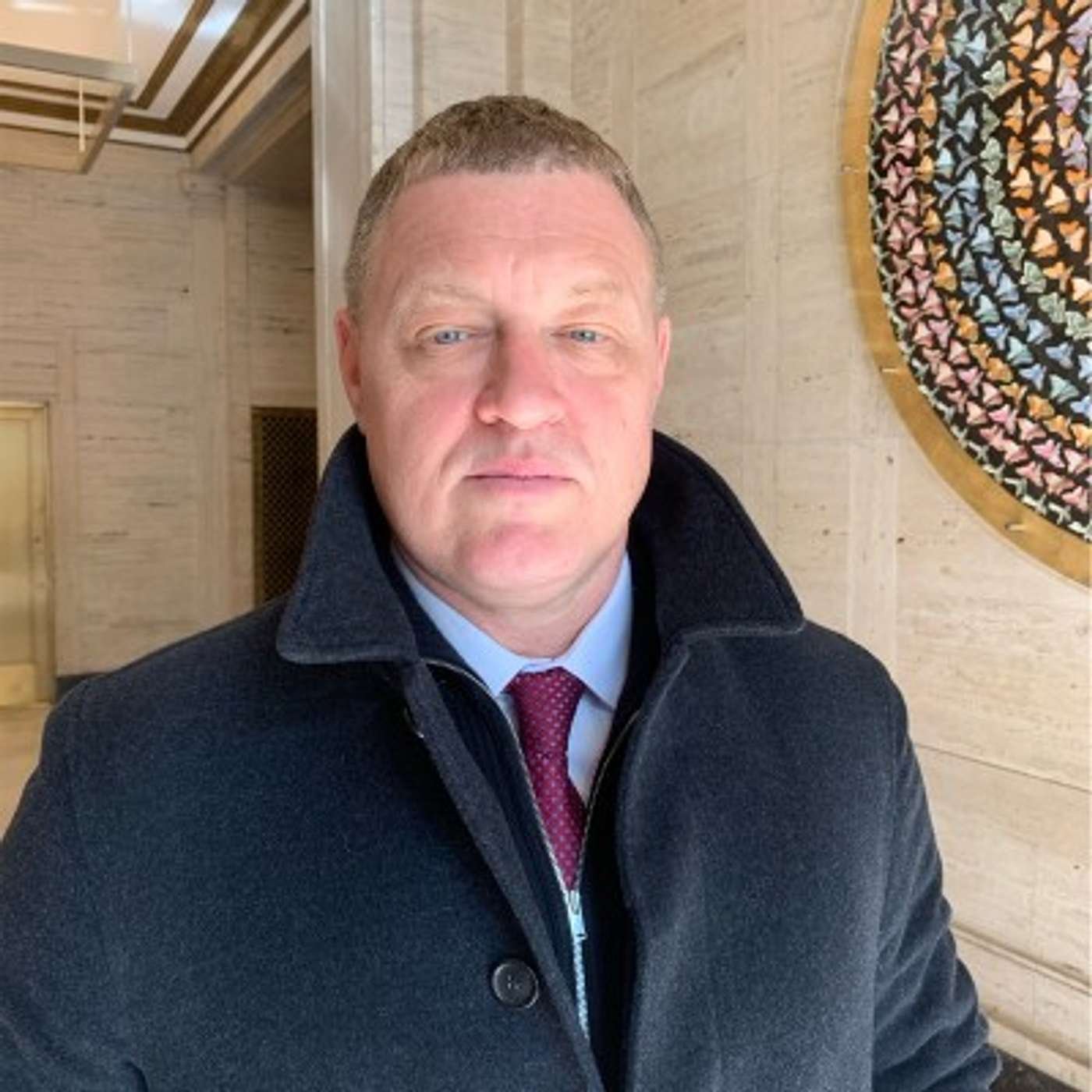
He built the boring plumbing of deregulated electricity. Then he did it again for the sun.
The trick to understanding Nate Owen is that he has essentially made the same bet twice, twenty years apart, and both times the bet has been on the software behind the meter rather than the meter itself. In 1996, when most of the United States still bought electricity from a single regulated monopoly, Owen founded Energy Services Group, a Maine-based back-office platform for the thousands of small retailers about to be turned loose by deregulation. The retailers came and went. The billing systems, EDI translators, and customer enrollment workflows he built for them stayed. That is a good career, and for most people it would have been sufficient.
In 2014 he did the same thing again, this time in a shed in Bar Harbor. He called it Ampion, which is now a Boston Public Benefit Corporation with about a hundred and twenty employees on Milk Street, roughly 1.5 gigawatts of community solar capacity under management, and, by its own count, more than forty-two million dollars in cumulative electricity-bill savings passed through to residential and small-commercial subscribers. It has never been acquired. It has never acquired anyone. It has raised about twenty million dollars total, ten of it in a Series A in early 2021, which by cleantech standards is basically a rounding error.
What Ampion sells, if you squint, is not electrons. It is the unglamorous machinery by which a solar farm in upstate New York becomes a two-line credit on a household bill in the same utility territory - the acquisition of the subscriber, the enrollment, the utility interface, the monthly reconciliation, the regulatory compliance, the customer service call when the credit doesn't show up on time. The industry term is community solar. The industrial term, if you asked Owen on a candid day, is probably subscription management. The two concepts are more or less the same problem, and he has been solving versions of it since the Clinton administration.
The story of community solar in America is normally told as an environmental story, sometimes as a policy story, occasionally as a venture story. Owen tells it as a plumbing story. Every state that has passed a community solar statute has produced a slightly different regulatory dialect - Massachusetts is not New York, New York is not Illinois, and California is a category unto itself. Someone has to translate between the solar developer, the utility, the regulator, and the subscriber. Someone has to send the right file to the right utility server on the right day of the month, in the right format, or nothing gets credited to anyone. Ampion is, essentially, that translator at scale.
The Public Benefit Corporation designation is worth pausing on. It is not, in most states, a tax status or a regulatory privilege. It is a legal commitment written into the charter, which obligates directors to consider a broader set of stakeholders than the standard fiduciary rule contemplates. Ampion adopted the structure at inception. Owen has kept it there through a decade of growth. When you talk to him about it, the reason is not particularly ideological. It is that the customer base - lower-income households picking up thirty-dollar credits on a monthly bill - is not the sort of customer base one wants a growth-at-all-costs board to lose interest in.
We're selling a slice of bread. They want 10 bakeries.— Owen, on corporate demand for community solar, Clean Power Hour Ep. 206
Owen's thesis for the next decade of the sector - the one he trots out on the podcast circuit under the phrase Community Solar 2.0 - is that the model has to graduate beyond the state-specific residential program that has defined its first ten years. The traditional shape is a five-megawatt solar array, a handful of local subscribers, and a bill credit routed through a friendly utility. The new shape, in Owen's telling, is larger projects sold in slices to a mix of residential and corporate offtakers, with renewable energy certificates bundled in for the buyers who need Scope 2 accounting to line up.
The Wendy's deal, announced in 2023, was the demonstration. A fast-food chain does not, ordinarily, subscribe to community solar. It signs a virtual power purchase agreement or writes a check to a REC broker. But Ampion structured a bundle in which Wendy's could point to actual local generation, actual local subscribers, and actual retired certificates, all from the same project. It is a deliberately unsexy piece of financial engineering, and it is exactly the sort of thing a former back-office software vendor would think to build.
None of this makes for particularly exciting television. Owen's public appearances - a Norton Rose Fulbright project finance podcast in 2023, Clean Power Hour in 2024, an Energy Changemakers interview shortly after - tend toward the same measured, systems-level explanation, punctuated by mild frustration whenever California comes up. He is on record as a fan of standardization, stakeholder collaboration, and the long tail. He is on record as a skeptic of moonshots. The word he uses most often in interviews is probably evolution.
Which is, in a way, the whole point. The renewable transition, as it turns out, is not being carried across the finish line by ten-year-old startups with thousand-percent growth rates. It is being carried, slowly and unglamorously, by companies that know how to file the right paperwork with the right utility on the fifteenth of every month. Ampion is one of those companies. Owen, at this point in his career, is unusually well cast to run one.
Ampion was founded in a coastal Maine town best known for lobsters and Acadia National Park. The Milk Street headquarters came later.
Owen scaled Ampion to 120 people entirely on organic growth. In a sector defined by roll-ups and SPACs, that is a choice.
He is one of the few people whose resume spans the deregulation wars of the 1990s and the community solar buildout of the 2020s.
An econ and political-science degree turns out to be an unusually apt combination for a career spent between utility regulators and rate design.
Ampion has been a PBC since day one. The customer base is often low- and moderate-income households; the charter is written to keep them centered.
That's the total clean energy Ampion says its projects have produced under management. Enough to notice on a grid map.
“Community solar is an equalizer for energy access, and it can power communities, easing utility bill burdens and helping the planet.”
“We're selling a slice of bread. They want 10 bakeries.”
“We are pleased to see more states enacting community solar legislation to encourage renewable energy adoption.”
Founder and CEO of Ampion, a Boston-based Public Benefit Corporation that acquires and manages community solar subscribers across multiple states.
He founded Energy Services Group in 1996, providing back-office systems to retail electricity and gas companies operating in newly deregulated markets.
John Bapst Memorial High School in Bangor, Maine, followed by a bachelor's degree in Economics and Political Science from Bowdoin College, class of 1993.
Around 120 employees, headquartered in Boston, managing approximately 1.5 GW of community solar capacity.
Owen's term for extending shared solar beyond state-specific residential programs into larger projects with corporate and institutional offtakers, often bundled with renewable energy certificates.