BREAKING - Myriota raises US$32M led by Australia's National Reconstruction Fund Four new UltraLite nanosatellites launched via SpaceX Transporter-12 World-first direct-to-nanosatellite IoT transmission proven in 2013 100+ granted patents in satellite communications Coverage extended to Mexico, Brazil, Chile, Argentina and the Middle East Ten years of deep tech out of Adelaide's Lot Fourteen
Company Profile - Satellite IoT

Myriota.

The Adelaide company teaching water tanks, cattle and mining rigs to talk directly to satellites - on a battery that lasts years.

Adelaide, Australia Founded 2015 Direct-to-orbit IoT ~72 employees
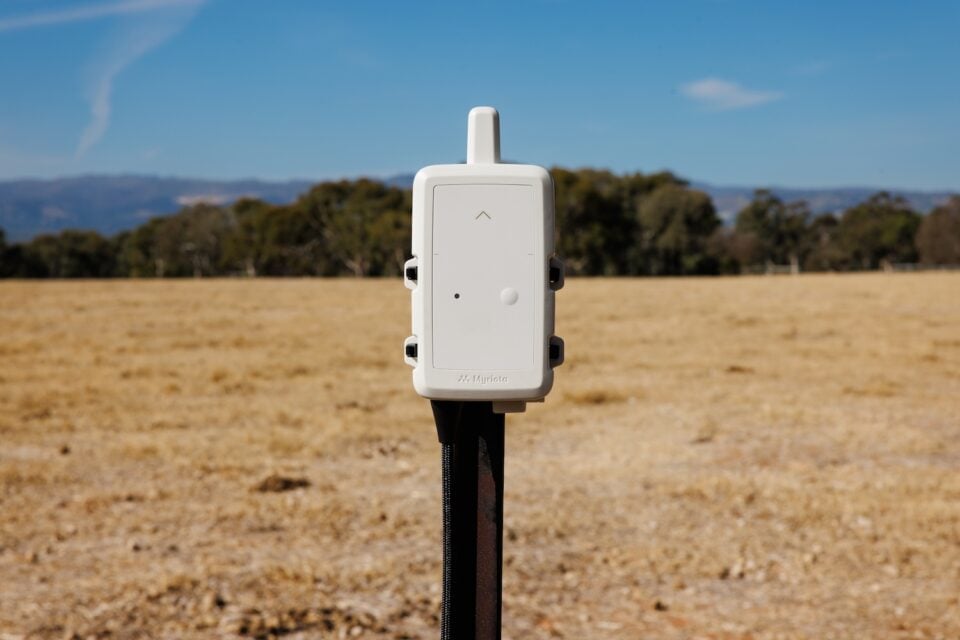
Myriota FlexSense satellite IoT device mounted in a remote Australian field

FIELD INTELLIGENCE. A Myriota FlexSense device stands alone in a dry South Australian paddock - no cell tower for miles, its data going straight up to a nanosatellite passing overhead.

2013
First-to-orbit proof
100+
Granted patents
US$80M+
Total funding
5
Continents in reach
The Dispatch

A satellite network built for machines, not people

Most of the Internet of Things stops where the mobile network stops. Beyond the last cell tower - out on cattle stations, mine sites, pipelines and river gauges - there is a great deal of the planet and almost no coverage. Myriota built its business precisely there.

The Adelaide company makes low-cost, low-power satellite connectivity that lets a small sensor send data directly to a constellation of nanosatellites in low Earth orbit. There is no ground network to build, no cellular contract, and no mains power required. A device can sit in a field and report for years on a single battery.

The approach is deliberately unglamorous. Myriota is not chasing satellite phone calls or video streaming. It moves small, infrequent messages - a tank level, a location ping, a temperature reading - the kind of data that keeps remote industry running. Because the messages are small and the power draw is tiny, the economics work at a scale that human-facing satellite services rarely reach.

That focus traces back to a physics result. In 2013, before the company was formally founded, researchers in Adelaide demonstrated a world-first: sending IoT data straight up to a passing nanosatellite. Myriota was spun out of the University of South Australia's Institute for Telecommunications Research in 2015 to turn that demonstration into a network.
Myriota aims to revolutionise the Internet of Things by offering disruptively low-cost and long-battery-life global connectivity.
- Myriota company mission
Who it serves

The customers live past the edge of the grid

Myriota's customers are organisations whose most valuable assets sit where connectivity is hardest: agricultural producers watching water and livestock, utilities monitoring remote tanks and pipes, mining and heavy-industry operators tracking equipment, transport and logistics firms, and government and defense agencies.

The problem it solves is simple to state and expensive to ignore. When a remote water tank runs dry, a town can lose supply. When a pump fails on a distant site, someone drives hours to find out. The old answer was to send a person; Myriota's answer is a sensor that reports on its own.

Because the network is direct-to-satellite, there is no local infrastructure to install or maintain - a decisive advantage in places where building a cell tower or laying fibre makes no economic sense.

AGRICULTURE

Smart farms

Water tank, soil and livestock monitoring across properties with no coverage.

UTILITIES

Water

Remote tank levels and metering with partners like Grundfos and Taggle.

MINING

Heavy industry

Tracking and monitoring equipment on isolated sites.

DEFENSE

Government

Asset tracking and remote sensing with agencies including DSTG.

The angle

What sets it apart

The satellite connectivity race is crowded, but most competitors aim at phones and broadband. Myriota built for the opposite end: tiny messages, ultra-low power, and the lowest possible cost per transmission. Its patented Dynamic Pulse technique lets a sensor send data straight to orbit without a heavy, power-hungry radio - which is what keeps batteries alive for years.

Rather than manufacturing and launching every spacecraft itself, Myriota also hosts payloads on shared satellites through partners such as Spire Global. That asset-light approach lets it grow the constellation while keeping its focus on the two numbers that decide the market: cost per message and battery life.

It sits alongside a global field of satellite IoT players - Sateliot, Astrocast, Swarm (now part of SpaceX), Skylo, Kepler, Kineis, Hiber and fellow Australian firm Fleet Space - but its ten-year head start, 100-plus patents and long-life, low-cost design give it a defensible niche in direct-to-orbit connectivity for remote industry.

Money in

Funding over time

$15M
Series A '18
$19.3M
Series B '20
$32M
Growth '24
$80M+
Total raised

Figures in USD, approximate and drawn from public announcements. The 2020 Series B was AU$28M (about US$19.3M); the December 2024 growth round of US$32M was led by the National Reconstruction Fund Corporation and Main Sequence.

Products & services

From modules to finished field devices

2023

FlexSense

Ruggedised, configurable satellite IoT device with flexible sensor inputs for water, tank and environmental monitoring.

2024

HyperPulse

Next-generation, 3GPP/5G standards-aligned satellite IoT connectivity.

2025

UltraLite

Ultra-low-power constellation and module technology behind long-battery-life, direct-to-orbit transmission.

2023

AssetHawk

Satellite-connected tracking for high-value equipment in off-grid locations.

2018

Module & Dev Kit

Off-the-shelf modules, dev kits, RTOS support and cloud APIs for device makers to add satellite connectivity.

Business model

A B2B mix of hardware and recurring connectivity. Myriota sells modules and finished devices, then charges recurring satellite data plans priced per message or subscription, and works through OEMs and system integrators who embed its network into their own products.

Expertise

Deep signal-processing and wireless communications know-how from a university research lab, hardened into a commercial constellation - power-optimised radios, satellite pass scheduling, secure data transfer and edge-to-cloud integration.

The record

Ten years, earth to orbit

2013

World-first transmission to a nanosatellite

Researchers in Adelaide prove IoT data can be sent directly to a passing nanosatellite.

2015

Myriota founded

David Haley and Alex Grant spin the technology out of the University of South Australia.

2018

Series A and Boeing backing

Raises Series A funding with investors including Boeing HorizonX and In-Q-Tel.

2020

AU$28M Series B

Hostplus and Main Sequence lead a round pushing total funding past AU$50M.

2023

FlexSense and product expansion

Broadens its lineup with configurable, field-ready sensors.

2024

US$32M growth round

National Reconstruction Fund and Main Sequence back global expansion.

2025

Constellation expansion & a decade

Four new UltraLite satellites launch via SpaceX with Spire Global as Myriota marks ten years.

At a glance

The file

Legal name
Myriota Pty Ltd
Headquarters
Adelaide, South Australia (Lot Fourteen)
Founders
Dr David Haley (CTO), Dr Alex Grant
CEO
Ben Cade, Chair & CEO
Team size
Approximately 72-75 people
Industry
Satellite IoT / telecommunications
Selected partners

Who it works with

Spire Global

Hosts Myriota payloads on shared nanosatellites.

Boeing HorizonX

Strategic investor and partner.

AWS

Cloud and Ground Station integration.

Optus

Australian market satellite IoT services.

satellite iotdirect-to-satelliteleo nanosatellites low-powerremote monitoringagriculture miningdefenseaustralian space
The margins

Things worth knowing

Proof before the company

The core tech was demonstrated in 2013 - two years before Myriota was formally founded.

Lab origins

Spun out of the University of South Australia's Institute for Telecommunications Research.

A PM on the cap table

Former Australian Prime Minister Malcolm Turnbull invested in the Series B round.

Years on one battery

Devices are designed to run for years with no power and no phone signal.

Space Agency neighbours

Based at Lot Fourteen, the same Adelaide precinct as the Australian Space Agency.

Rode a SpaceX rocket

Its 2025 satellites launched on SpaceX's Transporter-12 rideshare mission.

Watch & explore

Demos, interviews and channels

Around the web

Links & sources

Questions

Frequently asked

What does Myriota do?

Myriota provides low-cost, low-power satellite connectivity that lets remote IoT sensors send data directly to a constellation of low Earth orbit nanosatellites - without any ground network or cell coverage.

Who founded Myriota and when?

It was founded in 2015 by Dr David Haley and Dr Alex Grant, spun out of the University of South Australia's Institute for Telecommunications Research, building on a world-first direct-to-satellite demonstration in 2013.

Where is Myriota based?

Myriota is headquartered in Adelaide, South Australia, at the Lot Fourteen innovation precinct that also hosts the Australian Space Agency.

Who uses Myriota's technology?

Customers span agriculture, water utilities, mining, transport and logistics, energy and government/defense - typically organisations that need to monitor assets in remote, off-grid locations.

How much funding has Myriota raised?

Myriota has raised roughly US$80M+ across multiple rounds, including an AU$28M Series B in 2020 and a US$32M growth round led by Australia's National Reconstruction Fund Corporation in December 2024.