The annoying thing about the future is how often it gets stopped by a laptop. A coding agent can draft a mobile feature from a cloud sandbox, trace a bug through unfamiliar Swift, and prepare a pull request before lunch. Then it meets Xcode. The build wants macOS. The app wants a simulator. The reviewer wants to tap the thing, not admire a diff and hope. Suddenly the cloud's tireless new worker is waiting outside a locked workshop.
Muvaffak Onuş has chosen that locked door as his company. Limrun gives cloud agents remote Xcode, iOS simulators and Android emulators, then lets them return with evidence: streaming logs, a demo recording and a preview that opens in a browser. The model still writes code wherever it normally works. Limrun supplies the native machinery it cannot carry into the sandbox.
It is a very specific answer to a broad change in software. Coding agents have made the act of producing code cheaper and stranger. The friction moves outward. A tool that can edit a repository still needs somewhere to build, run and prove its work. Mobile makes the constraint visible because Apple's toolchain has never pretended to be a placeless utility. Somewhere, a Mac must enter the story.
An apprenticeship in invisible machinery
Onuş arrived at the problem by spending years beneath the visible layer of software. At Sabancı University, he studied computer science and engineering alongside economics, with an exchange term at Purdue. His student work wandered usefully: a social-media analysis project in Scala and Spark, a React Native app, parallel graph coloring with CUDA. Microsoft appeared as a summer-school internship, then Amazon as a software-development internship in 2017, where he worked on optimizing EMR clusters for machine-learning workloads.
The double major tells only part of the undergraduate story. Onuş later recalled taking courses in visual arts, management and psychology as well. High school had briefly given him the dangerous impression that he understood how the world worked; college restored the gaps. His point was less about collecting subjects than preserving surprise. The engineer who would later connect cloud systems developed an appetite for crossing categories first. Economics asks what scarce resources do to behavior. Computing asks what precise instructions do to machines. Art and psychology complicate both answers. Limrun now sits at a similarly untidy junction, where machine capability, expensive hardware and human confidence have to agree long enough for a feature to ship.
After graduating in 2018, he joined SAP and built Kubernetes controllers intended to turn on-premise applications into on-demand cloud services. The phrasing sounds dry until you notice the recurring trick. A controller takes a declared intention and works until reality matches it. The user asks for an outcome. The machinery worries about the sequence.
At Upbound, Onuş moved deeper into that idea. He became a maintainer of Crossplane, the open-source cloud control plane, and led provider work around Terrajet and Upjet. The aim was to make the sprawling catalogs of AWS, Azure and Google Cloud available through consistent, declarative interfaces. In one public celebration, he counted hundreds of generated resource definitions across the three clouds. A person should be allowed a little excitement after teaching several thousand infrastructure objects to speak Kubernetes.
He also became a public explainer and mentor. Onuş helped mentor Crossplane contributors through CNCF programs, spoke about the project to the Istanbul cloud-native community, and took tutorials to KubeCon. In Valencia he demonstrated provider code generation. In Detroit, with Sidarta Aguiar de Oliveira, he spent a long session building a customizable Heroku-like platform from Crossplane, Backstage and other cloud-native parts.
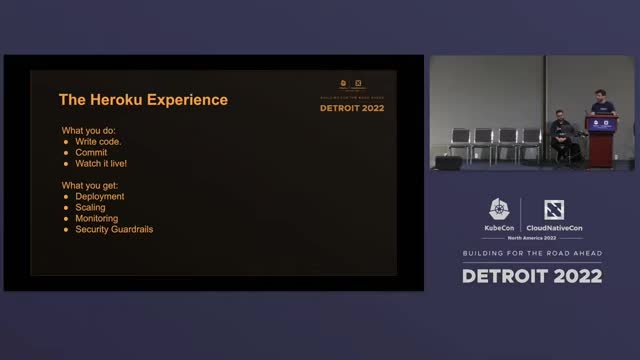
The code attached to that talk contains a small, revealing joke. Onuş described a custom Backstage action, then warned readers that he had written it for KubeCon “without knowing much TypeScript.” It is an engineer's disclaimer and a maker's confession. Learn enough to make the missing part. Publish it. Tell people where it may creak.
The sandbox before the startup
In 2023, Onuş joined QA Wolf, where the problem shifted from provisioning cloud resources to running unreliable, demanding software work at scale. He founded and led the team that built web and mobile testing sandboxes. The environments had to survive arbitrary tests, browsers and devices while remaining observable and economical. By the time he left as a senior staff engineering lead in 2025, the outline of Limrun was hiding in plain sight.
One QA Wolf experiment made that outline especially clear. The open-source project crik explored checkpointing a Kubernetes process when a spot machine was about to disappear, then restoring it elsewhere. Onuş presented it at KubeCon Europe in 2024 under a title with suitable nightclub optimism: “The Party Must Go on.” The technical concern was continuity. Long-running tests should not lose all their progress because cheap compute received an eviction notice.
Control planes, generated providers, disposable sandboxes, interrupted processes. These are not the glamorous nouns of consumer software. They are the stagehands. They arrange for a desired action to occur somewhere complicated, and they leave the audience with a clean result.
SAP: Kubernetes controllers for cloud services.
Upbound: Crossplane maintenance and provider engineering.
QA Wolf: web and mobile testing sandbox infrastructure.
Limrun: native development services for cloud agents.
A feedback loop with a phone in it
Limrun turns those stagehand skills toward the mobile development loop. An agent syncs code from its existing sandbox and triggers a remote Xcode build. It watches logs arrive in real time. It attaches the result to an iOS or Android simulator, drives the interface, and records what happened. The final pull request can include a video and a browser link through which a teammate can use the simulator without checking out the branch.
The sequence matters because generated code carries an unusual burden of proof. A human author can explain the intent across a desk. An agent produces more work, more quickly, and often without a witness. A successful compile is useful. A recording of the intended flow is better. An interactive preview gives the reviewer the final small pleasure of distrust: press the button personally and see what breaks.
Limrun says its infrastructure is in production at Replit, Rork, Momentic, minitap and other agent-focused companies. Replit's president and head of AI, Michele Catasta, has praised the team's focus on quality and ability to handle the company's scale. Momentic CTO Jeff An has said the service brought his team to market faster than building the same layer on a hyperscaler. Those endorsements describe the business, but they also identify the hidden customer need: agent companies do not want to become reluctant operators of fleets of Macs and phone simulators.
The old essay inside the new company
Five years before founding Limrun, Onuş wrote a short essay called “curiosity and happiness.” He argued that sustained curiosity depends on seeing the effect of one's work. If a small change requires six approvals or waits half a year for feedback, the eventual result becomes difficult to connect with the original impulse. Shorten the loop, he suggested, and exploration stays alive.
It reads now like an accidental product memo. Native mobile work has a punishing loop when the builder lives in a remote sandbox: generate code, hand it to someone with the right local setup, wait for a build, request screenshots, revise, repeat. Limrun compresses that distance until the agent can encounter the app directly. The philosophy did not predict coding models. It predicted that curiosity, whether human or automated, benefits from consequences that arrive on time.
A second essay, “buggy culture,” supplies the social half. Onuş described software as a living organism and pushed against the reflex to hunt for the individual responsible for a failure. The better question is what the surrounding process allowed and how it can improve. This is useful counsel when a new nonhuman contributor enters the repository. Blame is even less productive when directed at a probability distribution. Instrumentation, repeatable environments and visible feedback have a fighting chance.
Limrun is still a small company, with a three-person team and the compressed ambitions common to a young infrastructure startup. Its present product is deliberately narrow: remote native tools that an agent can compose from its own environment. Yet Onuş frames the larger aspiration as cloudifying the local utilities that modern development still depends on. Mobile is the sharp edge because Xcode and simulators make locality impossible to ignore. Games, GPU-heavy workflows and other stubborn toolchains sit nearby.
The thread through his career is not merely cloud computing. It is the translation of complicated systems into something callable. A Kubernetes controller accepts a desired state. Crossplane turns cloud services into resources. A testing sandbox makes hostile workloads disposable. Limrun lets an agent ask for a native build and a running phone. Each layer hides machinery, but the good versions return proof.
That may be Onuş's most practical observation about the agent era. Intelligence alone does not finish the job. It needs tools, environments and a short road back from action to evidence. The future can keep its grand declarations. For now, it would like access to Xcode.