Limrun Wants Your AI Agent to Build iPhone Apps Without a Mac
The three-person Y Combinator startup drags Xcode, iOS simulators and Android emulators into the cloud. Coding agents that could only ship web apps can now compile, test and preview mobile ones.
For most of the last two years, the AI coding boom had a quiet blind spot. Agents could spin up a website, wire an API and deploy a backend before lunch. Ask one to build an iPhone app and it stalled. Not because the model could not write Swift, but because somewhere down the line, iOS demands Xcode, and Xcode demands a Mac. You cannot rent a physical laptop through an API. Limrun's entire reason for existing is to make that sentence untrue.
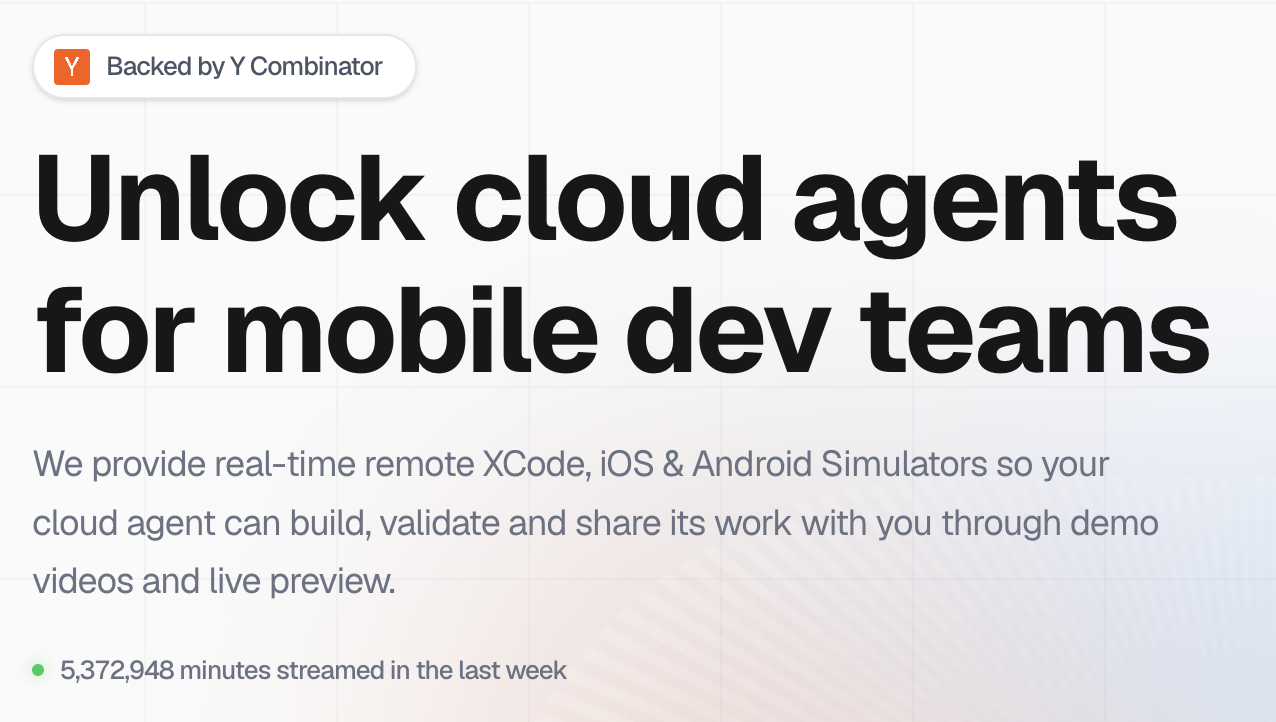
Limrun, a Y Combinator company in the Spring 2026 batch, sells the parts of mobile development that never made it to the cloud. It runs Xcode, iOS simulators and Android emulators as remote services, then lets a coding agent - or a CI runner, or a browser sandbox - reach in and use them. The agent compiles the app, watches the build logs stream by, drives a simulator, and hands back a preview you can open in a tab. No Mac on a desk. No local install.
01The problem nobody wanted to own
The gap Limrun is filling is unglamorous, which is exactly why it sat open. Building for iOS has always been tethered to Apple's hardware. Teams that wanted cloud mobile builds ended up racking Mac minis, renting cloud-Mac instances, or bolting together their own simulator farms. That is fine when a person is at the keyboard. It falls apart when the "developer" is an autonomous agent that expects everything to be an API call.
Founder and CEO Muvaffak Onus had spent years close to this exact seam. Before Limrun he maintained Crossplane, a widely used cloud-native open-source project at Upbound, worked on Kubernetes at SAP and cluster optimization at Amazon, then built and led the web and mobile testing sandbox teams at QA Wolf. In other words: someone who had already run mobile test infrastructure at scale decided the cleaner business was to sell it as a service.
02What it actually does
Strip away the framing and Limrun is three cloud services that used to be local:
Remote Xcode handles code syncing and compilation with streaming build logs and cached artifacts. The cloud iOS simulator exposes an accessibility tree and records at 60fps, and speaks the languages of mobile test tooling - Appium, Maestro, Detox and agent-driving frameworks. The Android emulator is reachable over an ADB tunnel proxy. On top sits a preview layer: shareable browser previews, on-demand demo videos, and direct device installs over WebUSB.
The detail founders tend to notice is speed. Limrun advertises sub-one-second simulator boots on warm caches. For an agent iterating in a loop - build, run, check, fix - the difference between a one-second boot and a thirty-second one is the difference between a usable product and a demo.
03Who is already plugged in
Limrun's customer list reads like a directory of the AI app-building wave. These are not logos on a "coming soon" page - they are companies routing production mobile workflows through Limrun's infrastructure.
The endorsements matter more than the count. Replit's president and head of AI, Michele Catasta, framed it as a scale story, which for an infrastructure vendor is the whole ballgame.
For customers, the appeal is mostly arithmetic: building your own cloud mobile stack is a multi-quarter project before you ship a single feature. Momentic AI's CTO, Jeff An, put a number on skipping it.
04How it differs from the alternatives
The alternatives to Limrun are not new - they are just built for a different user. Mac farms, cloud-Mac instances and device farms assume a human is steering. Limrun assumes a program is. That single assumption reshapes everything from the API surface to the pricing.
| Capability | DIY Mac farm | Cloud-Mac / device farm | Limrun |
|---|---|---|---|
| Agent-drivable simulators | manual | limited | built-in |
| Sub-second boot | no | rare | yes |
| Streaming build logs | DIY | partial | native |
| Browser previews | DIY | partial | native |
| Priced by build/idle time | fixed cost | per hour | usage |
The business model follows from the same idea. Instead of charging per seat, Limrun charges for build and idle time - infrastructure priced like infrastructure. That aligns cost with how agents actually work: bursts of compilation and testing, then nothing, then another burst.
05Where it sits in the market
There is a whole layer forming underneath the AI-agent hype - the plumbing that lets agents actually run software rather than just write it. Sandboxes, browsers, code interpreters, test harnesses. Limrun is claiming the mobile pipe in that layer: the specific moment an agent needs Xcode or an Android emulator and does not have one.
Rough maturity of cloud agent tooling by domain. Mobile is where Limrun concentrates; the mission statement hints at more.
The company's stated ambition runs past mobile. "Cloudify every local development utility" is a bet that Xcode is just the first, hardest example of a broader pattern - Unity for game teams, Blender for 3D, anything else that still assumes a workstation. Whether a three-person team can chase all of that is an open question. For now, the wedge is sharp and the customers are real.
It is worth sitting with how small the team is against what it carries. Limrun is roughly three people, and one of its customers is Replit. That imbalance is either the risk or the proof, depending on your mood. The founder's read is that infrastructure this specific does not need a big team - it needs the right one.