There is a remarkable distance between answering one ringing telephone and deciding what an AI model should say to millions of people. Mustafa Suleyman has worked at both ends of it. As a young man, he left Oxford to help run the Muslim Youth Helpline, a service for young British Muslims built with volunteers and a thin budget. Today he is executive vice president and CEO of Microsoft AI. The machinery is new; the central problem is familiar. What happens when someone asks for help, and who gets to decide what a helpful answer is?
Suleyman calls that early organization his first startup. It needed money, people willing to work without pay, and a way to keep the phones operating every day. The practical lessons were less romantic than the phrase “change the world” usually implies. You needed to show up. You needed to listen. You needed to keep the system running. He spent almost three years there after leaving his studies in philosophy and theology. A later career in artificial intelligence can look like a sharp turn from that beginning, until one notices his persistent interest in making a useful conversation available at scale.
The boy who knew a future co-founder
Suleyman grew up in north London, near Caledonian Road. His father, who came from Syria, drove a taxi; his English mother was a nurse. He attended Thornhill Primary School and then Queen Elizabeth’s School in Barnet. Through a school friend he met that friend’s older brother, Demis Hassabis. Their conversations about making an impact would eventually become part of the story of DeepMind. At the time, the link was rather ordinary: a friend had an interesting sibling. Silicon Valley likes a grand origin myth, but sometimes a consequential introduction is made in the loose geography of childhood.
Oxford gave Suleyman a place to study ideas; the helpline offered a place to try them. Later he worked in human rights policy for London mayor Ken Livingstone and helped build a conflict resolution consultancy. He has recalled projects in Cyprus, where Greek and Turkish groups had to negotiate, and in Amsterdam, where people explored local food production. At climate negotiations in 2009, his task was to help scientists, activists and others find a shared position on deforestation. This was training in the stubborn nature of collective action. A room full of clever people does not automatically become a room that agrees.
By 2009, he was increasingly drawn to technology’s ability to reach beyond one room or one phone line. Facebook’s growth had caught his attention, as had the unsettling possibility that such reach could magnify the effects of any decision, good or bad. In 2010, Suleyman, Hassabis and Shane Legg co-founded DeepMind in London. The company would become a defining research lab in modern AI, and Google acquired it in 2014. Suleyman was the co-founder most closely associated with applying its work outside the lab.
The cooling bill
One of DeepMind’s most legible projects was also one of its least glamorous. Data centers generate heat, and cooling them uses substantial electricity. DeepMind built a system that analyzed operating data and suggested adjustments. In 2016, the company reported a reduction of up to 40 percent in the energy used for cooling at Google data centers. The percentage was attached to a specific task, not the whole electricity bill, but it made a point. AI could turn from a laboratory result into an operational decision with a measurable consequence.
DeepMind also taught him how hard it is to carry a powerful idea into a large institution. Researchers, product teams and policymakers bring different clocks and different definitions of success. Suleyman established work on AI ethics and society and became a founding co-chair of the Partnership on AI. He joined Google in a policy and product role after leaving DeepMind in 2019. His career at the lab had ended amid complaints about his management style, which he later acknowledged and apologized for. It is a necessary part of the record for a leader who asks institutions to take accountability seriously.
The question that followed him out of Google was what a broadly useful AI would feel like to an ordinary person. In 2022 he joined forces with Reid Hoffman and Karén Simonyan to co-found Inflection AI. Their first public product, Pi, arrived in 2023. Its name stood for “personal intelligence.” The interface placed conversation at the center. It asked questions, remembered context and aimed for an approachable tone. If an AI is meant to sit beside someone during a working day, the words on the screen matter as much as the benchmarks behind them.
A companion with limits
Pi made visible an enduring tension in Suleyman’s work. A more conversational machine may be easier to use. It can also invite more trust than it deserves. Suleyman’s public argument has long been that AI’s promise comes paired with a problem of control. He and Michael Bhaskar put that argument into a 2023 book, The Coming Wave, which explored how rapidly advancing technologies might be contained. The book reached readers just as the companies building those systems were pressing to make them more widely available.
A year after Pi’s launch, Microsoft brought Suleyman, Simonyan and several Inflection colleagues into a newly formed Microsoft AI organization. Satya Nadella made Suleyman its CEO and placed consumer products including Copilot, Bing and Edge within its remit. It was a peculiar kind of move in a peculiar industry: a startup’s people moved into a giant company, while the startup continued separately. The appointment also made Suleyman answerable for the experience of AI at a scale that Inflection could only imagine.
He described a future in which people would have a personal AI companion, one that could adapt to their style and help with daily tasks. That is a product pitch with a philosophical trap inside it. The more an assistant knows about a person, the more useful it may be. The more natural the exchange feels, the easier it is to grant the assistant authority it has not earned. The design question is whether the user finishes the conversation with more judgment and more room to act, or simply with a stronger habit of asking the machine.
The larger room
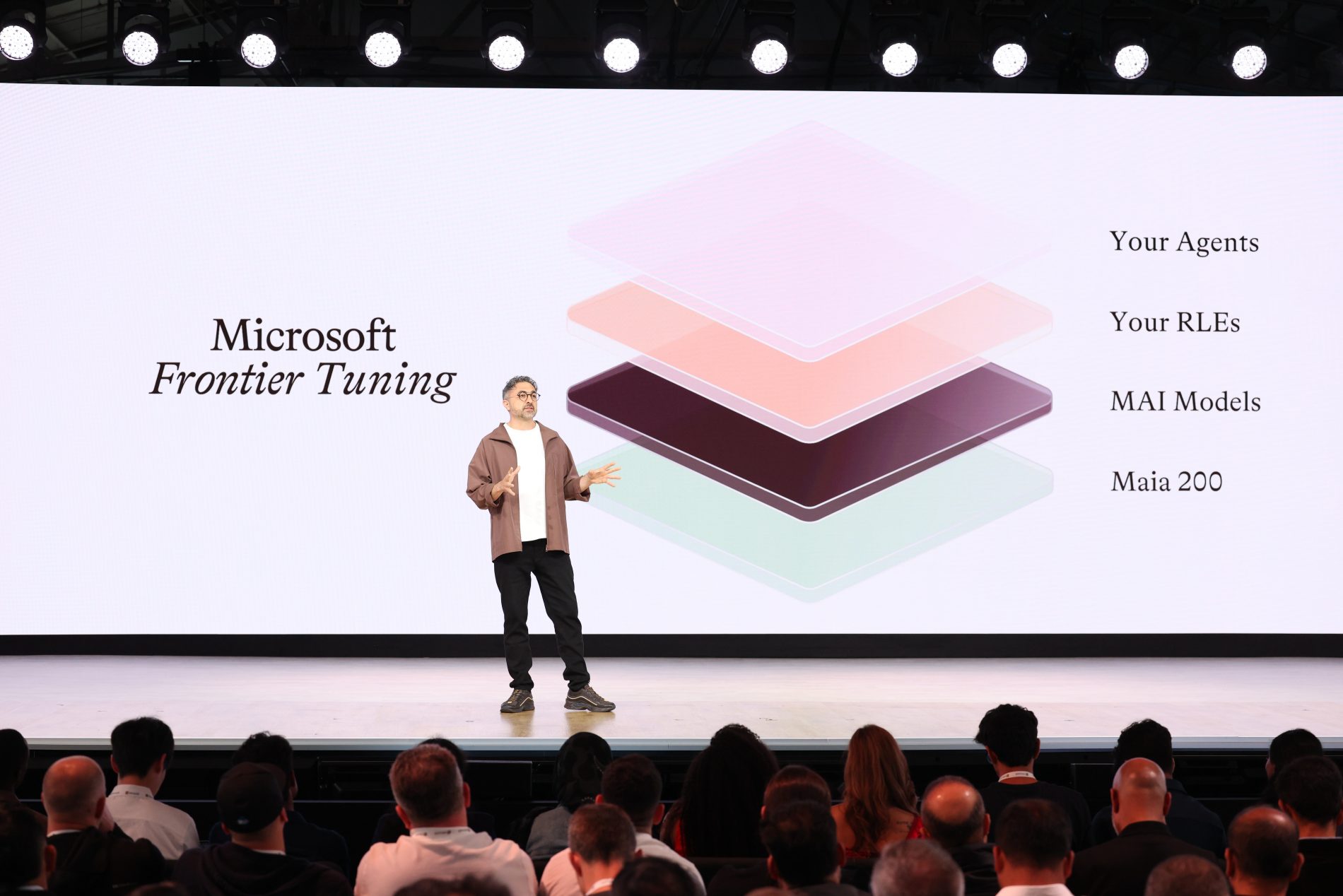
The Microsoft assignment changed shape in March 2026. The company unified consumer and commercial Copilot leadership under Jacob Andreou, while Suleyman concentrated more directly on frontier models. He remained CEO of Microsoft AI and part of the wider Copilot leadership group. This was a shift in emphasis, from the conversational surface toward the systems underneath it. In June, he stood onstage at Microsoft Build in San Francisco and presented seven MAI models across image, voice, transcription, reasoning and code work. It was a public marker that Microsoft wanted to build more of the intelligence its products rely on.
There is a pleasing symmetry, and an uncomfortable one, in that trajectory. The young organizer learned that a small service could fail if it could not keep the phones staffed. The executive now faces the opposite scaling problem: a model can speak everywhere, all the time. The design decisions made before it reaches a user will be repeated, often invisibly, across countless interactions. Good intentions offer little protection unless they survive the training process, the interface and the pressure to ship.
What control looks like in print
In September 2026, Microsoft AI published a draft code of conduct for its own models and invited public feedback. It says people should retain meaningful control, and that models should be designed as subordinate to human direction. These are plain words for a difficult engineering and governance problem. When an assistant can propose actions, carry out tasks and become more persuasive, “control” must mean more than a visible stop button. It reaches into how a model handles correction, how it represents uncertainty and whose interests guide its behavior.
Suleyman has argued that a powerful model should make people more capable rather than train them into dependence. It is a standard that can embarrass its author, which is precisely why it is useful. A system that produces a quick answer may still reduce the user’s understanding. A product that appears attentive may still obscure its limits. A code of conduct can articulate the desired direction; ordinary product choices will show whether that direction holds when convenience, speed and competition pull elsewhere.
His record makes the question personal. He has been an activist, a founder, an applied AI leader, a startup CEO and now an executive inside one of the world’s largest technology companies. He has helped put powerful systems into use while warning that power needs constraints. There is no tidy resolution in that combination, and his own management history complicates any easy claim to moral authority. What makes his current position interesting is that he cannot leave the argument on the page. The models his teams build will give it a practical answer.
For a person who began with a phone line, perhaps the test is still simple enough to understand. After an exchange with a machine, is the human clearer about the world and freer to choose what comes next? Suleyman is now in a position to shape the response at extraordinary scale. Whether the response meets his own standard is the story still being written.