BREAKING
Mote closes $7M first tranche of Series A — March 2025
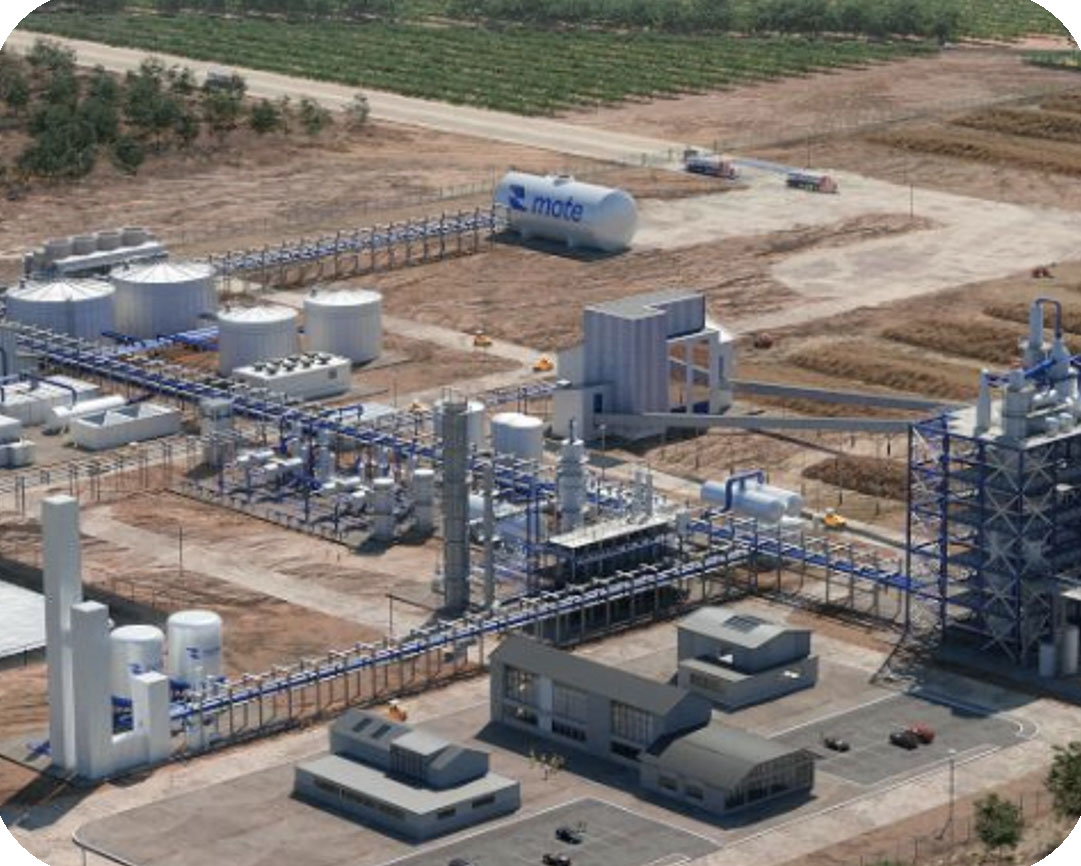
One plant: ~60 tons clean hydrogen / day
~450,000 tons CO2 removed per year, by design
Wood waste in → hydrogen out
Kern County project rides the ARCHES hydrogen-hub award
Second plant in Northern California with SMUD
Spun out of Lawrence Livermore National Lab
BREAKING
Mote closes $7M first tranche of Series A — March 2025
One plant: ~60 tons clean hydrogen / day
~450,000 tons CO2 removed per year, by design
Wood waste in → hydrogen out
Kern County project rides the ARCHES hydrogen-hub award
Second plant in Northern California with SMUD
Spun out of Lawrence Livermore National Lab
Who they are now
A startup that makes fuel out of the stuff California usually sets on fire.
Somewhere outside Bakersfield, a stack of woody waste is being measured for a future it didn't expect. It could rot. It could burn. Or it could become hydrogen. Mote is the 19-person company arguing for the third option, and as of early 2025 it has $7 million in fresh capital to make that argument with concrete and steel instead of slides.
Mote is a Los Angeles climate-tech company with a deceptively simple pitch: take the wood waste nobody wants, react it with pure oxygen, and pull out two things at once - clean biohydrogen to sell, and carbon dioxide to lock away underground. The leftover ash goes to fertilizer makers. Almost nothing is wasted, which is a nice trait in a company built entirely around waste.
Most energy companies dig something up and burn it. Mote does the opposite - it takes carbon out of the cycle and sells you the fuel anyway.
The problem they saw
California's forests are full of fuel. The trouble is what kind.
Every year, the state's forests and farms produce enormous volumes of woody residue - thinnings, slash, dead trees from drought and beetle kill. Left alone, much of it decomposes or feeds the next wildfire, releasing its carbon into the air either way. It's a liability measured in smoke.
Meanwhile, the clean-hydrogen industry has a different headache. The cleanest route most people know - splitting water with renewable electricity - is real, but power-hungry and expensive. Hydrogen that's good for the planet has a habit of being bad for the budget.
Mote saw both problems as one answer. The wildfire fuel was an energy resource that nobody was pricing correctly. The carbon that would otherwise drift into the sky could instead go down a well. The tension that runs through everything the company does is right here: can you produce energy that removes more carbon than it emits, and still sell it at a price the market accepts?
The forest floor was never garbage. It was a fuel depot with a filing error.— the Mote thesis, paraphrased
The founders' bet
It started, improbably, with a government report.
In 2020, a Lawrence Livermore National Laboratory study called "Getting to Neutral" mapped out how California might hit carbon neutrality by 2045. One of its strategies: turn biomass into hydrogen while capturing the carbon. Joshuah Stolaroff, who had spent more than a decade leading the lab's carbon-capture program, co-authored the rationale. His friend Mac Kennedy - an environmental lawyer who'd worked at the DOE, the DOJ, and the EPA - read it and decided someone should actually build the thing.
So they did. Stolaroff brought the science of carbon capture; Kennedy brought the law, policy, and patience that energy projects demand. The bet was that the cheapest carbon removal on Earth might be hiding in plain sight, in the residue of forestry and agriculture, and that pairing it with hydrogen would make the economics work where pure carbon removal alone might not.
Joshuah Stolaroff
Co-founder & CEO
Former head of the carbon-capture program at Lawrence Livermore National Laboratory. Co-authored the report that became the company's business plan.
Mac Kennedy
Co-founder
Environmental lawyer by training, with stints at the U.S. Department of Energy, Department of Justice, and EPA. Founded Mote in 2020 after reading the LLNL report.
The product
One process, three outputs, and a remarkably small power bill.
Mote calls its approach BiCRS - biomass carbon removal and storage. Woody waste is gasified with pure oxygen into a gas stream that gets separated and purified. Out comes hydrogen for sale, a concentrated CO2 stream for permanent underground storage, and ash that can go to fertilizer producers. The company says the process uses roughly a quarter of the electricity an electrolyzer needs to make the same hydrogen, because the chemical energy already locked in the wood does most of the work.
Biomass-to-hydrogen plants
Utility-scale facilities built on existing biomass supply chains and proven equipment to keep cost and risk down.
Carbon removal (BiCRS)
The CO2 produced is captured and stored for good, making the hydrogen carbon-negative rather than merely clean.
Hydrogen offtake
Carbon-negative hydrogen sold for power generation, transport, and industry - plus durable carbon-removal value.
It uses about 25% of the power an electrolyzer needs. The wood, it turns out, was holding most of the energy all along.
The proof, continued
Small company, serious backers.
For a 19-person startup, Mote keeps unusual company. Its Kern County project is folded into ARCHES, California's federally backed hydrogen hub. Its second plant is a collaboration with the Sacramento Municipal Utility District. The technology traces back to Lawrence Livermore, and the company has drawn support from the Department of Energy, NREL, CalFire, the U.S. Forest Service, and the California Department of Conservation - roughly $1.2 million of which went toward the Northern California project alone.
The March 2025 Series A first close was led by Nella Next and Preston-Werner Ventures, with Counteract joining. The round is reported to target around $15 million total. The cash goes toward the first commercial-scale facility, more engineering hires, and deeper ties across the hydrogen, forestry, and energy worlds.
Carbon removal remains essential to our shared fate, and it would be hard to do it alone as a small company.— Mote
The mission
Make every ton of hydrogen a ton of carbon removed.
Mote's stated mission is to unlock hydrogen and carbon removal from Earth's abundant wood waste, and to fuel what it calls a new era in domestic clean-energy production. The framing matters. This isn't carbon removal that costs money and produces nothing sellable, nor hydrogen that quietly leaks emissions upstream. It's the two stapled together, each helping the other's economics.
The wildfire angle is the part that tends to surprise people. By giving forestry waste somewhere useful to go, Mote ties hydrogen production to fire-risk reduction. The same material that fuels a catastrophic season instead fuels a truck or a turbine. It's an oddly satisfying loop, assuming the plants get built at the scale the spreadsheets promise.
Why it matters tomorrow
The world needs carbon removal that pays for itself.
Climate models keep insisting we will have to pull billions of tons of carbon back out of the atmosphere, not just stop adding it. The awkward question is who pays. Most carbon removal is a cost with no product at the other end. Mote's wager is that hydrogen is the product that makes the removal affordable - and that the cheapest place to start is the residue we were going to burn anyway.
That bet is still unproven at commercial scale. The first plant has not yet produced its first ton. But the pieces - the lab science, the utility partners, the federal support, the fresh capital - are lined up in a way that few early carbon-removal companies can claim.
Back outside Bakersfield, that stack of woody waste is still waiting. In the old story, it rots or it burns, and either way the carbon wins. In Mote's version, it becomes hydrogen, the carbon goes underground, and the smoke that never rises is the most important thing about the whole operation. Same pile of scrap. Entirely different ending.
The smoke you don't see is the product. The hydrogen is just how they pay for it.