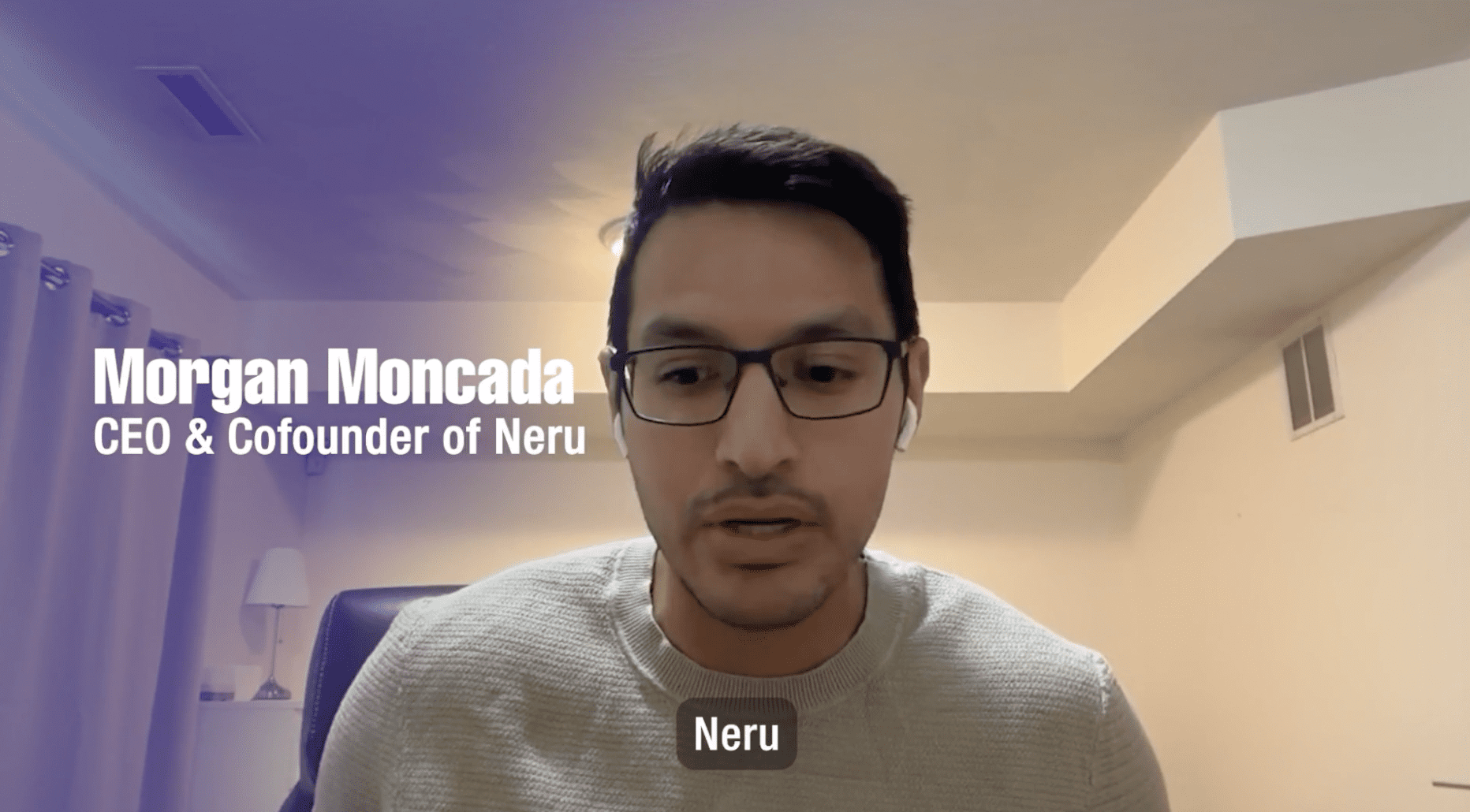
He left synthetic biology to chase a problem nobody puts on a pitch deck: the patient who stops picking up the phone. The fix is an AI named Nora.
Caught mid-sentence on a podcast, lit by a laptop and a conviction. The chair behind him is empty - the company isn't.
Most healthcare startups want to invent the cure. Morgan Moncada went looking for the boring part instead - the follow-up call, the reorder reminder, the question at 3 a.m. that goes unanswered because the office closed at five. Neru Health, the company he co-founded and runs, sells a vertical AI assistant called Nora to the durable medical equipment providers and specialty clinics that keep chronic-care patients on track. Nora handles onboarding, coaching and resupply. She does not take weekends.
The thesis is unfashionably practical. Software that schedules, nudges and reorders is not the stuff of magazine covers. But it is the difference between a provider that protects its revenue and one that bleeds patients through the cracks between appointments. Moncada built a company around the cracks.
Neru spun out of Harvard's Blavatnik Life Science Fellowship in 2023, alongside co-founders Maria Grebenshchikova and Catherine Tadina. Within a year it was working with national and regional providers managing tens of thousands of patients. The pitch fits on a sticker: Support every patient. Extend every team.
Early deployments report 90-day compliance running between 75 and 83 percent, a 20 percent lift in patient satisfaction, and a third fewer human phone calls. One provider reached payback inside a single month.
Support every patient. Extend every team.
— The Neru Health Operating Principle
A clinician-trained voice-and-text assistant that runs the full patient lifecycle - intake, adherence coaching, resupply. She picks up when the office is dark, which is most of the time.
Neru sells to durable medical equipment providers and specialty clinics - the operators behind the gear, not the gear itself. Small teams, enormous patient panels, thin margins.
Nora integrates with Brightree, WellSky and NikoHealth, the back-office systems providers already live in. HIPAA-compliant, and a member of AAHomecare. No rip-and-replace required.
Moncada spent more than ten years inside life-science startups - antibody therapeutics, synthetic biology, the kind of work that wins grants and loses sleep. Moderna. Aromyx. Nucleate. Imagine Human. Then he traded the bench for the back office, and the pivot stuck.
He holds a B.S. in Biology from Stanford and, improbably, two Harvard degrees earned in tandem: an MBA and an MS in Biotechnology. The combination reads like a Venn diagram of someone who refuses to pick a lane.
Over a decade across therapeutics and synthetic biology - roles touching Moderna, Aromyx, Nucleate and Imagine Human.
Spun out of Harvard's Blavatnik Life Science Fellowship with Maria Grebenshchikova and Catherine Tadina.
First place at a West Coast Regional University pitch competition, hosted by the Honors Fund and Orca Network.
Inaugural cohort of Harvard's Startup Foundry; named a Rock Health Innovation Fellow.
The assistant grows to 30,000+ patients across national and regional providers.
The first version of Neru aimed at the sleep-deprived - shift workers, nurses, first responders, the truckers logging miles on four hours of rest. The data science was elegant. The wedge was narrow. So Moncada and his co-founders did the thing founders are always told to do and rarely manage: they followed the pain to where the money and the urgency actually lived.
That turned out to be the providers - the operators drowning in manual follow-ups and lost reorders. The technology stayed. The customer changed. What looked like a detour was the road all along. Neru's research roots didn't vanish, either; the team has collaborated with Harvard and the NSF on circadian-rhythm work, and was advised early on by serial entrepreneurs Craig and Dean Marris on B2B sales and operations.
It is a quietly contrarian bet. While the industry chases flashier frontiers, Moncada is automating the follow-up call. Not glamorous. Just load-bearing.
Not "the platform." Not "the model." Nora - and she works the night shift nobody else wants.
The opening $150,000 came from winning a university pitch competition, not a term sheet.
An MBA and an MS in Biotechnology from Harvard, stacked on a Stanford biology degree.
Brightree, WellSky, NikoHealth - the unsexy systems that decide whether a patient gets resupplied on time.
Part of the inaugural cohort of Harvard's Startup Foundry, plus a Rock Health fellowship.
Headquartered in Boston, Massachusetts - a short walk from where the company was conceived.
Stanford biologist, Harvard MBA + MS Biotech, a decade in life-science startups. The operator who points the company at boring, load-bearing problems.
Former machine-learning researcher at Harvard's D³ Institute. The science behind Nora's clinician-trained brain.
Veteran of Amazon and Boeing. The systems and scale instinct that lets a small team support tens of thousands.
The Startup Foundry has been instrumental in helping us navigate the early stages of a new company.
— Morgan Moncada