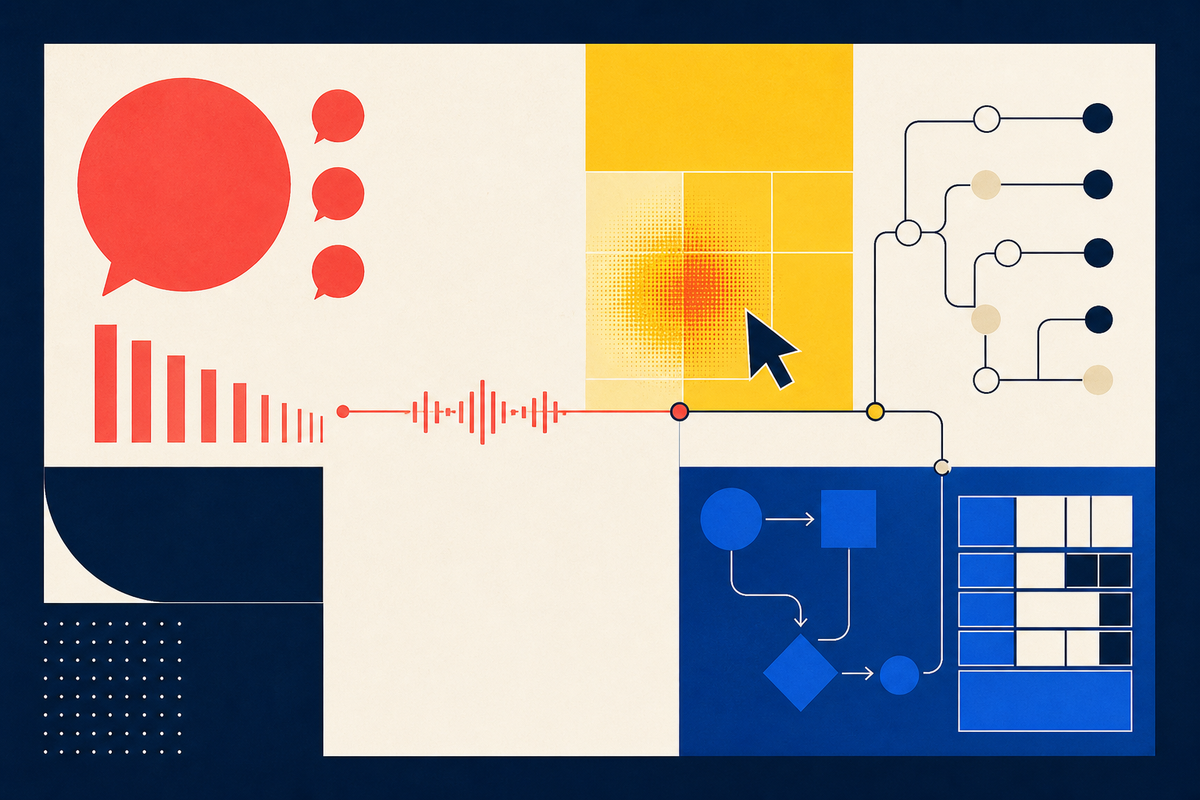
A customer abandons a checkout form. The team wants to know why. That ordinary sentence can send a buyer toward four very different pieces of software. SurveyMonkey can ask a carefully structured question and distribute it widely. Mopinion can place the question inside the checkout at the moment friction appears. Contentsquare can show what the visitor did before leaving and connect that behavior to a comment. Feathery can replace the form itself with a workflow that validates documents, moves data and routes exceptions.
All four products touch customer data. All four can produce something that looks like a form. This surface resemblance is where bad shortlists begin. A feature grid will dutifully record logic, templates, integrations and analytics, then give four green ticks without explaining that the products start from different assumptions. One treats the question as research. One treats it as a contextual signal. One treats it as evidence attached to behavior. One treats data intake as the first stage of an operation.
The useful choice, then, is not “Which feedback tool wins?” It is “What decision are we trying to improve?” Once that is written down, the field separates quickly.
SurveyMonkey owns the questionnaire
SurveyMonkey is the broadest and most familiar starting point here. Its product spans survey creation, logic, distribution, templates, analysis, enterprise administration and access to respondents through its Audience panel. A team can send a link, invite people by email, embed a survey on a site, use a QR code or distribute by SMS. That reach matters when the research question exists independently of a single screen or session.
Think brand tracking, employee engagement, concept testing, customer satisfaction or a post-event study. These projects need a defensible questionnaire and a respondent strategy. They may require randomization, branching, multilingual versions, data exports or comparisons across segments. SurveyMonkey's strength is the campaign around the question.
Its breadth can also tempt a team to over-survey. A polished questionnaire sent to a large list still depends on memory and willingness. If the issue happened three days ago on one obscure payment screen, the respondent must reconstruct the experience. SurveyMonkey can collect the account; it does not automatically carry the digital scene of the incident with it.
Mopinion owns the moment
Mopinion narrows the aperture. It is built for feedback across websites, mobile apps and email campaigns, with targeting that can react to page context and user behavior. A team can open a form as a modal, slide-in or embedded element, customize it to the brand and attach technical metadata. Its visual-feedback feature can let a user point to the page element in question.
That small design choice has large consequences. “This page is confusing” becomes more useful when it arrives with the page, device, screen resolution and selected element. The user does less forensic work for the company. Product and digital-experience teams receive a signal nearer to the cause.
Mopinion is a particularly coherent fit when the organization already knows where it wants to listen: after a failed search, beside a help article, inside a logged-in app, after checkout or within an email journey. It supports familiar measures such as NPS, customer effort and customer satisfaction, but the distinctive value is placement and context, not ownership of every research method.
Published product claims are directional, not a common benchmark. Scope and counting methods differ by vendor.
Mopinion also changed ownership in September 2025, when European experience-management company Netigate acquired it. The logic of the deal is revealing. Mopinion brought real-time digital feedback; Netigate brought a wider customer and employee experience program, analytics and automation. Customers were asking for fewer islands. The acquisition does not erase Mopinion's specialization, but it places that specialty inside a broader suite.
Contentsquare owns the disagreement
People are unreliable narrators of their own sessions. They forget, rationalize and use words differently. Behavioral data has the opposite limitation: it records the action but cannot always supply intent. A rage click may signal a broken button, impatience or simple habit. A low-scroll page may be efficient, irrelevant or unreadable.
Contentsquare is most interesting at the seam between those two kinds of evidence. Its experience-intelligence platform includes capabilities such as journey analysis, heatmaps and session replay alongside Voice of Customer research. The company says a team can open the session connected to a survey response, giving a written comment a behavioral backstory. Its 2023 acquisition of product-analytics company Heap widened that behavioral view.
Where the center of gravity sits
Conceptual axis: from stand-alone questioning at left to data intake embedded in an operational process at right. This is a model, not a product score.
This is a different purchase from a survey subscription. It asks for instrumentation, governance and people who can interpret multiple forms of evidence. The return is context. If a user says a page is slow, a replay can show whether they waited, clicked repeatedly, met an error or simply changed their mind. The comment and the action can confirm each other. More valuable still, they can conflict.
That fit makes Contentsquare compelling for digital teams running high-value sites and apps where diagnosing friction justifies a broader analytics layer. It can be too much machinery for a researcher who simply needs to test five product names with a targeted panel.
Feathery owns what happens next
Feathery makes the comparison deliberately awkward, because its center of gravity has moved. Founder Peter Dun wrote that the idea began after his work on Robinhood's growth team, where hand-coded forms were slow to change and repeated experiments helped double conversion. Early Feathery presented a customizable, developer-friendly form builder. The current company describes an AI operating and decisioning platform for financial services.
Its homepage now speaks the language of wealth-management and insurance operations: account opening, underwriting submission intake, advisor transitions, document intelligence, integrations and regulated data. Its AI assistant, Robin, is designed to generate forms, logic, integrations and document flows from plain-language instructions. In 2026 product updates, Feathery announced data hubs, server-side logic, an AI workflow builder and an MCP server for connecting AI tools to forms, submissions and extraction results.
This makes Feathery a fit when the “form” is really a process boundary. An applicant uploads documents; the system extracts information; rules validate it; data syncs to a CRM or custodian; an exception goes to a reviewer; a document is generated for signature. The quality of the customer experience matters, but the product's value sits in completing work across systems.
For a marketing team that wants to ask visitors whether a new homepage is clear, this operational depth is misplaced. For a financial firm replacing email attachments and re-keyed client data, comparing Feathery with a basic survey builder misses most of the product.
Choose when questionnaire design, reach, panels and repeatable research programs matter most.
Choose when a small prompt must appear inside a specific website, app or email moment.
Choose when teams need to connect what customers say with what they actually did on screen.
Choose when complex intake must trigger logic, documents, integrations and human review.
The shortlist before the shortlist
A buyer can avoid weeks of demos by writing one sentence: “We need to learn this, from these people, at this moment, so this team can take this action.” Each blank removes a different kind of ambiguity. “Why did visitors abandon?” calls for context or behavior. “Which message does the market prefer?” calls for structured research. “How do we open an account without re-keying data?” calls for workflow design.
- Name the evidence. Do you need an opinion, a representative measure, observed behavior, submitted records or some combination?
- Name the moment. Should the request arrive during a session, after an event, on a research schedule or as part of a required process?
- Name the operator. Research, product, customer experience, analytics and operations teams need different workflows even when they share a dashboard.
- Name the next action. A response may open a support case, inform a roadmap, trigger analysis, route an application or change nothing. Decide before collecting it.
- Count the hidden work. Include implementation, consent, data governance, analysis, integrations, respondent recruitment and the recurring cost of acting on what you learn.
A company may reasonably use more than one of these products. A central research team could run SurveyMonkey studies while a product team deploys Mopinion intercepts. A digital-experience group could use Contentsquare to investigate priority journeys. An operations team could run regulated intake through Feathery. The danger is not overlap by itself. It is duplicate prompts, disconnected identifiers and insight that lands in four queues with no owner.
The cleanest stack collects the smallest amount of evidence that can change a real decision. Sometimes that is one question shown at the right second. Sometimes it is a representative study. Sometimes it is a replay. Sometimes the best feedback intervention is to rebuild the process that created the complaint. These four products look less like contestants once the job is clear. They look like different instruments, waiting for a precise brief.
Common questions
Which is best for feedback inside a website or app?
Mopinion is the most directly specialized for targeted in-context feedback. Contentsquare is a stronger starting point when that feedback must be investigated beside session replay and behavioral analytics.
Is SurveyMonkey only for simple surveys?
No. It supports logic, multiple distribution channels, analysis, integrations, enterprise controls and an audience panel. Its useful distinction here is breadth, not simplicity.
How is Contentsquare different from survey software?
Contentsquare centers on experience intelligence. It pairs Voice of Customer capabilities with observed behavior such as journeys, heatmaps and session replay.
What is Feathery best suited to now?
Feathery currently focuses on AI-assisted operational workflows for insurance and wealth management, including onboarding, document intelligence, integrations and complex data intake.
Can one product replace all four?
Possibly for a narrow organization, but not by default. Broad research, digital intercepts, behavioral diagnosis and end-to-end workflow automation remain different operating jobs.
Products, reporting and primary sources
- Mopinion for websites and its Netigate acquisition announcement
- SurveyMonkey product features and the SurveyMonkey Forms launch
- Contentsquare session replay guide, Voice of Customer documentation and the Heap acquisition announcement
- Feathery's current platform, its founding story and product updates