On autumn Sundays in Minneapolis, a strange exchange takes place. Sixty-six thousand people trade money, time and emotional stability for three hours of uncertainty. They wear the same two colors. They clap over their heads in a rhythm borrowed from Icelandic football supporters. They shout a Scandinavian toast - SKOL - at a team named in 1960 to evoke the Nordic character of the Upper Midwest. Then the game begins, and nobody in the building controls the ending.
That lack of control is not a flaw in the Minnesota Vikings' product. It is the product's voltage. A scripted show can promise satisfaction; football can only promise consequence. Every game changes the standings, the conversation and the mood of a region. The Vikings have turned that tension into a company that sits at the intersection of professional sport, media, retail, hospitality and civic life.
Legally Minnesota Vikings Football, LLC, the franchise is headquartered at Twin Cities Orthopedics Performance Center in Eagan and plays at U.S. Bank Stadium in downtown Minneapolis. The NFL awarded the team in January 1960 to Max Winter, E. William Boyer, H. P. Skoglund, Ole Haugsrud and Bernard H. Ridder Jr. Play started in 1961. A group led by Zygi and Mark Wilf bought the club in 2005. Forbes estimated its value at $6.3 billion in 2025, a remarkable number for an organization acquired two decades earlier for a reported $600 million.
The scarce thing and the abundant thing
The Vikings' inventory begins with something deliberately scarce: NFL games. A normal regular season offers only 17, with roughly half at home. Those dates support tickets, season memberships, suites, club seats, group packages, food and beverage sales, parking, in-stadium sponsorship and merchandise. Premium buyers purchase access and convenience; families buy an occasion; corporate hosts buy a room where a relationship can happen with a scoreboard humming in the background.
Around that scarcity, the club creates abundance. Every snap produces highlights. Every injury, draft choice and depth-chart decision produces news. Practices become clips; press conferences become quotes; history becomes documentary material. The official website, app, podcasts, social feeds and YouTube channel stretch a three-hour event across an entire week. Fans who never enter the stadium still generate attention, buy apparel and make the brand useful to sponsors.
The commercial model mixes local execution with league economics. The NFL pools enormous national media, licensing and sponsorship revenue, while teams compete to generate local income and relevance. Forbes estimated Vikings revenue at $609 million for the 2024 season. National distribution gives every club a powerful floor. Local identity, stadium economics, sponsorship craft and the willingness of fans to keep showing up determine much of what rises above it.
The team sells scarcity on Sunday and abundance everywhere else.YesPress analysis
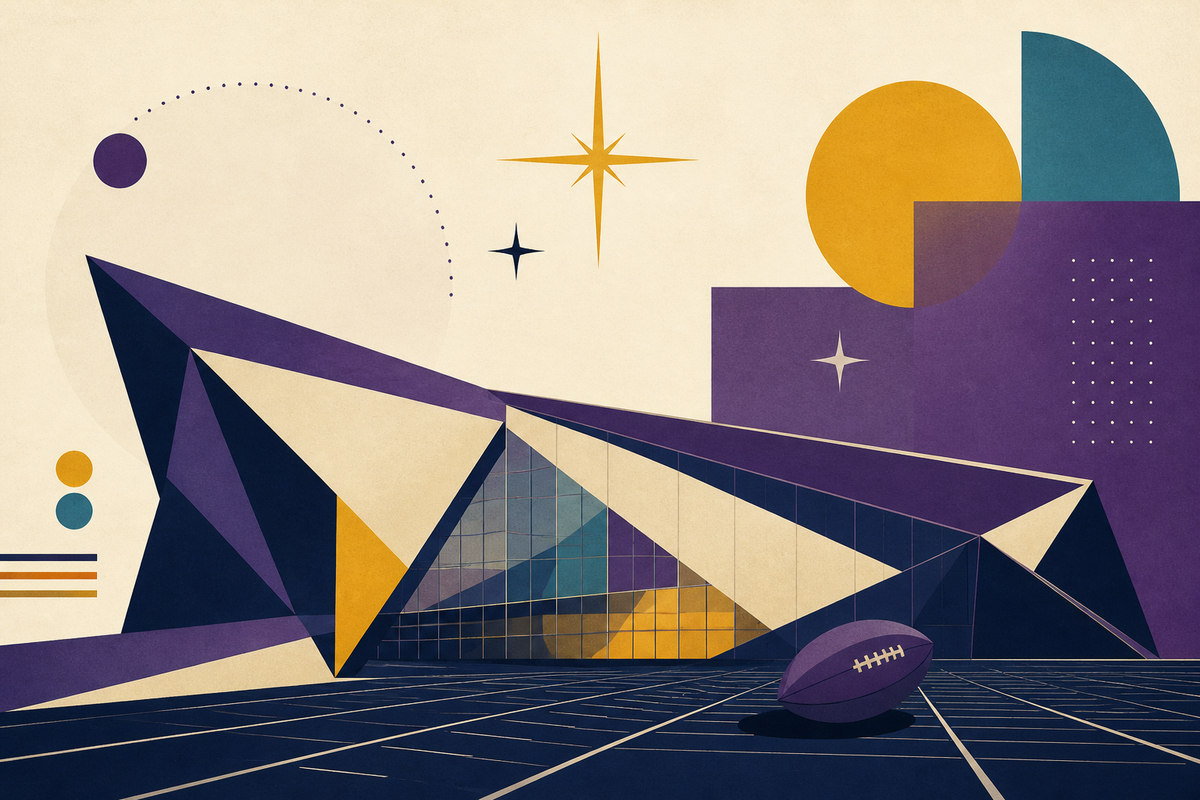
The stadium is a product interface
U.S. Bank Stadium opened in July 2016 on the old Metrodome site. Its steep roofline and transparent ETFE sections are instantly legible from the freeway, but the meaningful design work happens after the turnstile. Sightlines, sound, giant doors, club spaces, concession flow and mobile connectivity decide whether the live product feels worth leaving the sofa for. Television gets cheaper, sharper and more comfortable every year. The stadium has to offer what the broadcast cannot: scale, friction, noise and proof that you were there.
The building also expands the Vikings' business-to-business surface. Suites and premium clubs create hospitality inventory. Screens, concourses and activations create sponsor inventory. A 2025 extension with PepsiCo runs through the 2031 season and spans game-day products, retail, community work and fan experiences. That is more revealing than a sign on a wall. Modern sports partnerships are designed as programs, with the team lending attention and cultural permission while the partner supplies products, distribution and budget.
The Vikings do not own the stadium outright; the Minnesota Sports Facilities Authority does, and the team is its major tenant. That public-private arrangement brings obligations as well as advantages. A stadium serves the franchise, but it also hosts concerts, college sports, community events and mega-events. Super Bowl LII arrived in 2018. The 2028 NFL Draft is next, secured by Minnesota Sports and Events, the Vikings and regional partners. The team's platform is local, but the events can briefly make the region a national stage.
A company built out of identity
Most companies can change a product that is not working. A sports franchise cannot casually change its city, history or schedule. The Vikings' advantage is therefore less about features than about accumulated meaning. Purple is unusually ownable in American sports. The Norseman, horned helmets and SKOL vocabulary create a compact visual and verbal system. Bud Grant, the Purple People Eaters, Fran Tarkenton, Randy Moss and Adrian Peterson supply eras that parents can hand down to children.
The record contains both triumph and ache. Minnesota won the 1969 NFL Championship, reached four Super Bowls and lost all four. The 1998 team went 15-1, scored a then-record 556 points and lost the NFC title game in overtime. These are not neat brand stories. They are better: unresolved ones. The possibility of redemption keeps the past active. A championship would satisfy a desire that decades of near misses have made legible.
This is how the Vikings differ from competitors. The Packers, Bears and Lions sell their own histories in the same division. Minnesota cannot win by offering football with more football in it. It wins attention by making the experience unmistakably Minnesotan and recognizably Vikings. Against the Twins, Wild, Timberwolves, Lynx, United FC, concerts, games and streaming platforms, the club competes for leisure time. The answer is not only entertainment quality. It is identity density - how much belonging can fit inside three hours.
Fans buy tickets, memberships, merchandise, content access and a public way to signal affiliation.
Partners buy attention, hospitality, activation space and association with a regional institution.
Broadcasters and platforms distribute scarce live drama plus an expanding archive of stories.
Youth health, education and football programs create utility that reaches beyond paying customers.
The customer is also part of the cast
The people in purple are more than buyers. They make the atmosphere that television sells back to the wider audience. Their noise affects the experience, their rituals provide camera-ready spectacle and their arguments keep the story circulating between games. Few consumer businesses ask customers to help manufacture the product in public, unpaid and emotionally exposed. Sports does it every week.
That changes the organization's job. Customer service cannot stop at the transaction. Digital ticketing must work at the gate. Food lines must move. The app must make accounts and content usable. Social posts must sound like they come from inside the culture rather than a distant marketing department. The Vikings' roughly 730 employees, according to supplied company data, span football operations, performance, media, marketing, partnerships, hospitality, events, finance and community work. The roster is famous; the machine behind it is mostly not.
Community programs give that machine another purpose. The Minnesota Vikings Foundation, launched in 2017, focuses on youth health and education. The organization also supports youth and girls flag football, employee volunteer work and nonprofit partnerships. These programs build trust, but describing them only as brand building misses the point. A major team has reach that local institutions can use. The public test is whether that reach produces durable participation and resources when no camera is present.
“We always say we're stewards of this great organization with such a rich history.”Mark Wilf, owner and president
What other companies can steal
The Vikings offer three practical lessons. First, distinctive assets compound. Purple, the horn and SKOL work because the organization repeats them instead of reinventing itself each season. Second, rituals make customers participants. A chant has almost no marginal cost, yet it can turn a seat holder into part of the show. Third, a calendar can be a product system. Draft, camp, preseason, weekly games, playoffs and offseason decisions create recurring appointments that organize content and commerce.
There is also a warning. An NFL franchise benefits from a national revenue system, limited supply and protected league membership. A startup cannot copy that moat. What it can copy is the discipline of pointing many products toward one emotional promise. Tickets, clips, jerseys, suites and youth camps look like different businesses. For the Vikings, they all answer the same quiet question: where do I belong this Sunday?
The future will add distribution formats, international games and new kinds of fan data. Minnesota's scheduled 2026 game in Mexico shows how the league can export a local identity. The 2028 draft will turn team-building administration into a public festival. But the core transaction is unlikely to change. A ball will rise into the air, strangers will hold their breath together, and for one uncertain second the entire business will depend on where it lands.