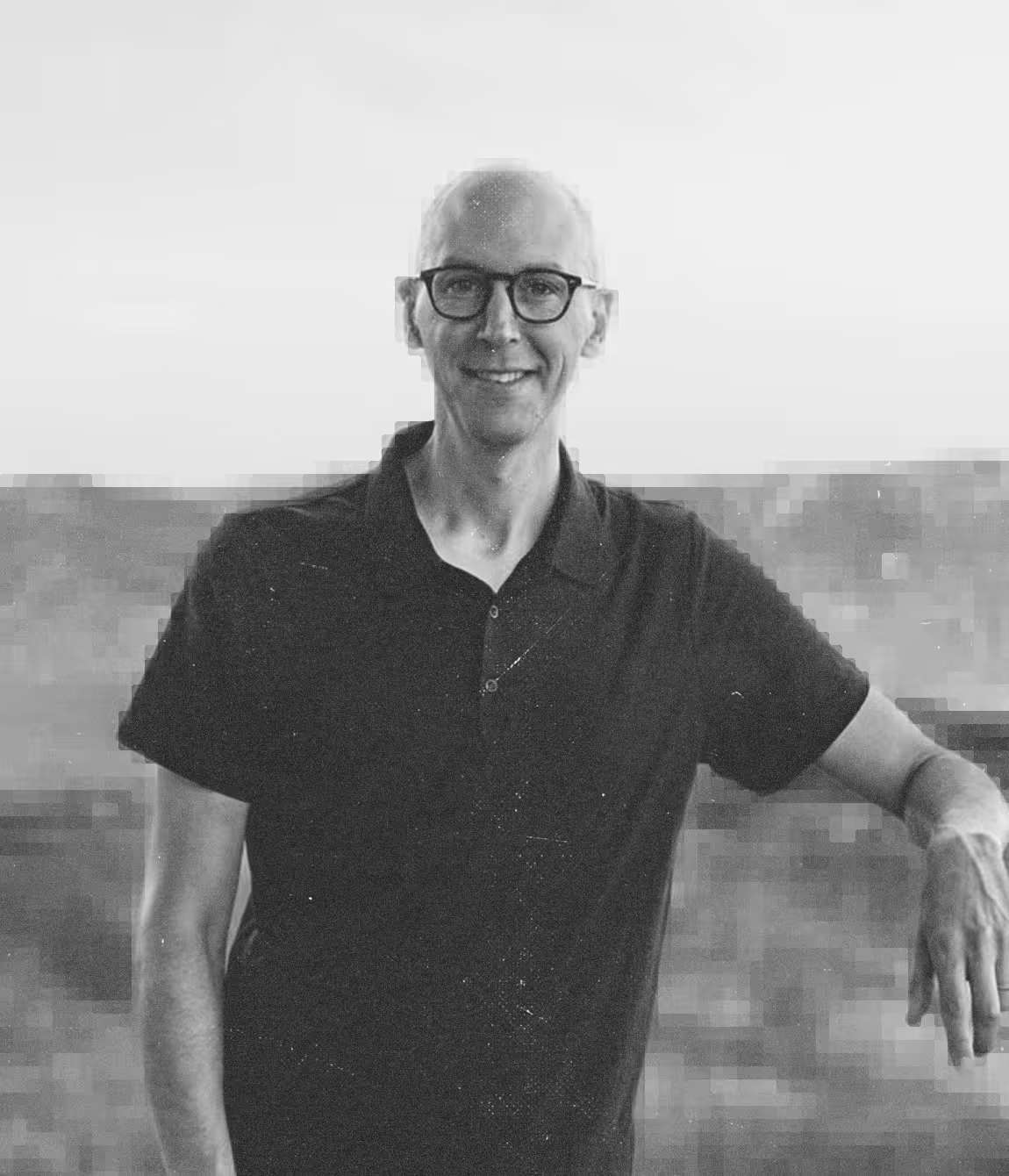
Mike Dauber started at Thomas Jefferson High School for Science and Technology - a school so competitive that getting in is itself an achievement, in a zip code full of people who collect achievements. From there: an electrical engineering degree at Michigan, semiconductors at Velio Communications, enterprise sales at Altera selling FPGAs to Cisco, and then Wharton for an MBA. That's a specific detour.
Most venture capitalists arrive from one direction: finance, consulting, or a single successful startup. Dauber arrived from three directions at once. He understands what it means to design chips. He understands what it means to walk into a Cisco procurement meeting and explain why your product matters. And he has the financial fluency to structure a term sheet. That combination is rarer than it sounds, and the founders who work with him notice it immediately.
In 2008, he joined Battery Ventures as an investor focused on early-stage enterprise infrastructure. The bets from those years tell the story: Splunk went to NASDAQ. RelateIQ went to Salesforce. Platfora went to Workday. By 2014, Forbes had him on the Midas Brink List - the publication's watch list for investors on the way up.
Then he left Battery for something smaller, riskier, and more intentional. Sunil Dhaliwal had left Battery first to start Amplify Partners, a firm with one explicit mission: build a haven for technical founders. Dauber joined in August 2014, when Amplify had one fund, roughly $50 million, and two partners. At the time, he told Fortune the simple version of why he did it: "I've always wanted to go off and do my own thing."
The longer version involves a thesis. Dauber believes the next $1.5 trillion in enterprise tech market cap was going to belong to the companies dismantling the incumbents - and that the founders doing the dismantling would be practitioners, people who had lived inside the broken systems they were now rebuilding. His job was to find them before anyone else did.
What does "practitioner founder" mean in practice? It means the founder has worn the badge, attended the standups, debugged the production incident at 2am. It means they understand the buyer not from customer discovery calls, but from having been the buyer. Dauber looks for founders who are "deeply steeped in their domain, have something to prove, and are borderline obsessed with their ideas." The last part is not a cliche - obsession, in his reading, is a feature, not a red flag.
The results at Amplify have backed the thesis. The firm has grown from $50 million across two partners to over $900 million across nine. The portfolio includes Chainguard, which is redefining how software supply chains get secured; Temporal, which makes distributed application development dramatically more reliable; Gremlin, which pioneered chaos engineering as a discipline; and SiMa.ai, which built purpose-built machine learning hardware that has raised over $260 million. Across 170+ investments, Amplify has produced 13 unicorns, five IPOs, and more than fifty acquisitions.
Dauber's engineering background shows up in his investment philosophy in a specific way. He cites the core lesson from his hardware days: "Everything is about tradeoffs, and you get nothing for free." Early-stage investing requires constant triage - which metrics matter now, which founders should focus where, which partnerships are worth pursuing. Someone who learned to optimize systems under constraint brings a different kind of patience to founder coaching.
That quote comes from a SaaStr podcast appearance where Dauber broke down why founders conflate revenue traction with fundraising success, and why they should think of runway as time rather than money. The title of the episode - "Why Hiring Sales People Is Like Being Thirsty" - is the kind of thing that sounds like a bumper sticker until you hear the explanation, at which point it becomes the framework you use for every subsequent sales hire decision.
In June 2025, Amplify announced the close of three new funds totaling $900 million: Fund VI at $400 million for seed and Series A, Fund VI Select at $300 million for follow-on as portfolio companies scale, and Amplify Bio I at $200 million - the firm's first dedicated digital biology fund. That last vehicle is a significant bet. The same technical founder thesis that worked for cloud infrastructure and cybersecurity is now being applied to biology: practitioners who understand sequencing, computation, and drug discovery, building tools and platforms that the life sciences industry hasn't seen yet.
Dauber marked eleven years at the firm when those funds closed. His post on LinkedIn at the time: "When I joined this journey 11 years ago it was to build the haven for technical founders, and nothing has changed except we have far more resources than I ever imagined to help the people we're built to serve." That's either a satisfying way to end a sentence or the setup for the next eleven years. Knowing Dauber's track record, likely both.