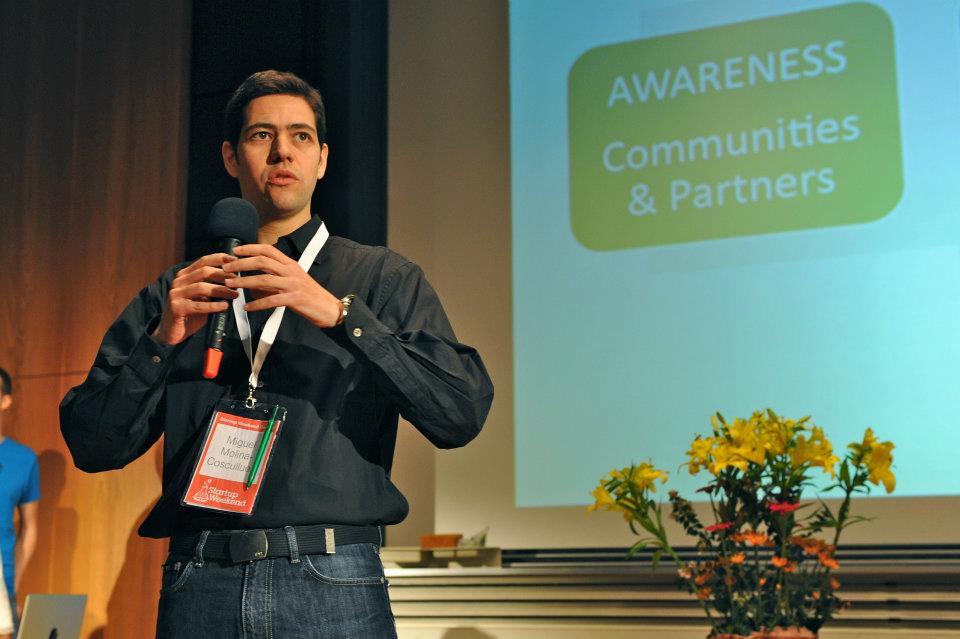
In an early startup photograph, Miguel Molina Cosculluela stands with a microphone between his hands. His badge hangs almost to his belt. Behind him, a projected slide reads “Awareness,” followed by “Communities & Partners.” There are flowers beside the screen, an agreeable concession to a room otherwise occupied by business ideas. He is caught in the familiar founder’s predicament: the idea makes sense in his head; now it must make sense to everybody else.
That problem has stayed with him. Today, as founder and CEO of Analytikus, he explains how universities can use their data to understand students and act sooner. His subject has changed from the early ventures of his career. The work of persuading people to see a possibility, then do something useful with it, remains recognizable.
Consider the student who fails to return for another semester. By the time an institution records the departure, the useful moment may already have passed. Molina’s company works further upstream, using machine learning to identify the risk of attrition and help institutions organize support. The ambition is practical: give people enough notice to respond. A forecast earns its place when somebody can use it.
This is the question around which his professional story turns. The software has grown more elaborate. The question has retained the virtue of being understandable without a computer science degree.
02Before the university, the business of data
Molina’s earlier work crossed customer relationships, loyalty and digital marketing. His MySollars profile describes work for HP, Sony and IHG, and identifies him as CEO at World Climate Credit. His personal biography also lists Intellego, Quaxar and Hewlett-Packard among his professional affiliations. The recurring material is data, business development and the difficult business of getting an organization to change its habits.
From August 2011 to 2014, he served as CEO of MySollars, a venture whose public pitch connected everyday actions with action on climate change. In 2011, he presented MySollars at CEO Day in Bern. A photograph of that pitch appeared in the Swiss Venture Guide the following year. Years before the current education platform, he was already taking a young company into rooms where its proposition had to survive questions.
His education moved across borders too. He studied information systems engineering at Tecnológico de Monterrey from 1997 to 2001. He also lists the University of Essex and the Sorbonne. In 2013, he completed IESE Business School’s Program for Leadership Development; his LinkedIn profile records that he was president of the class.
The combination gives his later career a useful shape: technical education, commercial work, entrepreneurship and formal leadership training. It helps explain the range of his public conversations, which move between what a model can calculate and what an institution can actually accomplish.
03The missing name on next semester’s register
Analytikus was founded in June 2015. Molina built it alongside Armando Alvarez Govela, its chief data scientist. The early company description already gave the business a concrete purpose: use machine learning and AI to decrease student attrition, improve recruitment and predict performance. An example was plain enough to fit in a sentence: identify the students most likely to miss the following semester.
The partnership matters to the portrait. Molina is the public explainer and business builder; Alvarez leads the data science. The company’s team includes mathematicians, data engineers and education specialists. A university problem demands all three kinds of attention. There is the prediction, the information needed to produce it, and the educational setting in which someone must decide what to do.
By 2017, Analytikus had won the Latin American Global EdTech Startups Awards competition. Its work included helping EdTec improve recruitment, recommend subjects in relation to students’ abilities and predict performance in an online course. These were specific decisions, rather than a promise that an institution could sprinkle AI across everything and await enlightenment.
The original idea also makes Molina’s choice of sector distinctive. A prediction about a customer’s next purchase has a commercial purpose. A prediction about a student’s next semester enters a relationship between an institution and a person trying to complete an education. The stakes make the response as interesting as the calculation.
04A percentage point has a person behind it
One reported result gives that ambition a scale. Universidad Latina de Costa Rica used Analytikus’s Foresight platform to predict dropout risk and support early intervention. Its published case study reported a gross dropout rate falling from 34.3 percent to 28.9 percent in 2019. The difference is 5.4 percentage points. It is an institutional outcome, achieved through a program involving people and technology, rather than a personal trophy for the founder.
The platform ran on Microsoft Azure tools for collecting, processing and presenting data. Those details explain how Molina’s commercial argument becomes operational: historical information is organized, risk is assessed and teams receive information they can use. The point of the machinery is the opportunity it creates for a timely conversation.
At Tecmilenio in Mexico, a 2023 case study described Foresight’s use in an institution with more than 60,000 students across 29 campuses. That is a different kind of test. A process that works for a small group must reach across a large university, while still producing information relevant to an individual student.
Neither example turns a probability into destiny. A risk flag concerns what might happen. Its value lies in opening a chance to alter the course of events. This is where Molina’s original question becomes more demanding: after finding the student, can the university provide useful help?
Universidad Latina · reported 2019 outcome
decline in gross dropout
Bars use a shared 0–40% scale. Historical case-study result, not a forecast.
05The campus has more than one filing cabinet
Molina’s partnerships reveal how much of the work happens before a prediction appears. In June 2023, Analytikus and Frequency Foundry announced a collaboration combining student relationship management with machine learning and AI. The College of Southern Nevada was named as a flagship client. The plan brought information from interactions across the student journey into the analysis.
Then, in October 2024, Lingk announced partnerships with Analytikus and Doowii. Its integration platform and data agents were intended to help institutions bring together information from more than 40 systems. The number belongs to the integration proposition. It gives a sense of the administrative landscape these companies are trying to connect.
“Analytikus is committed to delivering advanced analytics that improve student outcomes,” Molina said in the announcement. The sentence is restrained by the work beneath it. Useful analytics depends on information reaching the right place in a form that can be used. A splendid graph cannot repair a missing connection by looking splendid.
For Molina, these alliances put business development close to the educational mission. His company can build a model, but a campus also needs its systems to cooperate and its staff to receive the results. The founder’s job includes finding other organizations whose work makes his own work possible.
06The teacher keeps the difficult part
As generative AI entered the conversation, Molina’s argument widened. In August 2023, he joined Eliut Flores Caraballo for a University of Puerto Rico webinar about AI and higher education. He described a future in which content delivery could become digital while teachers retained the discussions requiring empathy, understanding and negotiation. The classroom, in his account, still needed human relationships.
That position runs through his later public writing. Sharing an essay by Ayari de Wit Ostos, he discussed operational support and personalized learning alongside the limitations of generative models. He treated educators’ expertise and responsibility as central to the design. His vocabulary included critical thinking, creativity and agency, qualities a university must cultivate even when answers become easier to generate.
After the 2025 Foro Generación IA: EduEmpleo in Galicia, he emphasized inclusion, fairness and dignity in the use of AI in education and work. His list of human responsibilities included “judgment, creativity, compassion, and accountability.” These are demanding words for a technology business. Each implies decisions that deserve scrutiny beyond whether a product runs quickly.
The aspiration is visible in the company’s language of the “Augmented University.” Molina wants institutional data and AI to extend what educators and support teams can do. The interesting test will be how that principle holds up in daily use, when speed, budgets, educational goals and individual circumstances all compete for attention.
“judgment, creativity, compassion, and accountability”Miguel Molina Cosculluela · after EduEmpleo 2025
07A founder who also takes the questions
Molina has another route into the subject: Simplifying Analytics. The podcast introduces its host as a managing partner of Analytikus who interviews data experts, vendors and practitioners. The title offers a small editorial discipline of its own. Guests can bring complicated ideas; somebody must help a listener follow them.
A public post celebrating more than 2,000 downloaded episodes thanked a long list of guests, including his co-founder and data science author Q McCallum. McCallum also describes their conversation on his own website, covering how companies can make sensible first steps in data. The format places Molina among people who practice the work, with room to ask how their ideas translate into decisions.
In episode 71, the usual interviewer appears as a guest in a conversation with Rafa on Squash Challenge. The episode description traces Analytikus’s evolution from an advanced analytics consultancy into an education company specializing in AI. It also addresses the continuing importance of data as new tools arrive. The founder has become a case study in the field he has spent years discussing.
His personal profile adds smaller details: he enjoys travel and genealogy and has finished an Ironman 70.3. These facts need no grand theory attached to them. A person can run a technology company and also like tracing family trees. Even a founder is allowed interests that do not require a pitch deck.
08The next appointment is already in the diary
In October 2026, the work is still moving. Analytikus announced on October 2 that its OS for Augmented Universities had reached the shortlist for the AI Innovation in Education category of the QS Reimagine Education Awards. It advanced to the second round. The result is a selection milestone; the awards process continues.
Another date is nearer. ANUIES-TIC has announced an online seminar for October 28, 2026, with Molina and Harold Villota, a senior developer of agentic and AI solutions. Its subject combines advanced analytics, generative AI and student persistence. Its title, “De la predicción a la acción,” means “From prediction to action.” That would serve equally well as a description of the business problem he keeps returning to.
The early photograph has a founder explaining awareness, communities and partners. The current calendar has him explaining what universities can do once their systems notice something. Between those two points are ventures, a co-founder, campus implementations, partnerships and a podcast. The thread is a repeated effort to make information useful to other people.
For Molina, the next stage of the university involves more capable software and people equipped to use it thoughtfully. The student at risk of leaving remains the clearest reason to care. A university can calculate the probability of an empty seat. The worthwhile part begins while someone is still sitting in it.