Michael Simon’s business card once offered two reasons to get in touch. You could talk business. Or you could ask where to eat in Budapest. Many executives use those few square inches to establish rank, preferably in a font that suggests the stationery has its own board of directors. Simon left room for dinner. The invitation is a small detail, but a revealing one: Hungary was a place he knew well enough to recommend, and a place he expected other people might want to know.
By then, he was running LogMeIn, a company that made it easier to reach a computer without sitting in front of it. The Budapest suggestion gave that abstract business a human address. Behind the remote connections were actual connections: colleagues, former colleagues, engineers and partners whose working lives had crossed his own. The restaurant invitation was an unusually compact way of saying that a conversation might lead somewhere.
Follow Simon’s career and the company names change several times. The geography is more persistent. Boston and Budapest keep appearing, linked by people who find fresh reasons to work together.
The first investment was a plane ticket
Simon trained as an electrical engineer at Notre Dame, then earned an MBA at Washington University in St. Louis. After business school, he went to Hungary through the MBA Enterprise Corps, a program supported by USAID. That was 1992. His professional route into Central Europe began with a program intended to bring business skills into economies undergoing enormous change.
When he received the Harsányi Prize in 2025, he recalled the economics of that first year. The support was around $15,000, covering most of his salary and living expenses. He used the occasion to thank Hungarian colleagues by name, including Márton Anka, Tamas Kovacs-Bernardt, Andras Milassin, Balazs Fejes and Peter Tanczos. The names matter. A career told only through acquisitions and public offerings can make people disappear behind their company logos.
His account of the trip and the people who followed offers a more grounded beginning. Before there was an exit, there was help paying for a year abroad. Before there was a transatlantic business network, there were people meeting one another and deciding to work together. That is a useful order to remember when a founder’s history starts to look inevitable.
Games first. Then the machinery behind them.
In 1995, Simon founded Uproar, a provider of online game shows and interactive games. It became a publicly traded company and was acquired by Vivendi Universal Games in March 2001. Entertainment came before enterprise software in his career. An audience that wanted to play and a customer who wanted to work would seem to have rather different shopping lists.
Yet running online games also means running computers. Simon and Anka worked together at Uproar. Anka went on to develop RemotelyAnywhere, software for accessing machines at a distance. The practical problem behind a games business became a business opportunity of its own. By February 2003, the two were co-founders of the company that became LogMeIn, with Simon leading the business and Anka serving as chief technology officer.
There was another branch of the Hungarian story, too. Simon co-founded Fathom Technology with Balazs Fejes. The software outsourcing company was acquired by EPAM Systems in March 2004. His work in the region was spreading through different kinds of companies, rather than depending on one product finding one market.
The overlap is the interesting part. A first venture can produce more than a sale. It can produce a set of people who have learned something about each other under pressure, then discover that the next problem needs some of the same skills.
Online games
Remote access
Public offering
Wealth technology
Advisor platform
The price of an open door
Remote access was already possible when LogMeIn began. Making it approachable was another matter. Configuring software, routers and firewalls could turn an apparently simple request into a small technical expedition. People wanted their files. They did not necessarily want a second occupation administering the route to them.
The company set out to make that route easier for homes and small businesses. By 2013, it had 650 staff and 20 million users. Simon was already considering a broader world of connected machines. The ambition extended beyond the desktop: the same question of access would arise wherever a useful device joined a network.
There was also a distribution problem. Having useful software did not automatically make it inexpensive to find customers. Growth specialist Sean Ellis, who had worked on Uproar, joined Simon’s next venture. His account describes an early burst of LogMeIn sign-ups from search advertising, followed by a plateau. At his suggestion, the company moved from a paid offering to a freemium model to distinguish itself from GoToMyPC.
That account of the early growth work is a reminder that a familiar product name can conceal a less tidy beginning. A free entry point still needs customers who understand the product and a business that can earn money around it. Software has to cross two distances: the technical distance between machines, and the more awkward distance between a product and someone willing to try it.
“Anything that could be connected will be connected in the next decade.”
Michael Simon · 2013
A founder makes room
Simon led LogMeIn through its public offering in 2009. Six years later, the company announced that he would leave the CEO role at the end of 2015. The scale at that point makes a useful pause in the story: a business that had begun as a three-person startup now had nearly 1,000 employees, nine global offices and more than $200 million in annual revenue.
His successor, Bill Wagner, had joined in 2013 as chief operating officer, then became president in January 2015. The succession plan gave the change a sequence: hire, expand responsibility, hand over the chief executive job. Simon remained chairman and took an advisory role. Founders are frequently celebrated for entering rooms. Here was a founder arranging for somebody else to take the chair.
His board work added other vantage points. Simon joined HubSpot’s board in June 2011 and served on the board of customer loyalty software company SessionM from 2016 to 2019. His LogMeIn chairmanship ended in March 2019, with his board service ending that May. The dates distinguish several different jobs that can blur together in a short biography: co-founder, chief executive, chairman and director.
LogMeIn later became GoTo. The name attached to the company changed in 2022, years after Simon had passed on the CEO role. His place in that history is the founding chapter and the long period of building that followed.
Another kind of access
In 2019, Simon founded NDVR, pronounced “endeavor.” The next problem sat in wealth management. Its technology was designed to turn a client’s investment preferences, tax circumstances and spending requirements into a customized portfolio. The engineering work had moved into a field where the inputs could be intensely personal, even when the calculations were mathematical.
The team combined his company-building background with investment expertise. Roni Israelov led research and portfolio management. In 2022, former TIAA chief executive Roger Ferguson joined NDVR’s advisory board. The combination of advisors and technology was part of the proposition from the outset. A client’s requirements had to be understood before software could do anything useful with them.
NDVR’s regulatory disclosure recorded just over $203.8 million in client assets managed as of January 31, 2025. That figure describes assets managed for clients; it is a different measure from the revenues of Simon’s earlier software business. The distinction matters because the story now follows a founder learning to build in a different commercial setting, with a different vocabulary and a different relationship to customers.
The company’s name suggests sustained effort, which seems fitting. Each new industry gives an experienced founder an unfamiliar set of questions. The previous business may provide colleagues, capital or confidence. It does not supply every answer.
The partnership changes shape
Claro Advisors acquired NDVR in November 2025. When Claro announced its new advisor platform in February 2026, Simon joined as Executive Chairman and Founder. Ryan Belanger, Claro’s CEO and founder, brought the wealth management experience. Simon brought the technology background. The acquisition put the work of the two teams inside the same business.
The platform combined a system for managing client relationships, calendars and tasks with portfolio technology and support for finding prospective clients. Its portfolio tools covered work such as rebalancing, liquidity management and tax-aware strategies. The launch set out a practical division of labor: software and operational support would handle more of the machinery surrounding an advisor’s day.
In his own announcement, Simon emphasized human relationships alongside the technology. He described advisors facing fragmented systems, regulatory demands and rising client expectations. His stated goal was to help them deliver personalized portfolios while simplifying their practices. The aspiration is clear; the everyday work of an advisory business is where it has to prove useful.
In May 2026, Claro introduced Claire by Claro, an AI assistant built into its platform. It draws on client information to support meeting preparation, follow-up drafts and other advisor tasks. The new tool continues that direction: put more of the preparation within reach, so a person can spend less time assembling the pieces. After remote access, Simon is again involved in software that promises to shorten a complicated route to useful work.
The return trip
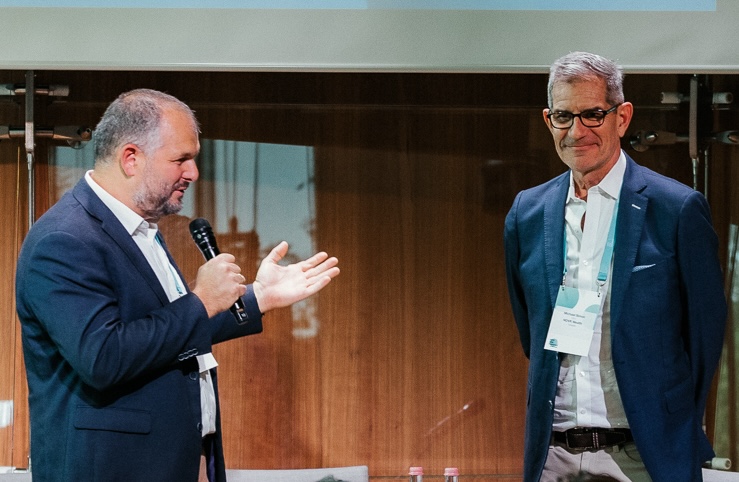
The Hungarian Private Equity and Venture Capital Association awarded Simon its 2025 Harsányi Prize, named for Nobel laureate John Harsanyi. The recognition connected several chapters of his work in Central and Eastern Europe, including Uproar, Fathom and LogMeIn. An award is a tidy object for a career made of considerably less tidy decisions.
His public biography supplies an ordinary counterweight to the company history. He and his wife, Katalina, have three children. They live in Boston and frequently spend time in Budapest. Golf, reading and skiing appear among his interests, alongside helping early-stage companies grow. A founder can acquire several companies’ worth of history and still have a recognizable list of things to do on a free afternoon.
That continuing life between the two cities brings the business card back into focus. Budapest was never simply a location in an origin story to be mentioned once and retired. It remained somewhere to return to, somewhere colleagues became friends, somewhere a visitor could use a good restaurant recommendation. Simon’s businesses have repeatedly dealt with distance. His career also shows what can happen when you keep making the trip.
Follow the connections
Michael Simon at Claro Advisors · LinkedIn · HubSpot biography · Budapest interview in Forbes Hungary · 2013 interview on connected machines · GoTo company profile