A hockey movie is supposed to end when the credits roll. Michael Eisner helped arrange a rather expensive exception. In 1992, Disney released The Mighty Ducks, a comedy about an unpromising children's hockey team. The following year, the Mighty Ducks of Anaheim were preparing to play professional hockey. The sequel had an unusual production budget: an NHL expansion fee of $50 million.
Eisner was Disney's chairman and chief executive, and the new team's governor. On March 1, 1993, the club received its name. Tony Tavares became president of Anaheim Sports. Jack Ferreira would run hockey operations as general manager, and Ron Wilson would coach. The film supplied an identity; those appointments supplied the people who had to make it work. Emilio Estevez could not be expected to handle the power play.
There was a practical problem underneath the theatrical flourish. Anaheim had a new arena, and Disney had a longstanding relationship with the city through Disneyland. A professional team offered the building a regular tenant. An entertainment company offered that team something most expansion clubs must patiently assemble: a name people already recognized, attached to a story they already understood.
Asked about the connection in December 1992, Eisner said, “The (movie) was our market research.” It was an executive's joke with an executive's calculation inside it. People had paid to watch the Ducks. Disney was asking whether they would pay to watch a different set of Ducks, with substantially faster skating and considerably less control over the ending.
“The (movie) was our market research.”
Michael Eisner · December 1992
The original club wore jade and plum. Its duck-shaped goalie mask became an emblem that could travel well beyond Orange County. Disney had its own artists to develop a logo, a useful advantage in a business where a sweater has to perform two jobs: identify the player on the ice and persuade someone in the stands to buy another one.
The inaugural season produced 33 wins, 46 losses and five ties. It also produced average home attendance of 16,989, with 27 sellouts. The team tied Florida's expansion club for wins. These numbers give the experiment some texture. Anaheim had a losing record, yet people kept coming. A familiar story had bought the club an introduction. Hockey had to earn the next visit.
Learning to like the vacant room
Eisner's route to that arena ran through classrooms and television offices. Born in New York in 1942, he graduated from the Lawrenceville School in 1960 and Denison University in 1964, studying English literature and theater. It is an education that makes sense beside his later work: read the story, consider the audience, decide whether the scene deserves to stay.
At ABC, he took on children's and daytime programming before moving into primetime. Schoolhouse Rock! belonged to the children's television world he helped develop. Happy Days became another part of his record. Barry Diller was an important colleague and mentor; Eisner followed him to Paramount in 1976. Their careers show how much an executive's judgment depends on who is in the room to challenge or encourage it.
One early assignment captures the appetite. In 1967, Eisner produced a television special about Marine World, a theme park south of San Francisco. He recruited Bing Crosby and the Rascals. The program was called Feelin' Groovy at Marine World, a title that could only have arrived wearing the calendar year 1967 on its lapel. An unwanted assignment became something watchable.
“I liked going into the uncontested territories within the company where I could have a lot of freedom,” he recalled. That is a revealing preference. The neglected department offers fewer people to impress and fewer established habits to defend. It also allows the ambitious newcomer to claim responsibility when something finally goes right.
Paramount gave that preference a larger canvas. During his 1976-1984 presidency, the studio released Saturday Night Fever, Grease, Raiders of the Lost Ark and Terms of Endearment. Those films have little in common at the level of costume or plot. Together they suggest an executive comfortable backing different kinds of pleasure, rather than insisting every audience arrive through the same door.
Disney grows, and the room gets crowded
Eisner took charge of Disney in 1984, alongside president Frank Wells. Jeffrey Katzenberg led the studio. The company's revival had many authors, including animators, composers, filmmakers and park designers. Giving the chief executive his place in that story requires leaving room for the people who actually wrote songs, drew characters and persuaded an audience to care.
The Little Mermaid, Beauty and the Beast and The Lion King arrived during his tenure. Beauty and the Beast became the first animated feature nominated for the Academy Award for Best Picture. Animation could command attention well beyond the children's matinee. For Disney, these films supplied characters and music that could keep working after the cinema lights came up.
The physical company expanded too. Disney-MGM Studios opened in 1989, Euro Disney in 1992, Animal Kingdom in 1998, and Disney California Adventure in 2001. Each park required visitors to make a far larger commitment than buying a movie ticket. Eisner's Disney increasingly occupied entire holidays, rather than an evening.
The acquisition of Capital Cities/ABC, announced in 1995 and completed in 1996, brought his old television network into Disney, together with a controlling interest in ESPN. Here was another connection between storytelling and sport. Owning a fictional hockey brand was one thing; owning a sports network put Disney inside the machinery that delivered games to millions of homes.
Expansion did not protect Eisner from criticism. Roy E. Disney and Stanley Gold organized opposition to his leadership. At the 2004 annual meeting, 43 percent of the shares voted withheld support for his board reelection. The board separated the chairman and chief executive positions. Eisner stayed as CEO until 2005, when Bob Iger succeeded him.
That ending matters to the portrait. A leader can help revive a company and later become the focus of its discontent. The same involvement that looks energetic during a turnaround can feel constraining once the organization has changed. Eisner's record contains both the films audiences remember fondly and a public reckoning with the way power was exercised.
The Ducks had their own departure. Disney sold the club to Henry and Susan Samueli in 2005. Anaheim won the Stanley Cup in 2007 under their ownership. Eisner helped give the franchise its beginning; the championship belonged to a later chapter. Sport is particularly good at keeping a ledger, and the dates deserve to remain on it.
- 1992The film opens; the NHL conditionally awards Disney a franchise.
- 1993The Mighty Ducks of Anaheim receive their name and begin play.
- 2005Henry and Susan Samueli buy the club from Disney.
- 2007Anaheim wins the Stanley Cup under Samueli ownership.
Another screen, another kind of animal
Leaving Disney did not send Eisner into a permanent retrospective. He founded the Tornante Company in 2005 to invest in and operate media and entertainment businesses. Its television work eventually included BoJack Horseman, Raphael Bob-Waksberg's animated series. The distance from Disney's family animation to BoJack's Hollywood satire is considerable, even if both require unusually expressive animals.
Tornante also developed Vuguru, which made scripted entertainment for digital platforms. Prom Queen was an early project. It placed a familiar storytelling form into a changing distribution business. Eisner could be skeptical, opinionated and commercially minded while still being willing to try a new place to put a show.
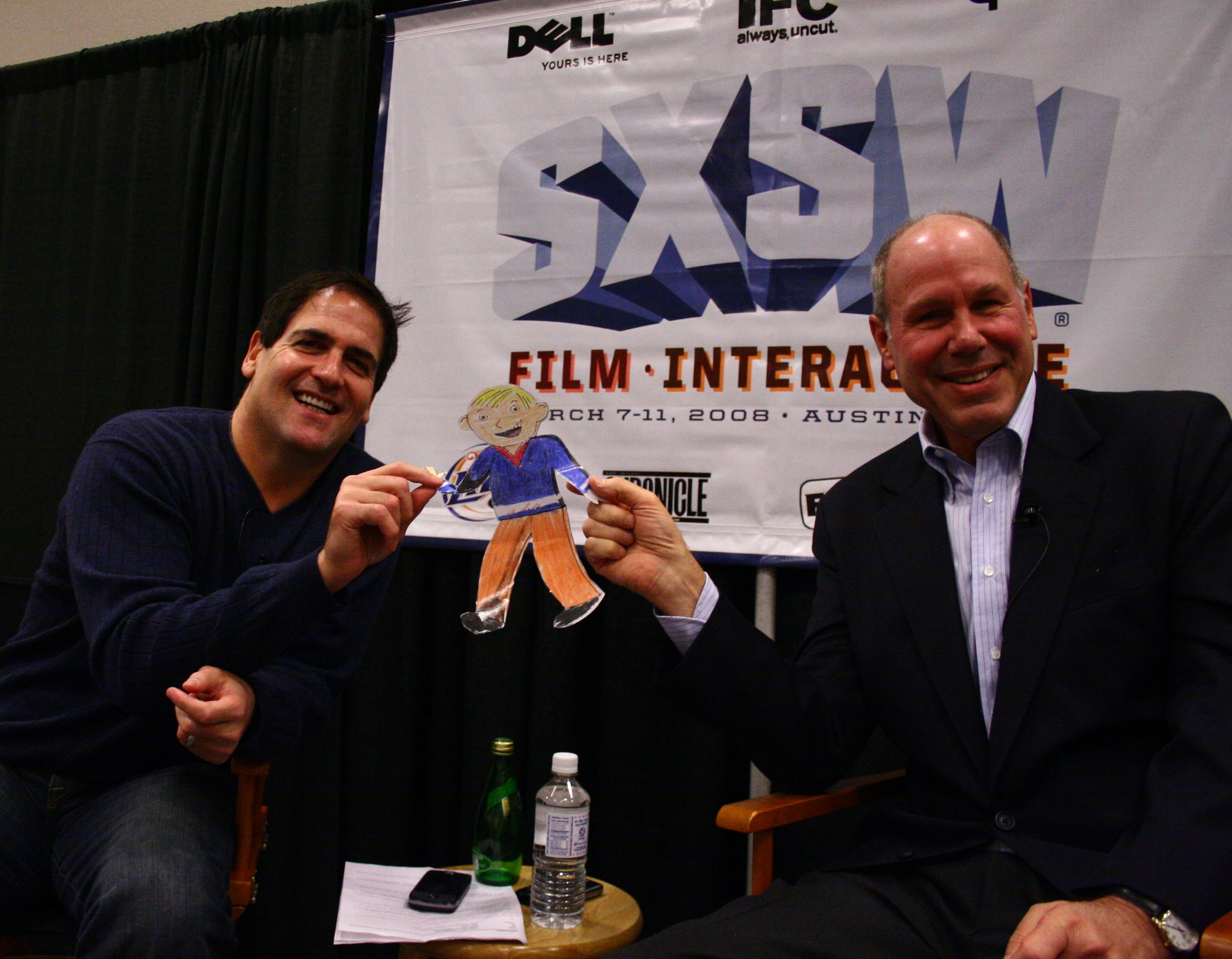
A photograph from SXSW in 2008 catches him beside Mark Cuban, the two holding Flat Stanley. The paper visitor looks quite comfortable between the executives. It is a small comic interruption in a career usually documented through transactions and boardroom arguments: two people whose work involved expensive decisions making space for a cardboard guest.
The television work continued. Long Story Short, produced by Tornante Television and ShadowMachine, premiered on Netflix in August 2025. In May 2026, Eisner moderated a conversation at the Skirball Cultural Center with creator Bob-Waksberg and actors Paul Reiser and Lisa Edelstein. After decades of reviewing other people's pitches, he was still sitting with the people who make the characters speak.

The club with a past of its own
In August 2017, Tornante acquired Portsmouth Football Club. This time, Eisner was entering a story that had started long before him. Founded in 1898, Portsmouth had a ground, Fratton Park, and supporters with memories that no American studio could manufacture. A movie audience can leave after two hours. A football audience remembers what happened thirty years ago and may wish to discuss it every Saturday.
The attraction was partly the place sports occupy in television. Matches happen at a fixed time, and the ending remains unknown. That gives a live game a claim on attention that a library of on-demand entertainment struggles to reproduce. Eisner's 2026 interview with Graham Bensinger described the family's purchase, stadium renovations and the work of rebuilding a historic club.
There is an intriguing reversal here. Anaheim began with a borrowed fictional identity and had to accumulate real history. Portsmouth already had the history; its owners had to respect it while building a future. Both ventures depended on people choosing to gather. The relationship between club and crowd, however, could not simply be copied from one country to the other.
The campfire keeps its place
For all the studios and stadiums, Eisner keeps returning to a smaller institution: Keewaydin, the Vermont summer camp he attended as a boy and later as a counselor. His memoir Camp appeared in 2005. An expanded twentieth-anniversary edition followed in April 2025. Four generations of his family have attended the camp across a century.
The book concerns canoes, campfires, relationships and leadership. There is something pleasingly unglamorous about an entertainment executive locating an education in the stern of a canoe. You can negotiate billing on a film. The canoe remains interested in whether everybody is paddling.
His other books include Work in Progress and Working Together: Why Great Partnerships Succeed. Partnership also has an institutional expression in the Eisner Foundation, which he and Jane established in 1996. It now supports programs connecting generations in Los Angeles County and New York City, bringing younger and older people into shared work.
Eisner's career has repeatedly involved choosing what deserves another chance: a programming department, an entertainment company, an unfamiliar format, a football club. The choices have produced arguments as well as audiences. In Anaheim, one of them produced a team that kept playing long after its original movie left theaters. The credits rolled. The season schedule carried on.