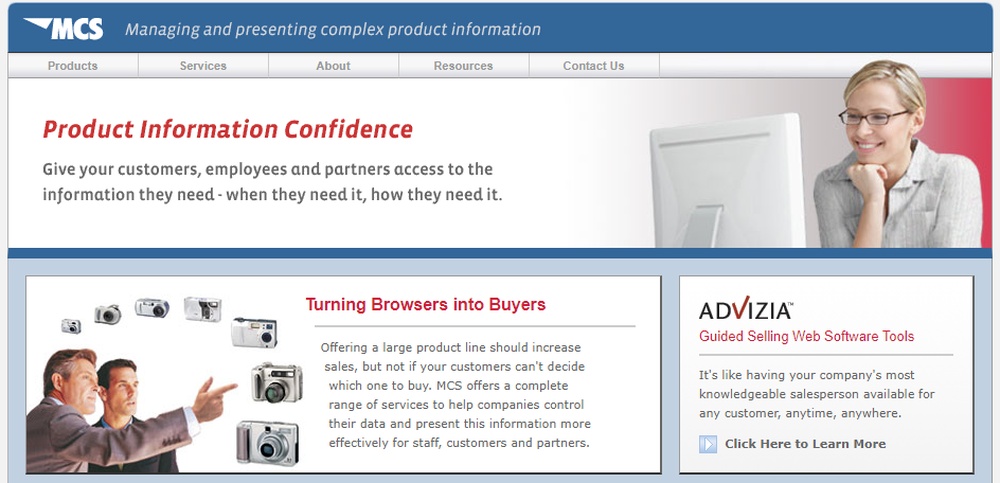
Consider the camera lens. To a manufacturer, it is a tidy collection of specifications. To the person buying one, it is a small examination: focal length, camera compatibility, aperture, price. The information may all be there. Knowing what to do with it is another matter. MCS built its software business around that awkward distance between having the facts and making a choice.
- MCS develops Advizia, a guided selling and product information suite.
- Its customers sell products whose specifications need explaining.
- One catalog feeds advisors, comparisons, PDFs and dealer websites.
A lens chart with a human problem
Sigma Corporation of America provides a useful example. In an MCS-published case, the lens maker described a shopping process that required customers to consult a chart. The chart contained answers, but extracting them took work. Sigma implemented Advizia, a JavaScript-based selector that reduced the available product set as shoppers specified requirements such as price or lens size.
The useful change was visible immediately: a selection altered the remaining choices. Shoppers could see how one requirement affected another. The website became a place to work through a decision. Sigma’s marketing manager, Tom Sobey, credited the tool with quicker product discovery and improved sales and satisfaction. Those are the customer’s reported benefits; the case presents no numerical sales lift.
“Previously, we had no way for our customers to easily narrow down our product line”Tom Sobey · Sigma marketing manager, in MCS’s published case
A brochure company follows the information
MCS’s route to this problem began on paper. Its own history dates the business to 1989, when it designed printed materials, including brochures and marketing literature. By the mid-1990s, it was working with databases and websites. In 2002, it developed Advizia. The publishing medium changed; the underlying assignment remained recognizable: organize complicated product information so another person can use it.
That background helps explain the shape of the company. MCS, legally Modern Creative Services, Inc., combines software development with implementation and information management services. It serves manufacturers and channel partners selling feature-rich or complex products. Its published advisor examples have included computers, mailing systems, instruments, motors, probes and power equipment. These are categories where a wrong choice can be more consequential than a disappointing color.
The catalog does the heavy lifting
At the center sits the Advizia Product Catalog. Marketing and product managers can maintain product records, upload images and documents, import and export information, and publish customer-facing pages. MCS describes it as software for nontechnical staff. That matters because a product database becomes less useful if every routine correction requires a developer.
The company also offers the work that precedes a reliable catalog: reviewing existing information, establishing uniform formats, cleaning records and combining data into a single database. This is where its expertise in databases and publishing meets the sales interface. A polished question cannot rescue a mismatched specification. The answer shown to a shopper is only as dependable as the record underneath it.
AdvisorCompare
ChartsPublish
PDFsDistribute
Dealers
Conceptual map of Advizia’s published modules
Keep the choice moving
Advizia’s Product Advisor asks understandable questions and updates matching products as the customer responds. Its product description makes an unusually crisp declaration: “No fuzzy logic.” It also promises that customers will not reach a selection with zero matching products. That makes the handling of choices an essential part of the product, alongside the speed of the screen.
There is a practical distinction here. A search box asks the buyer to supply useful words. A long specification table asks the buyer to perform the comparison. An advisor structures the task. Advizia adds help windows, accessory suggestions and analytics about customer preferences. Its Comparison Chart module then lets shoppers examine qualifying products together and download a PDF for later reference.
This also puts MCS in a particular corner of the commerce market: the research and selection stage. Manufacturers can use its tools to explain an assortment; dealers can present that assortment to their own customers; sales staff can use the same guidance. The published suite links those activities to product information management, making it relevant to the people maintaining the catalog as well as the people browsing it.
The same facts, everywhere
The less obvious part of Advizia happens away from that first selection screen. PDF Builder draws text and images from the catalog to create customized brochures, spec sheets and other marketing documents. Editing permissions limit which elements a user can change. The old brochure business is still visible here, now connected to the same information that supplies the website.
Channel Syndication extends product content and advisor functionality to dealers’ websites under their branding. It can accept partner feeds containing prices, availability and shopping-cart links. The Foreign Language module supports multilingual publication and metric-imperial conversions. Together, these tools address a manufacturer’s distribution problem: a product has one set of characteristics but appears in many places, maintained by many hands.
Borrow the question, then fix the data
Commercially, MCS describes Advizia as an on-demand application with standard and expansion modules. Implementation, custom programming, training and support sit alongside it. Its support materials promise a dedicated project manager and say support begins before installation. For a prospective customer, the purchase therefore involves both software functionality and the practical work of making a company’s existing information usable.
The lesson a reader can borrow is specific: begin with the questions customers can answer, then connect those answers to consistent product records. Test whether the questions distinguish real needs. Test what happens when requirements conflict. For a simple assortment, ordinary filters may be sufficient. For complicated products, the harder work is deciding which distinctions deserve a shopper’s attention. MCS has made that work its business.
A useful buying exercise would start with one troublesome product family. Give the advisor the questions a salesperson hears repeatedly, check the matches against actual specifications, and inspect the comparison a customer takes away. Then change a product record and follow it through the publishing tools. That small exercise tests the central proposition: whether maintaining information once can make several buying experiences easier.