There is a peculiar moment in the life of an investment firm. The portfolio managers understand the strategy. The consultants understand the category. The prospective client, however, arrives at the website and finds a fog of prudent nouns: discipline, partnership, conviction, solutions. Everybody is being accurate. Nobody is being memorable.
MBC Strategic built a business in that fog. It is a small marketing and branding agency in Santa Monica, founded in 1998 by Matt Brunini, and it works exclusively with financial and investment companies. The firm’s 15 listed employees occupy a curious position between creative studio and interpreter. They design logos and websites, certainly, but first they must understand a private-credit vehicle, a systematic equity process or the psychology of an investment committee well enough to explain it without sanding off the important edges.
That is the whole trick. Finance is full of people who assume complexity signals intelligence. Marketing rewards the opposite. The agency’s job is to find the point where precision becomes plain speech without becoming simplistic.

The AUM figure is MBC Strategic’s own current portfolio-level claim. It describes the firms served, not assets managed by the agency.
The first failure is usually translation
Brunini arrived at the problem from inside finance. Before starting MBC, he worked in product and marketing roles for investment businesses, including a bank-owned firm, a brokerage and a boutique investment bank. He had seen the relay race: portfolio management handed a technical idea to product, product handed it to sales, and sales tried to make it matter to a buyer. Every handoff risked dropping the baton.
So MBC’s method begins before the colors. It conducts stakeholder interviews, competitive analysis and audience research, then tries to isolate the thing a firm can credibly own. For Polen Capital, a growth-equity manager then overseeing $22 billion, the answer became “Going beyond.” The phrase connected the investment process to a broader commitment to clients, employees and community. It then travelled through the logo, palette, website and sales materials. The important part was not the line. It was that the line survived every format.

Marketing amplifies whatever exists beneath it. If brand clarity is weak, marketing scales confusion.MBC Strategic, Brand-to-Capital Framework
This observation is less glamorous than a campaign launch and more useful. A financial firm can buy traffic before it has settled what it does, for whom, and why anyone should believe it. The likely result is not growth. It is efficiently distributed ambiguity. MBC’s current framework makes the sequence explicit: establish the brand, build the digital surface, execute the marketing, then manage how AI systems retrieve and describe the firm.
The website is a room before the meeting
A consumer website often tries to hurry a visitor toward a purchase. An investment website faces a slower, stranger job. The visitor may be an advisor comparing funds, a consultant checking organizational stability or an investment committee member returning at midnight to confirm a detail. The site must make complicated information easy to locate while projecting enough restraint to feel credible.
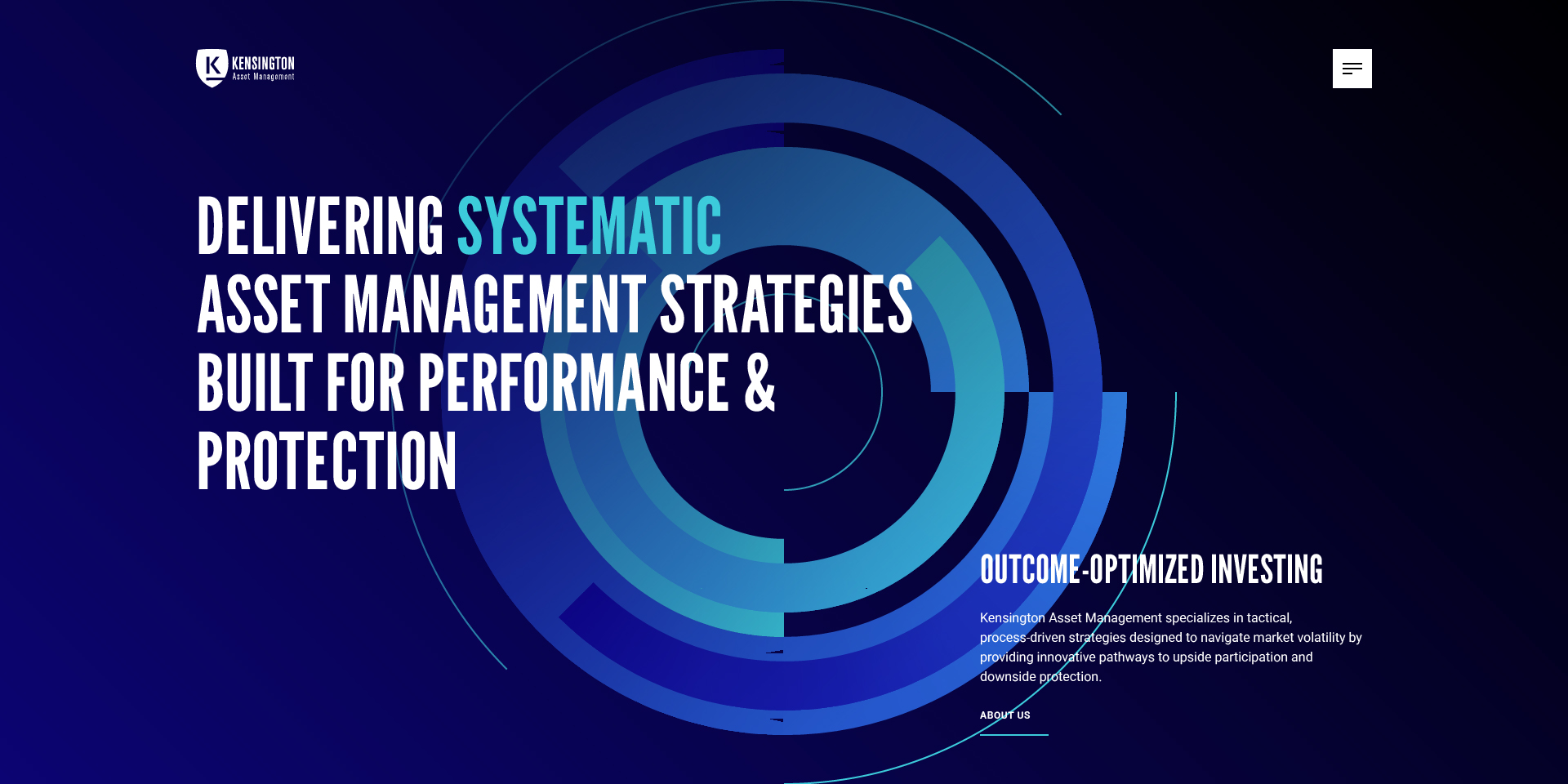
Kensington Asset Management shows the distinction. MBC replaced familiar financial photography with a system of geometric rings and data-like graphics, then paired it with automated performance feeds and clearer routes for different audiences. The design looks technical because the underlying investment process is systematic, not because somebody searched a stock-photo library for a skyscraper. The work collected a run of 2025 awards, including recognition from dotCOMM, WebAwards, MarCom and the Gramercy Institute.
A general campaign asks
- Did people see it?
- Did they click?
- Did the message travel?
An allocator journey asks
- Was the mandate clear?
- Could the proof be found?
- Did diligence advance?
That difference explains the specialist premium. A general agency may know how to make something attractive. MBC argues that financial marketing also requires fluency in investor types, fund structures, compliance review and long, non-linear sales cycles. Its customers range from emerging managers to global institutions, across asset management, advice, private equity, private credit, venture capital and real estate.
What changed was the unit of work
The agency began as Brunini’s one-person consulting shop. Over time, the assignment expanded. A positioning project pulled in a visual identity; the identity required a website; the website demanded content, data and ongoing campaigns. MBC became an integrated agency because, in practice, the pieces kept revealing their dependence on one another.
Angel Oak is the clearest example. The group contained asset management, mortgage, advisory and consulting businesses. A single logo could not solve the confusion. MBC began a multi-phase project in 2013 that included research, renaming, parent-and-subsidiary architecture, messaging, identity and several websites. The new system launched in 2014. MBC reports that Angel Oak’s asset-management business later grew from $2 billion to $20 billion in assets. Markets, performance, distribution and management all matter to that outcome, so the number is not proof that design produced tenfold growth. It is evidence that the brand system did not prevent a complex company from scaling.
The same logic now reaches machines. In 2026, MBC formalized AI-search visibility as the fourth part of its model. The premise is that prospects increasingly ask software to identify and compare firms before visiting a website. A company now has to be legible to a committee, a search engine and a language model. Stable descriptions, clear entities and structured proof have become part of reputation management.
The copyable part is disciplined narrowness
A small B2B company does not need MBC’s exact market to borrow its playbook. First, choose an audience narrow enough that its buying behavior can be studied. Second, interview the people closest to the product before inventing the message. Third, decide what the company can own without exaggeration. Fourth, make every touchpoint repeat the same useful idea. Finally, measure movement through the real decision, not the nearest available metric.
The conditions matter. This approach fits complicated, trust-heavy purchases with long evaluation cycles and several decision-makers. It fits a private-credit manager better than a novelty beverage; a specialist consultancy better than a flash sale. It also depends on the underlying product being sound. Clear language cannot rescue weak performance, confused leadership or evidence that fails inspection. It simply helps the market see those things sooner.
MBC’s own scale makes the argument slightly amusing. Fifteen people do not manage capital. They do not pick securities or underwrite loans. Yet their work sits at the narrow passage through which an investment idea must travel before somebody entrusts it with money. The industry likes to think the numbers speak for themselves. MBC Strategic has spent more than 25 years betting that they need an interpreter.