The useful thing about an alarm is its refusal to negotiate. At seven in the morning, philosophy ends. You either get out of bed or you do not. Max Gallinek, a University of Tennessee student from Charlotte, built a company around that blunt little decision. Rise Alarm pairs an iPhone app with a physical NFC pod placed somewhere inconvenient - across the room, in the bathroom, anywhere beyond the reach of a warm arm. The ringing stops only when phone meets pod. The first customer is not really buying an alarm clock. The customer is hiring a small plastic witness against tomorrow morning's excuses.
Rise is the venture that made Gallinek “the alarm clock guy” around campus. He has said he heard the phrase more than a hundred times in three weeks. It is a less grand title than serial entrepreneur, and therefore a better one. Serial entrepreneurs exist in biographies. Alarm clock guys exist in dining halls, carrying prototypes and explaining why the snooze button is a design defect.
The origin is almost indecently neat. Gallinek was irritated that a Chick-fil-A mobile order would not begin until his phone checked in against an NFC tag at the restaurant. He bought blank tags, copied the check-in and taped one to his backpack. Lunch moved faster. More importantly, the trick produced a question: if a tap can prove someone is present, what else can it compel a person to do? A chronic snoozer had found his mechanism.
The elegance of quitting
Rise looks like a first idea because its story is compact enough to survive a lift ride. It was not. Gallinek arrived in Knoxville in 2024 with the entrepreneurial appetite already well exercised. In high school, he landscaped, cleaned trash bins and scuba-dived into golf-course ponds to retrieve and resell lost balls. He also volunteered and shadowed emergency professionals through a Mecklenburg County EMS Explorer program. He briefly imagined becoming a paramedic. Business kept making its own emergency calls.
His first visible campus venture was AlertX, later discussed as NarConnect: a network meant to connect people witnessing an overdose with nearby carriers of Narcan while emergency services were on the way. The idea won second place and $1,000 at the fall 2024 Vol Court competition. Customer discovery supplied the objection. Gallinek surveyed a large student population and found too few people carrying the medication for the network to work as imagined. Legal complications added another wall. He stopped.
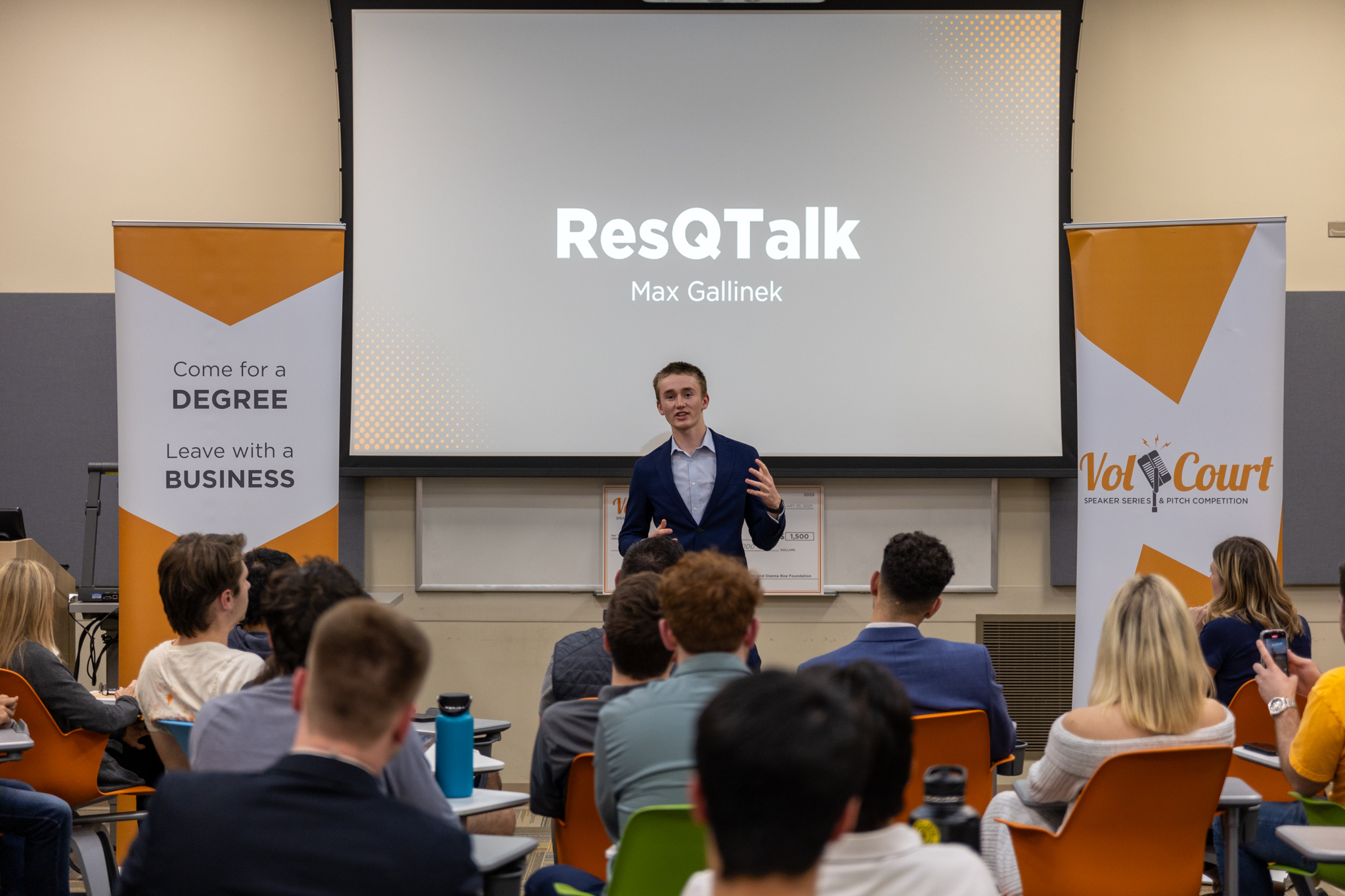
Next came ResQTalk, a proposal for real-time voice translation inside 911 calls. It won first place and $1,500 at the spring 2025 Vol Court. Gallinek had begun conversations with local police departments. Then a much larger technology company moved into similar territory. A campus clothing marketplace followed and faded after team changes. Prize money and applause had not made either concept inevitable.
“You only really lose if you stop trying.”Max Gallinek, reflecting on the ventures that did not last
There is a grown-up discipline in a young founder admitting that adaptation was weak, the market had changed or a team no longer had momentum. Entrepreneurship culture enjoys persistence so much that it sometimes mistakes the continued feeding of a bad idea for courage. Gallinek's useful habit is narrower: preserve the urge to build; do not preserve every object it produces. Failed concepts become tuition, not dependents.
AlertX wins campus funding, then meets adoption and legal barriers.
ResQTalk wins Vol Court with a real-time 911 translation proposal.
Rise Alarm turns an NFC experiment into an app, pod and shipped product.
Reefy reaches a national pitch stage with an acoustic coral-restoration concept.
Hardware has no sympathy
For Rise, Gallinek taught himself Swift and Xcode. He learned plastic manufacturing, worked through compilation errors and brought in Dan Fishman to handle finance and operations. Collin Tornstrom joined on marketing. The division of labor matters. The most romantic version of a college startup is one brilliant student alone under a dorm-room desk lamp. Rise is more ordinary and more credible: one person spots the mechanism, another manages the company, a third finds attention, and all three stand behind a table trying to make a small object feel necessary.
The product's clarity helped. There is no long education sequence between demonstration and desire. Put the pod away from bed. Set the alarm. Stand up to stop it. After an early campus video spread, Gallinek reported 350,000 Instagram views in a month and $5,000 in sales during the first three weeks of March 2026. These are early numbers, not a coronation. They are still different in kind from a pitch prize: strangers were paying.
Rise turns intention into a short obstacle course
In April, Rise won the growth category at UT's Graves Business Plan Competition, bringing in $5,000, plus a $1,000 prize for the best UT Entrepreneurs Club team. The founders had moved from an amusing hack to software, manufacturing, shipping, marketing and sales. Hardware is a useful antidote to theatrical entrepreneurship. It must connect. It must arrive. At seven in the morning, it must ring.
Listening below the surface
While Rise was becoming recognizable, Gallinek was researching something that did not fit the new nickname. He had been scuba diving for more than five years and disliked what he saw happening to coral environments. Reefy, his second current project, proposes an underwater speaker system that analyzes degraded reefs and broadcasts the soundscape of healthy ones. The aim is to attract fish and coral larvae, using acoustic enhancement as one instrument in restoration.
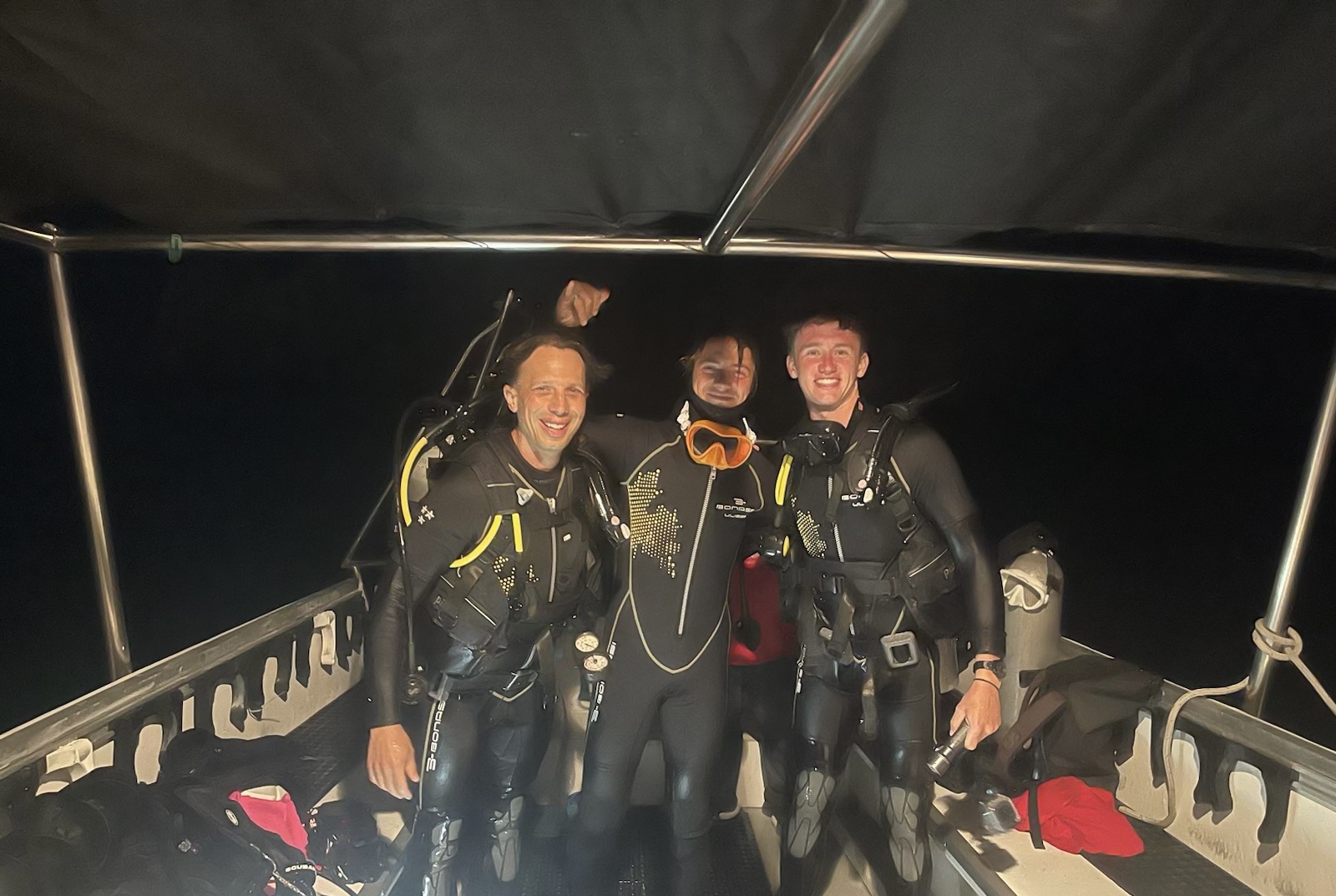
Reefy took him to the Red Bull Basement U.S. National Finals in Detroit in May 2026, one of 15 teams on that stage. In the preceding month he spoke with marine engineers, contacted research institutions and refined the pitch. The project did not advance to the world final. Gallinek said so plainly, congratulated the teams that did, and called the weekend one of the best of his life. Losing well is not a consolation skill for him. It is part of the operating system.
The jump from wake-up hardware to reef ecology looks enormous until one notices the common structure. Gallinek is attracted to a problem with a physical setting, then looks for a technical lever small enough to test: a nearby Narcan carrier, a translated voice, an NFC tap, an underwater sound. He does not yet have a career with a single thesis. He has a method for finding one.
The industries change. The instinct does not: find the stubborn moment where software must touch the physical world.
Put the founders in a room
Knoxville supplies the other half of the method. Gallinek has described the Anderson Center for Entrepreneurship and Innovation as the place where he spent the most time outside his dorm. It gave him competitions, mentors, customer-discovery prompts and a community impatient with purely hypothetical companies. As a student ambassador, he later taught young participants how to shape elevator pitches. He also became president of the UT Entrepreneurs Club.
His diagnosis of that club was candid. It could not out-resource the Anderson Center or out-teach the classroom. Its advantage was social: put builders together until each found people strong where the others were weak. Gallinek had met two close friends through the club; one became a co-founder. The club, in his telling, is not a small business school. It is a room engineered for collisions.
Outside that room, the clues to his restlessness are almost comically consistent. He is an advanced open-water diver and treasurer of VolWake, the university watersports club. His favorite animal is the shark. An Anderson Center biography lists adventure, problem-solving, playing music and making mustard among his interests. Mustard is the perfect minor detail: another substance improved by mixing unlikely ingredients and refusing blandness.
There is also a practical connection between the extracurricular life and the companies. Supply chain courses make manufacturing less mysterious. Pitch competitions impose deadlines. Watersports keep him close to the environments Reefy imagines serving. Even the entrepreneurs club functions like an informal hiring market. None guarantees that a venture will work; together they shorten the distance between wondering and testing. Gallinek's talent, at this stage, is not omniscience. It is arranging his days so that an answer arrives quickly, preferably before attachment hardens into doctrine.
Gallinek is still an undergraduate. That sentence should keep every number here in proportion. Rise has early customers, not a settled outcome. Reefy has a national pitch appearance, not a restored reef. What he has established is a tempo: observe, build, ask, discard, rebuild. The alarm rings. He gets up. Then he decides what deserves another morning.
Continue exploring