The quiet machinery of work
Most careers are explained by titles. Mathew Augustine’s makes more sense as a recurring question. What would it take for a smaller employer to give its people the kind of support that a corporation can buy by the department? The question has followed him from the first rush of technology outsourcing, through private benefits exchanges and a company called Workforce Junction, to his current role as Head of Benefits at Lumber, a workforce platform for construction.
The scenery changed dramatically. The workers Augustine once discussed were arriving in the United States to staff technology projects. The workers in his present brief may start a morning on a jobsite, with payroll, eligibility, credentials and compliance moving around them like invisible scaffolding. Yet the administrative disadvantage is familiar. Large employers can distribute complexity among specialists. At a smaller company, complexity has a habit of landing on one person’s desk, usually at 4:47 on a Friday.
Augustine’s public philosophy is not the usual software sermon. In a 2021 interview, while leading Workforce Junction, he gave his preferred order: “relationships first, service second, and technology third.” The sentence is revealing precisely because he has spent so much of his career around technology. He does not dismiss the machine. He gives it a job description.
“The role of technology is to empower people to do better work.”Mathew Augustine, 2021
A bridge built during the outsourcing boom
Augustine has traced his start to the technology-outsourcing boom of the early 1990s. Indian services companies were expanding in the United States, sending employees into an unfamiliar system of payroll, insurance and workplace administration. Their growth created a peculiar translation problem. An employer could understand the technical project perfectly and still find the American benefits apparatus baffling.
By 2007, Augustine was publicly identified as a principal of Hanna Global Solutions. The firm specialized in the needs of Indian companies with American workforces. It had begun working with Wipro when the technology company had only about 50 employees in the United States, then expanded its client list as the outsourcing wave gathered force. Hanna’s proposed “Bangalore Plan” combined payroll, insurance and related support for an employee entering the country. The name sounds like a route on an old airline map. The underlying idea was modern: bundle the bewildering back office into one navigable experience.
The figures belong to a young operation and an earlier economy, but they show the shape of Augustine’s work. This was not benefits as an annual packet placed on a desk. It was infrastructure for companies crossing a border at speed. The employee required help at the same time the employer required scale. Hanna sat in the middle, translating rules into service.
In 2013, as Hanna’s chief operating officer, Augustine described a U.S. benefits exchange created with UnitedHealthcare for Indian technology companies. Employees could compare options while the employer reduced administrative work. By the following year, he was speaking as Hanna’s CEO about UBA Benefits Passport, a private exchange that combined coverage choices with eligibility management, accounting, auditing and support. The appeal was not a glittering interface. It was the possibility of a “big company experience” for a midmarket employer.
The serious art of making enrollment less dull
Benefits administration has an image problem: it is important in inverse proportion to how much anyone wants to discuss it. Augustine has approached that problem with an operator’s instinct for participation. In advice published by United Benefit Advisors, he proposed making annual enrollment more engaging and involving employees through surveys, meetings and incentives. One client offered an iPad giveaway for joining webinars and answering questions. Participation improved.
There is a useful bit of wit in the story. A prize cannot make an eligibility file exciting, but it can persuade someone to open it. The anecdote also exposes Augustine’s method. Communication is not finished when information is sent. It is finished when the intended person has understood enough to act.
United Benefit Advisors recognized Augustine as its 2014 Principal of the Year. The award’s criteria included business growth, team development, contribution to the partner network and a willingness to share knowledge. It fits the public record: he appears not only as a company executive, but as a practitioner explaining how employee communication, private exchanges and outsourced administration could work.
His sense of stewardship also appeared away from the office. From 2010 to 2015, Augustine and his wife served on the board of St. Thomas Catholic Preschool in Milpitas, California. He described good early education as an investment in the country’s future. It is one of the few public glimpses beyond his profession, and it rhymes with it: build the structure early, take the long view, remember whom the system is meant to serve.
A junction, then a jobsite
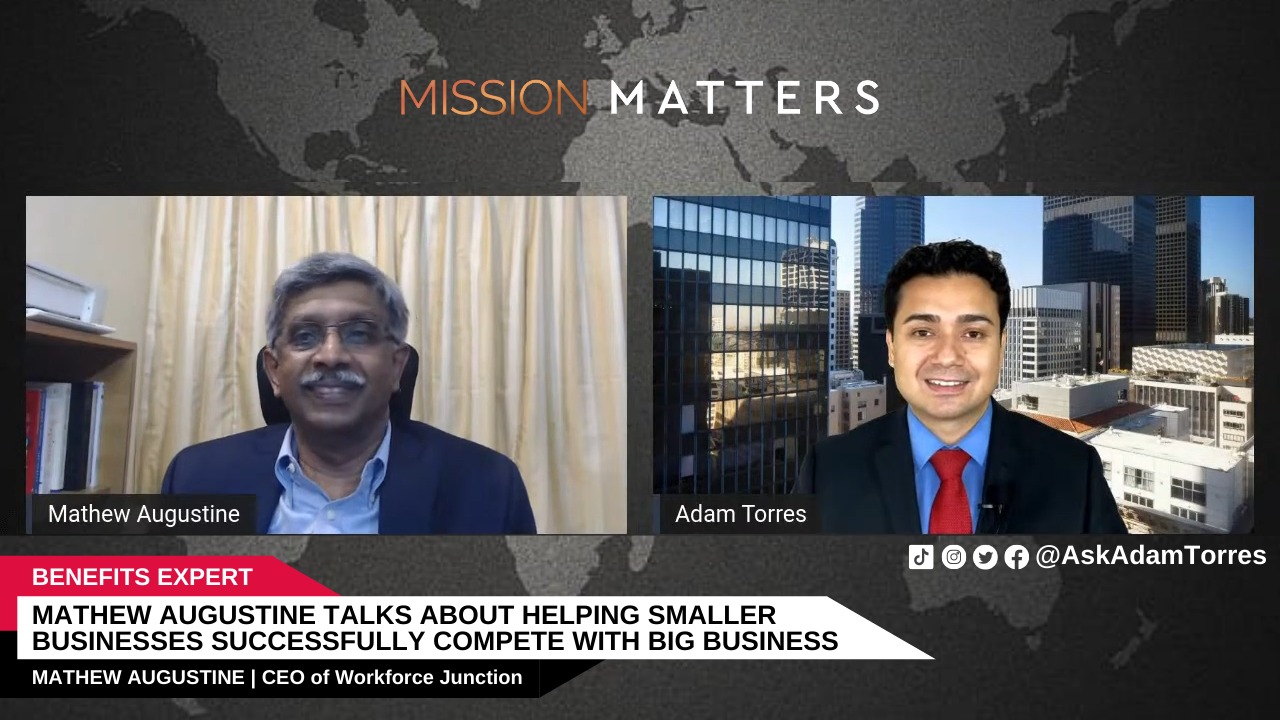
By 2021, Hanna had given way in Augustine’s public life to Workforce Junction. The new name was unusually accurate. The company stood where benefits advisors, employers, administrators and software met. On the Mission Matters Business Podcast, Augustine framed its mission in competitive terms: give small and midsize employers the edge they needed against big business, while helping benefits advisors serve those companies profitably.
He connected the mission to the economic role of small companies, arguing that they had created much of the net new employment in the first two decades of the century while remaining underserved in benefits. The point was less sentimental than structural. A small firm may be responsible for a great deal of employment and still lack the purchasing power, specialist teams and administrative margin of a national corporation. Importance and infrastructure do not arrive as a matched set.
“Benefits, along with pay, are one of the core reasons people choose to work for the employer they do.”Mathew Augustine
That conviction explains the move into construction technology better than the industry labels do. Lumber sells software for payroll, HR, field operations and workforce compliance. Construction adds its own grammar: crews move between sites, staffing follows projects, credentials expire, hours feed job costing, and payroll may need to account for union rules or prevailing wages. An administrative error does not remain politely inside an HR system. It can move into a paycheck or a project.
Augustine’s 2024 column for Lumber mapped the burden facing small and midsize contractors. He wrote about varying workforce needs, changing eligibility, leave administration, regulatory compliance, communication, data security, vendor management and cost control. The list is long because the problem is not one problem. It is a small parliament of problems, each insisting on the floor.
Begins working amid the technology-outsourcing expansion and its cross-border workforce needs.
Discusses Hanna Global Solutions’ combined support for Indian technology employers in the United States.
Receives UBA’s Principal of the Year award and advocates flexible private-exchange services.
Leads Workforce Junction with a mission centered on smaller employers and their advisors.
Brings the same midmarket focus to construction as Lumber’s Head of Benefits.
The value of an unglamorous question
Augustine now writes publicly about mismatches between payroll and carrier records, stale enrollments and administrative hours that quietly accumulate. These are not grand strategy phrases. They are the loose bolts of workforce operations. Finding them requires a particular temperament: patient enough to audit, experienced enough to know where errors hide, and practical enough to care about the bill before inventing a slogan.
His credentials - GPHR, SHRM-SCP and REBC - indicate fluency across global HR, senior HR practice and benefits consulting. Yet the more distinctive qualification may be duration. Augustine has watched workplace systems move from call centers and paper into portals, exchanges and integrated platforms. He has also watched each generation of technology promise that the difficult part is finally over.
His writing offers another clue to the way he sees work. Alongside technical material, Augustine has published reflections on Labor Day, freedom and the overlooked pressures carried by working fathers. The subjects are broader than administration, but they share an interest in the person underneath the employee record. In his Labor Day reflection, work is not merely output; it is bound up with purpose and dignity. That concern gives the operational details a human scale. A clean deduction file may be a triumph of process, but its meaning lies with the worker reading a pay statement and trusting that somebody got the details right.
He is equally attentive to what employers can miss. A benefit can exist on paper and still fail in practice if people do not understand it. A platform can hold accurate data and still create frustration if nobody answers the question behind the ticket. Augustine’s occasional calls for incentives, education and plain communication all press toward the same result: administration should be experienced as support, not as homework assigned by the company.
His hierarchy offers a useful correction. Relationships identify the real problem. Service carries responsibility for solving it. Technology increases the reach and consistency of the work. Reverse the order and a company may acquire an elegant way to misunderstand its employees at scale.
That is why the thread from Bangalore to the building site holds. Augustine has not spent three decades defending one product or one industry. He has kept returning to employers caught between ambition and administrative capacity. The promise is modest but consequential: a smaller organization should not have to feel small when its people need help.