The most valuable machine in an independent garage may be the one nobody notices: the shop-management database. It contains years of complaints, diagnoses, labor, parts and fixes. It also behaves like a locked filing cabinet. When a familiar vehicle returns with an unfamiliar rattle, the useful answer might be sitting in a repair order from 2021, written by a technician who now works three towns away. Mastertech.ai built its company around opening that cabinet.
The pitch is admirably concrete. Give technicians one place to ask what is wrong, look up a wiring route or torque specification, inspect a technical service bulletin and see how similar cases were actually solved. Give service advisors a second set of eyes on maintenance due at check-in. Give the shop its own institutional memory. The company combines licensed manufacturer material, CARFAX vehicle history, a garage's repair records and anonymized successful repairs shared by opt-in shops. The interface accepts plain English, not merely a diagnostic trouble code.
Two founders, one very specific headache
Mastertech.ai was founded in 2023 by Linda Gray and David Forman. Gray had spent roughly two decades in software, rising from Microsoft intern to principal engineer and leading work around Outlook, Teams and Xbox Live. Forman had more than 20 years in automotive repair as an ASE Master Technician and shop owner. The pairing matters. One founder knew how to ship complex software; the other knew exactly why a technician loses 20 minutes while the car, customer and next appointment keep waiting.
Gray has said that recent advances in AI changed her view of what software could do for hands-on workers. Forman supplied the reality check. Modern vehicles carry more components, electronics and software every year, while an independent shop may see almost any make or model. Mastertech.ai cites more than 60,000 distinct models on the road. The gap between what one person can remember and what the job can demand is the company's market.
“You're essentially immortalizing your best master technician's knowledge within your shop through AI.”Linda Gray, Gain Traction podcast
That line sounds dramatic until the best diagnostician retires. Then it sounds like succession planning.
What the product actually does
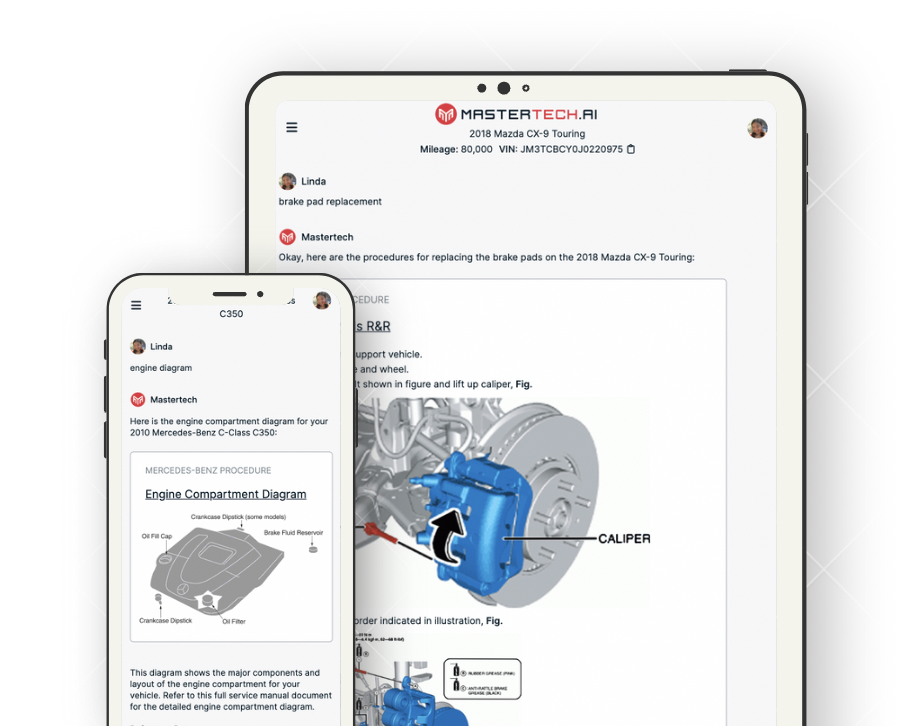
At intake, Mastertech.ai can pull vehicles from supported shop-management systems or scan a VIN with a phone camera. It checks manufacturer maintenance schedules against CARFAX and internal shop history, then produces an overdue-service report. Shops can replace factory intervals with their own policies, add branding and share plain-language explanations with customers. This is not only a technician feature. It is an advisor's chance to prepare a useful conversation before the customer has mentally left the building.
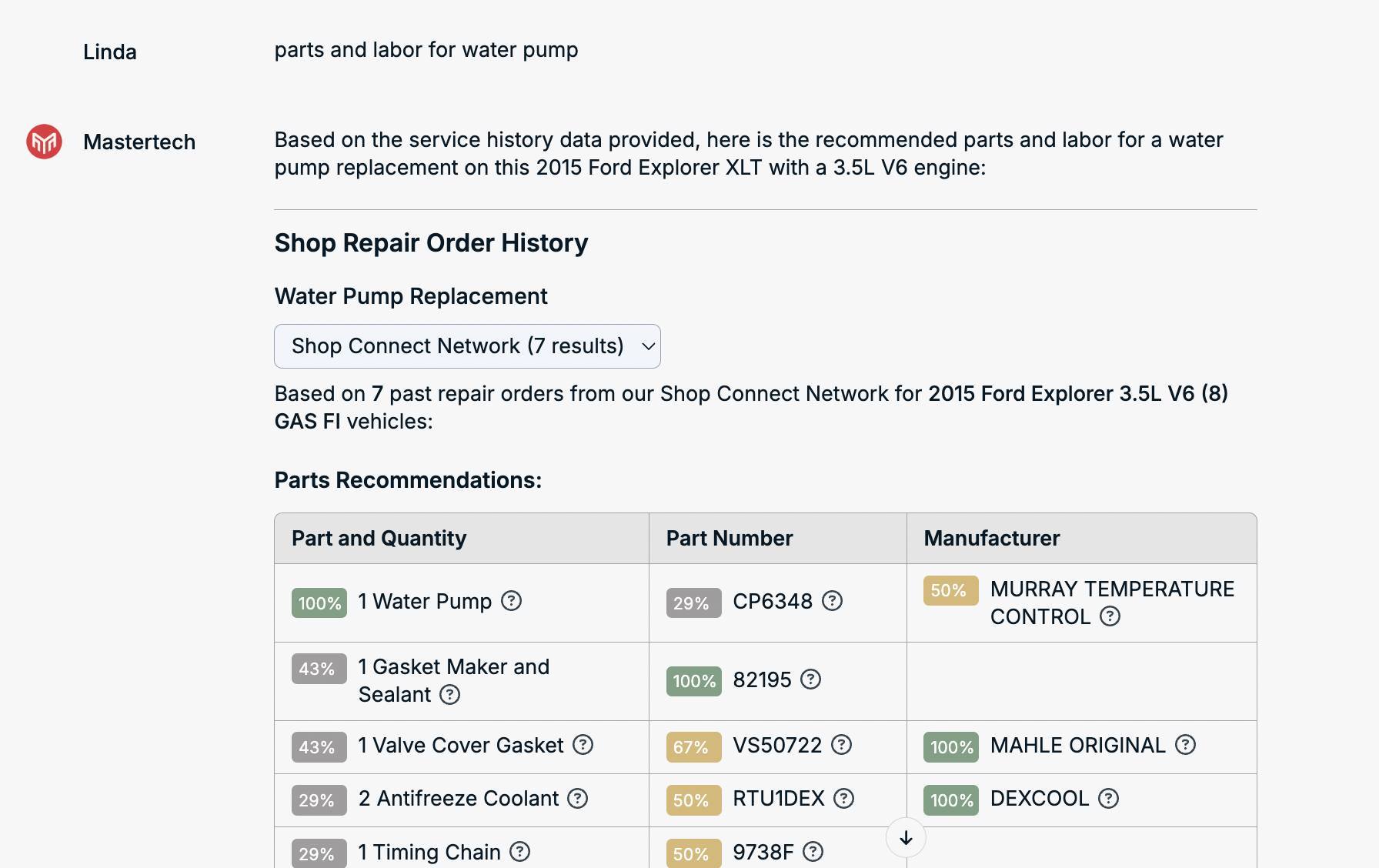
During diagnosis, a technician can describe the concern, review likely causes from similar repair orders and follow actual tests used in prior cases. The system also searches direct OEM procedures, thousands of DTC test plans, fluid capacities, component locations, wiring diagrams and MOTOR labor guides. One small trick is especially telling: Mastertech.ai extracts text embedded in TSB images. The company says up to 30 percent of bulletins contain critical words that ordinary text search misses. That is not science fiction. It is optical character recognition applied where a wrench-turner can use it.
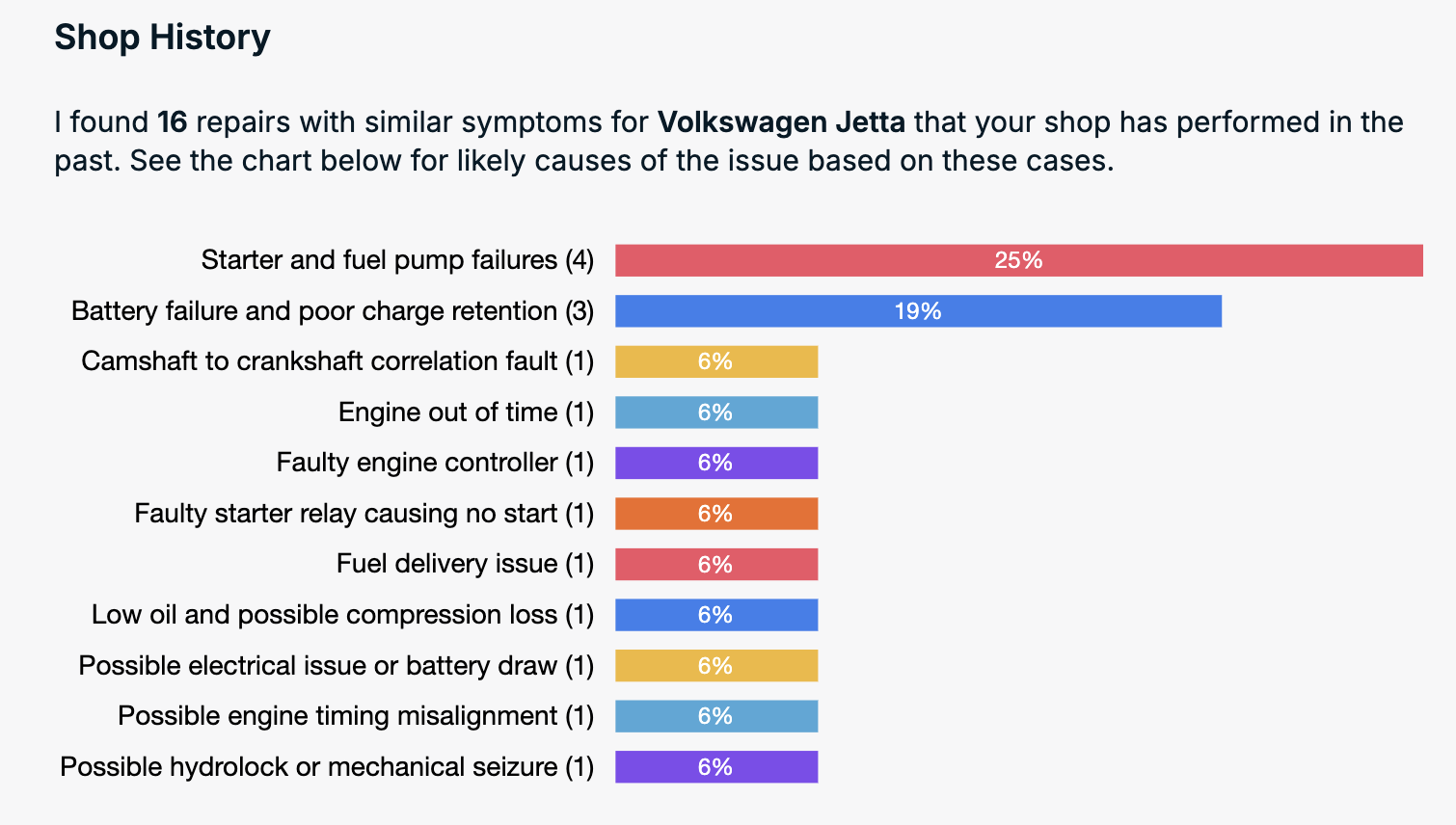
The estimates feature pushes the same logic toward revenue: recommend parts, part numbers and labor times, then surface services commonly done together. A shop can compare guide times with its own history. The promise is not that software knows better than a technician. It is that fewer useful clues die in separate tabs, PDF images or closed work orders.
The price - and the bet behind it
Up to 200 unique vehicles, seven additional users and a 30-day trial. Each extra vehicle costs 75 cents. Larger operations receive custom pricing.
That business model is classic vertical SaaS: a recurring shop subscription tied to usage, with custom contracts for bigger operations. The economic test is simple. Can the tool recover more than $199 through one avoided research detour, one more complete estimate or a few maintenance jobs that would otherwise be missed? Mastertech.ai does not publish customer revenue gains, so a buyer should run that calculation against its own repair volume rather than borrow the marketing arithmetic.
Its public customer count is also undisclosed. The visible proof comes from integration depth and data growth. Shop-Ware and Protractor connections can sync vehicles and repair orders, generate reports and place findings back into existing workflow. Goodturn Tire & Auto CEO Christian Seem says the software fits naturally into shop operations and simplifies complex data. In May 2025, Mastertech.ai reported more than 500,000 shared diagnostic reports in its opt-in Shop Connect Network. Its current site claims more than 2 million verified anonymous diagnostics.
What failed first was ordinary
The early release notes are refreshingly uncinematic. The first visible problems included email sign-up bugs and messy TSB references. The team added a feedback button below AI answers because accuracy was the product. Users then complained about typing VINs by hand, so Mastertech.ai prioritized a camera scanner. Early manufacturer coverage was incomplete: Stellantis arrived in July 2024 while Honda and Toyota approvals were still pending. It improved vehicle-loading time, parsing and data matching before expanding into bigger ideas.
The founders also met an early go-to-market reality. When they first approached LAUNCH in late 2023, their traction was too early for the accelerator. Instead of pretending otherwise, they joined Founder University, pushed out a test MVP, revised the product vision and earned backing from LAUNCH and Jason Calacanis. CB Insights reports a $130,000 angel round in April 2024. Gray later wrote that she stopped following generic founder playbooks and focused on real-world impact and financial independence. Her first paycheck from the startup came nearly two years after leaving her job - and was the smallest of her career.
The company stayed tiny while the feature list grew. LinkedIn places it in the two-to-ten employee band and publicly shows three people. That scale helps explain a culture visible in the release notes: direct contact addresses, same-day support, manual onboarding for a new integration and specific promises about what the team would build next. The posts do not read like quarterly theater. They read like a workbench - here is the bug, here is the customer complaint, here is the part we fitted. Mastertech.ai also exhibited at repair-industry events and created a Facebook group for active shops, gathering feedback from the people expected to trust the answer with a customer's car on the lift. In vertical software, that proximity is a form of expertise. Gray could translate the software; Forman and the shop community could tell her when the translation was wrong.
Why AutoVitals wanted it
AutoVitals announced its acquisition of Mastertech.ai in 2026. The price was not disclosed. The strategic fit is easier to see than the cap table: AutoVitals already manages digital vehicle inspections, shop workflow and customer communication. Mastertech.ai adds service intelligence inside that path. Linda Gray joined AutoVitals to guide product strategy and integration; existing Mastertech.ai customers were told service would continue while the companies build a deeper connection. AutoVitals customers are expected to gain the capabilities as an optional enhancement.
In market terms, Mastertech.ai sits between repair-information databases such as ALLDATA, Mitchell 1 and Identifix; shop-management systems; and general AI assistants. Its distinction is the combination. OEM documents provide authority. Vehicle history provides context. A shop's own repairs provide local habits and evidence. Shop Connect adds a network effect. The acquisition suggests that this intelligence becomes more valuable when it appears inside the inspection and estimate workflow, not as another lonely browser tab.
What builders can steal
Your customers may already create the proprietary dataset. Look for records produced as a by-product of paid work.
In high-consequence work, retrieval from trusted documents matters more than a charming answer.
Sync the VIN, write the report back and arrive before the appointment. Integration is part of the product.
A VIN scanner and searchable image text can remove more daily friction than a grand model announcement.
The playbook works best when a vertical has repeated, expensive decisions; trustworthy reference material; a useful backlog of customer data; and experts who can judge the output. It works poorly when records are sparse or inconsistent, integrations are blocked, privacy rules prevent useful aggregation or the answer cannot be checked. A tiny shop with little digital history may receive less advantage from the private knowledge base. A technician should also remain skeptical when a vehicle configuration or source document is missing. Mastertech.ai's own feedback controls acknowledge the point: the system is an assistant, and the accountable expert still works in the bay.
The neat ending is the acquisition. The better lesson is less tidy. Mastertech.ai did not discover a magical mechanic inside a language model. It found that garages were already writing the manual for their future selves, one completed repair order at a time. The company made those pages talk.
Keep turning the wrench