The character entered first
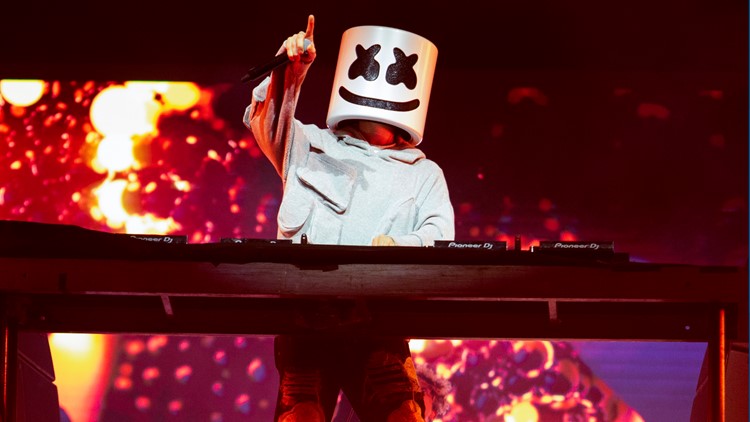
A white bucket walks onto a festival stage. Two black Xs stare out. A smile curves beneath them, permanently delighted, even when the bass is behaving badly. The person inside says nothing. He does not need to. Before Marshmello plays a note, the audience has already received the entire visual sentence.
It is tempting to describe the helmet as camouflage. That misses its better trick. Camouflage dissolves into the background; Marshmello can be identified from the cheap seats. The helmet hid Christopher Comstock's face while giving the project an exceptionally legible one. It made mystery friendly, reduced celebrity to three marks, and offered fans a character simple enough to draw on a notebook or become inside a video game.
Comstock has been clear about the point. He likes anonymity because it keeps attention on the music, the helmet and the things the character says. The project, in his telling, is not an invitation to trail a private person through his day. It is an invitation to listen. A celebrity economy built on access received an artist whose refusal became the access point.
Before the bucket, there was Dotcom
The overnight story began five years before the public met Marshmello. In 2010, Comstock started posting mashups, remixes and original productions on SoundCloud as Dotcom. The name came from a school-age joke on Comstock: Chris Dotcomstock. The music moved from dubstep toward the festival-trap sound gathering momentum in the early 2010s. He learned the internet's rhythm before he built a character designed for it.
In early 2015, Wavez appeared under the Marshmello name. Remixes of Jack Ü and Zedd followed, and Skrillex offered early support. The first impression was unusually complete: bright melodic production, white clothes, an LED smile, no biography required. Find Me announced the sound. Joytime, the 2016 debut album, gave it a home. Then Alone supplied a plot.
The Alone video placed Marshmello in high school as the odd figure whom classmates mock until his music gathers them together. It was a tidy creation myth, earnest enough for young listeners and knowingly literal enough for everyone else. Comstock sang on the track himself, with his voice pitched upward. The supposedly faceless producer had been audible all along.
The fixed face, the wandering sound
Marshmello's visual identity barely moved; his records refused to sit still. Silence gave Khalid's soft gravity an electronic frame. Wolves with Selena Gomez turned tension into sleek pop. Friends let Anne-Marie deliver a boundary with the crispness of a spelling lesson. Happier, made with Bastille, paired uplift with a breakup lyric and rose to No. 2 on the Billboard Hot 100. It remained at the top of Billboard's Hot Dance/Electronic Songs chart for 69 weeks.
The consistency was less a genre than a social function. These songs were built to meet people where they already listened. Comstock says he cycles obsessively through genres and learns their elements as a fan. When a Roddy Ricch session materialized on short notice, he made two beats specifically for the rapper before they met. Project Dreams was finished about six hours later. Adaptability here is not a plug-in. It begins with attention.
“Honesty. You don't want to tell somebody that you don't like their idea, and they don't want to tell you either.”Marshmello on what makes a collaboration work
His sessions with Juice WRLD reveal the same closeness. Comstock began as a fan, playing the rapper's work constantly. When they first met at an awards show, Juice ran over for a picture and discovered the admiration was mutual. Later, Marshmello went to his Los Angeles home at four in the morning. They recorded four or five songs that night, one of several fast, abundant sessions. Come & Go eventually matched Happier's No. 2 Hot 100 peak; Hate the Other Side reached No. 10.
There is care inside the velocity. Marshmello has said any decision about their remaining recordings belongs with Juice WRLD's family and team. The remark draws a useful border around his collaborative appetite: make freely in the room, then respect who holds the meaning outside it.
One helmet, several rooms
Illustrative map of major released work, not a measure of quality or listening volume.
A concert with no bad sightlines
The helmet found its ideal venue in February 2019. Inside Fortnite's Pleasant Park, players assembled as avatars for a concert that drew more than 10 million people to its first showing. The set was short. The implications were not. Fans did not merely watch Marshmello; they bounced, floated and danced inside the performance. His likeness was available as a playable outfit, so the crowd could also become him.
Comstock later said that was part of the pleasure: people could buy the helmet in life or wear it in a game. “Everybody can be Marshmello” is both a generous idea and a sharp piece of character design. The project had removed the one feature fans could not reproduce, the artist's face, and replaced it with a uniform.
This is why the Fortnite show felt less like a celebrity visiting a game than a native species returning to habitat. Marshmello already moved like an avatar. The blank expression survived every camera angle. The songs arrived as shared instructions. Where a human face can seem strangely stiff when digitized, the fixed smile seemed perfectly alive.
The Marshmello project emerges through online originals and remixes.
Happier turns a bittersweet Bastille collaboration into a long-running chart record.
Fortnite's Pleasant Park becomes a venue for more than 10 million players.
Shockwave trades one house style for a restless tour of electronic subgenres.
Sugar Papi gathers his Latin collaborations into a full album.
Comstock steps forward as the lead singer of pop-punk band Underbrook.
The pleasures of refusing the box
By 2021, the obvious choice would have been another Joytime. Instead, Shockwave opened with a clip dismissing him as overrated and spent the rest of the album answering with movement: trap, Jersey club, dubstep, Eurodance and pop-punk. Comstock called it the album he needed, music imagined from the studio as a future live set. It earned his first Grammy nomination, for Best Dance/Electronic Music Album.
The nomination reached him in a wonderfully uncinematic fashion. He was half asleep, saw his phone vibrating, and needed several passes to understand the news. His next instinct was to tell everyone who had worked on the record. That small reaction says more than a trophy-room photograph could. Even behind a singular mask, he thought in the plural.
He says he pictures the show while making the song: a crowd that does not yet exist, reacting on a stage he has not played. Production becomes rehearsal for a shared future.
The next turns widened the map. El Merengue with Manuel Turizo brought electronic polish to a song shaped by merengue; it reached No. 1 on Billboard's Tropical Airplay chart. Sugar Papi followed in 2023 as Marshmello's first Latin album. Country was already in the catalog through One Thing Right with Kane Brown. Miles On It, another Brown collaboration, later held the revamped Hot Dance/Electronic Songs chart at No. 1 for 35 weeks. Holy Water with Jelly Roll and Another Drink with Kelsea Ballerini continued the conversation.
None of these moves requires the claim that Marshmello invented crossover. Their interest is cumulative. The apparently impersonal character has become a reliable host for other people's voices. His face never competes with theirs. His production can borrow a room's furniture without pretending he owns the house.
When Christopher took the microphone
There was always another voice under the processed one. Comstock grew up playing in bands, sang on Marshmello records, and slowly let his natural vocal pitch enter the work. In 2025 he made the split explicit by launching Underbrook, a pop-punk band in which he performs under his real name as lead singer.
It would be neat to call this an unmasking, but neatness is the enemy of an interesting career. Marshmello continues. Underbrook is not the truth replacing the fiction; it is another room beside it. One project lets Comstock be a symbol. The other lets him stand at a microphone with friends and revisit the band energy he knew before the white helmet existed.
The relationship between the two projects makes the mask look less like a wall than a tool. It gave a private producer permission to become enormous. It gave collaborators a clean silhouette to work against. It gave fans a costume. After a decade, it may also have given Comstock enough distance to approach his own face and voice on his terms.
The smile stayed fixed so the ambition could keep moving.
Marshmello's career is often narrated as a solved mystery: clues gathered, databases checked, Christopher Comstock named. Yet the answer never made the project less effective. A magic trick can survive an explanation when the pleasure lies in the performance rather than the secret compartment.
That white cylinder is now old enough to carry nostalgia, but it has not become a museum piece. Current releases still place Marshmello beside artists from different scenes, and the official feed keeps presenting the next collaboration like another door opening. The useful mystery was never who occupied the helmet. It was how much music, play and human connection could fit inside something so simple.