The day before Mark Shuttleworth went to space, he sat in an empty swimming pool and wondered whether he really wanted to go. The preparations were complete. The approvals had arrived. A Russian replacement would have been quite happy to take his seat. Then his South African phone rang. Someone was looking for Petrus. Even the universe, it seemed, had trouble getting the right number.
He told that story years later, with the sort of humour that makes an improbable life briefly sound familiar. The money is less familiar. His company Thawte had been sold in a deal announced at $575 million. His Russian space trip would cost about $20 million. Here was someone with both the means to leave the planet and a perfectly ordinary capacity for last-minute doubt.
Shuttleworth went. On 25 April 2002, he launched from Baikonur in Kazakhstan with commander Yuri Gidzenko and European Space Agency astronaut Roberto Vittori. Ten days later he was back on Earth. The flight supplies the obvious opening to his biography. The more revealing question concerns the decades afterwards: what do you build when you have already bought the adventure?
A business hiding inside a browser
Shuttleworth was born in Welkom, South Africa, in 1973. At the University of Cape Town, he studied finance and information systems. That combination puts a useful pair of questions in the same room: does this work, and can anyone make a business out of it? In 1995, he founded Thawte, working in the developing market for digital certificates.
The problem was trust at a distance. A browser could connect a customer to a business on another continent. Establishing who stood behind that business was another matter. Digital certificates helped websites establish their identities and support encrypted connections. The work happened behind the shopping basket, far from the products people were actually buying.
By December 1999, VeriSign had agreed to acquire Thawte in a share transaction valued at $575 million. That figure needs its proper label: the announced value of a business deal, rather than a contemporary statement of Shuttleworth’s personal wealth. The surviving agreement names him as Thawte’s sole shareholder and sets out the exchange of ownership for VeriSign shares.
It is a wonderfully unshowy origin for a space traveller. Before the launch suit came the problem of persuading a machine that another machine deserved its confidence. Making unfamiliar systems cooperate would remain a recurring occupation.
Announced value of the Thawte transaction. A company sale, not a current net-worth estimate.
Ten days with a return ticket
The mission paired a privately funded South African businessman with professional Russian and European crew members. Shuttleworth became the first South African in space and the second self-funded visitor to the International Space Station, following Dennis Tito. The official mission record gives the launch date as 25 April and the landing as 5 May 2002.
Those two dates make the undertaking look wonderfully tidy. A departure, an arrival, a receipt large enough to discourage casual repetition. The photographs supply the everyday detail: Shuttleworth aboard the station, laptop open, cables and equipment occupying the surrounding space. Even an orbital adventure can contain the familiar posture of someone attending to a computer.
Spaceflight makes a difficult yardstick for the rest of a career. A rocket rises in public. Software accumulates through releases, fixes, packaging decisions and other work that rarely persuades anyone to gather outside and count backwards. Shuttleworth’s next major undertaking would depend on precisely that quieter kind of repetition.
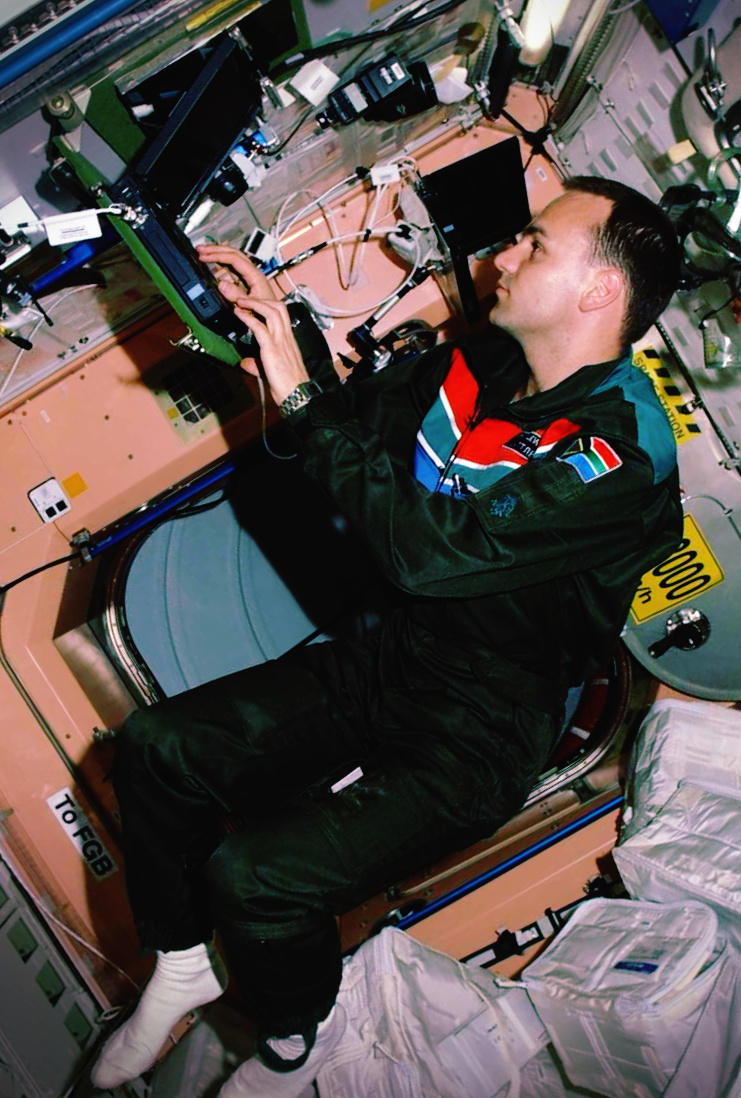
Photo: Mark Shuttleworth; adjusted and cropped by Paul Sladen. Image / CC BY-SA 3.0.

A warthog arrives on schedule
In 2004, Shuttleworth gathered Debian developers to create Ubuntu and founded Canonical to support the effort commercially. Linux already existed. So did the extensive body of work contributed by the Debian community. The opportunity lay in putting that work into a desktop system that more people could comfortably use, with a company prepared to stand behind it.
The first release arrived in October 2004, numbered 4.10 and named Warty Warthog. It was an admirably candid animal to put on a new product. Ubuntu’s name carried a more generous idea: humanity towards others. The project offered an operating system people could use without paying a licence fee, while Canonical developed services around it.
There was also a calendar. Ubuntu committed to releases every six months. Long-term support releases followed, beginning in 2006. The useful distinction was between people eager for new software and organizations that needed a dependable base for years. Both could participate without requiring everyone to keep the same appetite for change.
That is where Shuttleworth’s story begins to resist the usual plot of a founder’s second act. Ubuntu required him to stay interested after the unveiling. An operating system has another morning, another update, another person whose printer or server requires attention.
Free software, postage included
A free download assumes you can download it. Canonical’s ShipIt programme, started in 2005, took that small obstacle seriously. People could request Ubuntu CDs and have them delivered without paying for the discs or the shipping. When broadband was expensive or unavailable, the postal service became part of the software distribution network.
By the time the programme’s end was announced in April 2011, Canonical said it had sent millions of CDs to every country in the world. That is a more tangible expression of access than a declaration on a website. Someone had to manufacture the discs, arrange the packaging and pay to move them.
The service eventually gave way as downloads became more practical. Community groups could still obtain CDs, and users could copy and redistribute the software themselves. The method changed with the circumstances. For a project promising broad access, the useful question was always whether the intended recipient could actually get the thing.
It is easy to overlook the envelope when writing about the operating system. The envelope explains something about the operating system’s ambitions.
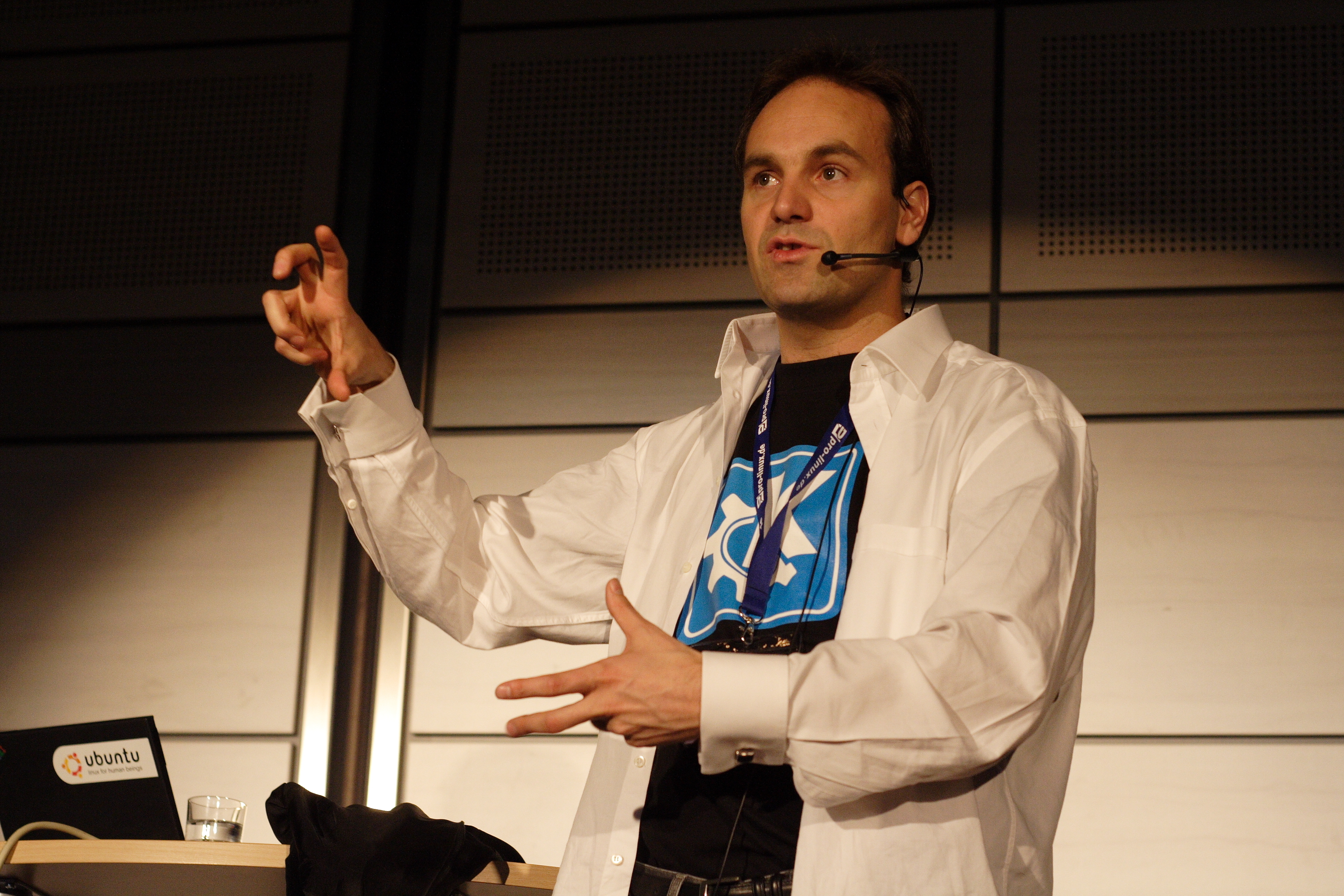
Photo: Martin Schmitt / CC BY 2.0.

Two foundations, different jobs
Shuttleworth had established the Shuttleworth Foundation in 2001. Its work developed around social innovation and open knowledge, funding people whose ideas could be shared and reused. The foundation describes itself as an experiment in open philanthropy. It extends an interest visible throughout his software work: allowing other people to do something useful with what has already been created.
A separate institution, the Ubuntu Foundation, was announced in 2005 with an initial funding commitment of $10 million from Shuttleworth and Canonical. Its purpose concerned continuity for Ubuntu. A user choosing a free operating system still has a reasonable interest in whether somebody will maintain it in the future.
The similar names can obscure the different jobs. One backed social innovators. The other addressed the durability of a software project. Neither removes the need for Canonical to operate as a business. Together, they show how much of giving something away consists of deciding what happens after the first gift.
The phone he stopped trying to build
The ambitions also produced a costly detour. Canonical pursued Unity8 and the idea of convergence across phone and desktop. In April 2017, Shuttleworth announced that investment in the phone and convergence shell would end. Ubuntu’s default desktop would return to GNOME, and the company would concentrate on cloud computing and connected devices.
He had believed the industry would welcome convergence. The response had disappointed him. In explaining the decision, he acknowledged that markets and communities determine which products survive. For a founder associated with financing his own convictions, this was an unusually public concession to other people’s preferences.
He said future investment would go to the parts of Canonical contributing to its growth. It was a business decision, however personally difficult. The freedom to pursue an idea also leaves someone responsible for deciding when to stop.
There was a leadership transition that year, too. Jane Silber, who had become chief executive in 2010, announced that Shuttleworth would resume the role in July 2017 while she moved to the board. Her account described a prepared handover after seven years as CEO. Ubuntu’s history includes people carrying the company through the long stretches between its founder’s better-known decisions.
“markets, and community, ultimately decide which products grow and which disappear.”
Mark Shuttleworth / April 2017
The beekeeper at the keyboard
There are less corporate ways to understand him. In a 2018 interview, Shuttleworth described taking up beekeeping and becoming interested in how a hive chooses where to direct its efforts. He also advocated working from home. “Commuting’s sort of nuts,” was his compact assessment. The observations suit someone whose company was built around people working across borders.
They also complicate the solitary-founder image. A hive is a peculiar hobby for anyone hoping to remain convinced that all useful decisions originate at the top. Ubuntu depends on contributors with their own priorities; Canonical employs people to turn some of that shared work into something customers can rely upon. Keeping those relationships productive is an occupation in itself.
Still at work beneath the next idea
In April 2026, Canonical released Ubuntu 26.04 LTS, Resolute Raccoon. The release included support for AI development tools, changes intended to improve security, and updated desktop and server capabilities. By 15 October, Ubuntu 26.10, Stonking Stingray, had followed. The animal names had survived. The technical work underneath them had kept moving.
The following month, a published Ubuntu Summit keynote put Shuttleworth alongside Jon Seager, Canonical’s vice president of Ubuntu engineering, discussing speed, isolation and community access in an era of AI agents. Snaps, LXD and microVMs entered the conversation. These are tools for packaging software and separating workloads, the less photogenic arrangements that help new applications run without causing trouble elsewhere.
There is a line connecting the certificate business, the free CDs and this work on computing infrastructure. Each asks what another person needs before they can safely or practically participate. The answers differ: an identity check, a disc in the post, a maintained operating system, a boundary around a running application.
Shuttleworth’s rocket trip had a landing date. Ubuntu keeps generating the next obligation. That may be the most telling use he has found for the proceeds of Thawte: the freedom to take on a project whose work is never conveniently finished.
Follow the threads
Writing, conversations and the projects that continue the story.