Mark McEntire returned to Emerge in September with the advantage most incoming chief executives spend months trying to buy: he already knew where the coffee was, who the customers were and which promises the company had made. He had worked there in 2022 and 2023, building its strategic account operation and customer advisory board. Then he left to run Princeton TMX. Three years after his first arrival, he came back as CEO. The curious part was not that he knew the building. It was how firmly he refused to act as if that meant he knew everything inside it.
“I came back with context, not with all the answers,” he wrote after returning. It is a modest sentence with sharp managerial edges. Emerge had logged more than 150,000 hours of product development and improvement while he was away. Familiar colleagues were now making a product he had never operated. A returning executive can become a tourist in his own memories. McEntire instead declared it day one.
His first 90 days were reserved for listening: customers, employees, partners, then priorities. This was not new choreography. When he took the top job at Princeton TMX in 2023, he promised to contact every customer during his first three months. He asked employees two questions. What did they love about working there? If they could run the place for one day with complete freedom, what would they change? It is the sort of inquiry that can produce useful answers and ruin a perfectly comfortable afternoon.
The long road to software
McEntire was born in Walnut Ridge, Arkansas, and studied transportation and logistics at Arkansas State University. His professional route began at J.B. Hunt, then ran through Penske Logistics, where he spent more than a decade and twice received the company’s President’s Award. He spent the next 17 years at Transplace, now part of Uber Freight, eventually becoming senior vice president of managed transportation. In 2009, an industry advertisement put the scale of the work in plain English: more than $600 million in transportation spending under his watch, moving familiar consumer brands to store shelves.
The résumé contains its share of executive polish - a General Electric Six Sigma Black Belt, APICS supply chain certification, industry recognition in 2017 and a lifetime-achievement honor in 2024. The more useful credential is less decorative. McEntire has sat in the procurement seat. He has run the bid, lived with the routing guide and answered for the result at quarter’s end. Software, in his telling, does not begin with the wonder of software. It begins with the invoice, the missed truck and the customer asking what happened.
His earlier work also kept him close to the stubbornly physical side of the economy. Beverage, food, retail and automotive customers do not experience a supply chain as an abstraction. They experience it when a shelf is empty, a plant waits or a delivery window closes. McEntire’s career moved steadily toward technology, but his vocabulary stayed rooted in consequences. That may explain why his public answers tend to land on service, capacity and trust before they arrive at features.
That distinction matters because freight technology is full of elegant answers to questions nobody in dispatch has time to ask. McEntire’s instinct is to reverse the sequence. When he sits with the Emerge team, he has said, he does not begin with technology. He begins with the problem a shipper needs solved. The product roadmap follows the customer rather than requiring the customer to admire the roadmap.
“If you get a rate in a bid, but it doesn’t come with reliable capacity, it isn’t really a rate.”Mark McEntire
The calendar is no longer in charge
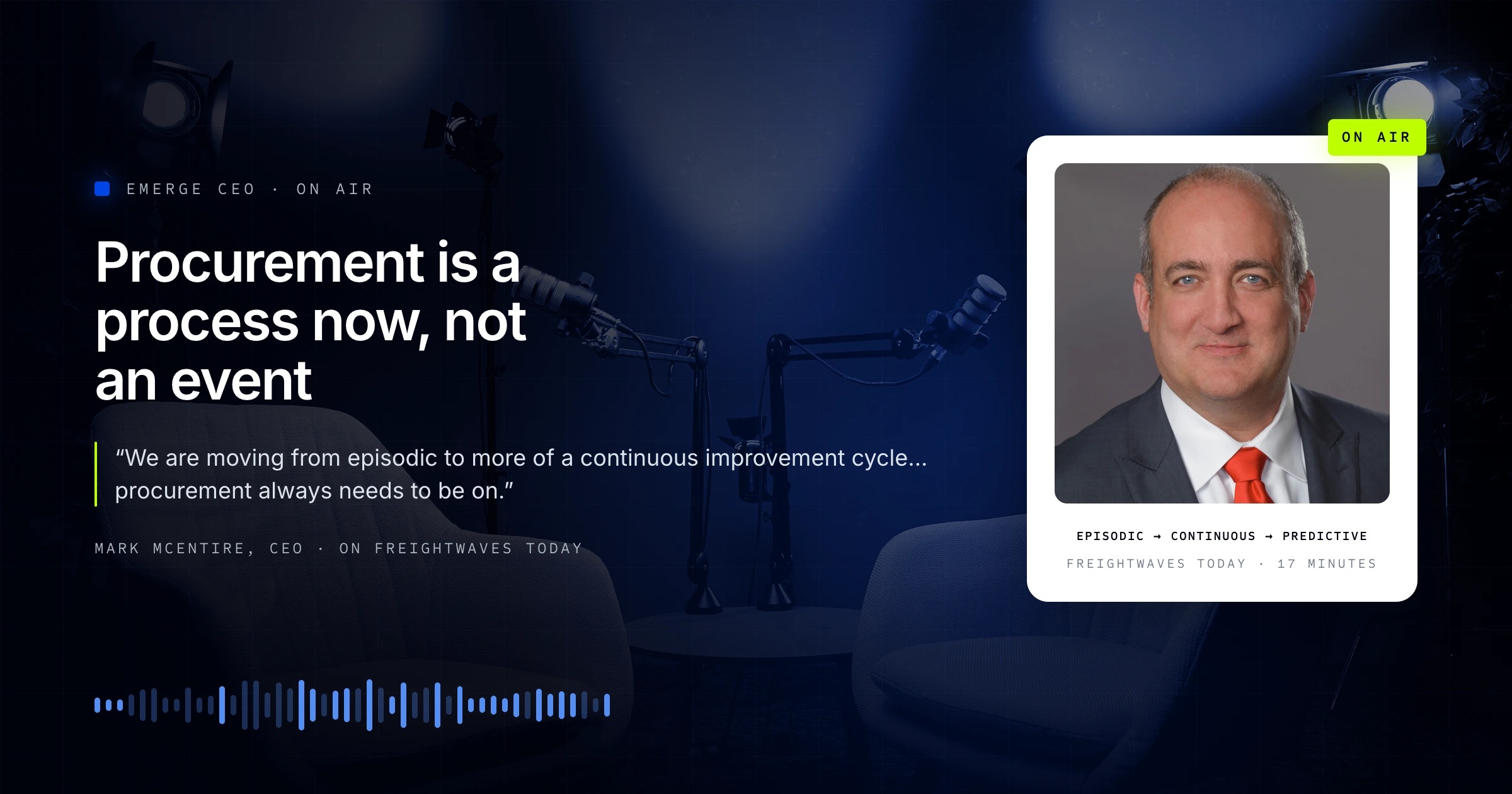
For decades, freight procurement had a comforting annual ritual. Gather the data. Invite carriers. Negotiate rates. Award lanes. Build a routing guide. Then return to the matter next year, by which point reality may have spent eleven months improvising. McEntire’s central argument at Emerge is that procurement has stopped being an event and become a process.
The annual bid still has a job. It establishes core relationships and a measure of stability. It simply cannot be the only job. Capacity disappears. Regional demand shifts. A carrier performs well on one lane and poorly on another. Fraud changes the risk calculation. A cheap rate, unsupported by a truck when needed, is accounting fiction with excellent posture.
McEntire wants awards to account for capacity, lane fit, service history and risk alongside price. He calls for mini-bids and more frequent adjustments when the market moves. That cadence used to be punishing because preparing the data could take two months. He says automation can compress the work into two or three weeks. Suddenly, “continuous” is not a demand for heroic overtime. It is an operating model.
His AI rule is bracingly free of incense. If the technology improves a decision, removes waste or eliminates work, it is valuable. If it does none of those things, he says, it is probably noise. The rule is less a philosophy of artificial intelligence than a purchase order: specify the result before falling in love with the machinery.
At Emerge, that means asking questions of procurement data in ordinary language, getting charts and reports back quickly, and detecting where a routing guide is beginning to fail. McEntire sees the progression moving from episodic to continuous and then predictive. Yet his attention keeps returning to people. The company uses a 16-member customer advisory board and a weekly executive call to distinguish an isolated feature request from a need shared across the market. “It all starts with that voice of the customer,” he says. A machine may find a pattern. Someone must still decide whether the pattern matters.
Ink, ego and the Power of Seven
There is a pleasantly analog streak in McEntire’s management. A University of Arkansas student who heard him speak noted that he writes three to five handwritten messages each week to recognize other people. He has returned to supply chain classrooms there for roughly 17 years, offering students what he calls a Power of Seven: face uncomfortable conversations, navigate uncharted water, use judgment without waiting forever for permission, keep ego from poisoning the organization, simplify, have fun and protect your values.
Long before he held a CEO title, he described curiosity and humility as practical career equipment. People can become so afraid of appearing uninformed that they stop asking for help; in his view, the paralysis can sink both a project and a career. When choosing people for development opportunities at Transplace, he looked for those who kept asking how and why, then paired that curiosity with a strong work ethic. It is an operator’s definition of potential: less performance of certainty, more appetite for finding out.
The principles are stern enough to need a joke. McEntire has one ready. A student profile recounts that he once calculated he had eaten 32,120 Pop-Tarts, based on two a day since age 14. The claim caught Jerry Seinfeld’s attention online and helped create a connection between Transplace and Kellogg. It is a ridiculous number, carefully calculated, attached to a business outcome. In other words, logistics.
His less sugary advice is to celebrate small victories and avoid running forever at breakneck speed. That may sound curious beside his belief that the pace of the leader sets the pace of the pack. The contradiction dissolves on inspection. Pace is not panic. A team can move quickly because its priorities are clear, its arguments are honest and somebody notices when the work goes well.
“True leaders don’t create more followers, they create more leaders.”Mark McEntire
The advantage of having been responsible
McEntire’s return arrives at a difficult moment for freight. Carrier networks are thinning in places. Rates can move faster than annual plans. A routing guide built from yesterday’s assumptions can fail with embarrassing speed. Emerge did not hire him to discover those pressures. It hired someone who has previously had to explain them.
His objectives for the next year sound simple: get closer to customers, grow by earning more of their work and raise the company’s pace. None is simple in practice. Closeness requires leaders to spend time outside their own reporting lines. Growth from existing customers requires trust rather than merely a contract. Pace requires choosing what not to do.
Still, the shape of his bet is clear. Freight procurement will become more frequent because the market demands it and less exhausting because software can absorb the drudgery. AI will be judged by work removed and decisions improved, not by the excitement of its label. Carrier relationships will remain stubbornly human. The executive responsible for knitting those ideas together will keep asking customers what they need, employees what they would change and himself whether he is listening closely enough.
There are grander ways to announce a chief executive’s philosophy. McEntire’s version fits into the cab of a truck: learn first, move with purpose, and never mistake a rate for a promise. He came back to a familiar company in an unfamiliar market. The coffee may be where he left it. Everything important is moving.