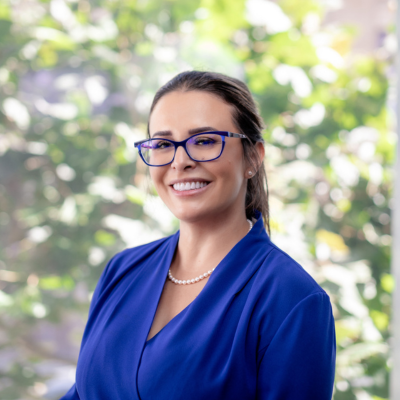
A doctor who decided papers weren't enough
In a Mountain View office a few blocks from the company that inspired her core idea, Maria Artunduaga runs Samay - a medtech startup whose entire premise is that a chest can be read like a tuning fork. Place a small sensor on it, send a sound in, listen for the resonance that comes back. That is the company. That is the bet.
Samay - the word is Quechua, the language of the Andes, and it means "to breathe deeply" - is building a wearable paired with an AI platform that turns a patient's breathing into a continuous stream of data, the kind that until now only existed inside a hospital. Artunduaga holds the patents. She also holds the unusual distinction of being the first woman to lead a US-LATAM company to win MedTech Innovator, the most competitive accelerator in medical technology, where her startup beat out more than 1,300 others.
The résumé reads like three people's. MD from Colombia. A postdoc in human genetics at Harvard. A plastic surgery residency at the University of Chicago. A master's in public health from the University of Washington and a second master's in translational medicine from UC Berkeley and UCSF. Publications in Nature, NEJM and PNAS. Then, somewhere in there, she taught herself hardware and became a chief executive.
Starting a business is risky. But I want more women to just do it.
Age 34, and a hard left
She was on a clean track. Reconstructive plastic surgery for children, one of the most competitive specialties in medicine, was within reach. Her mother is an ENT surgeon; she had grown up around the operating room and chosen it deliberately. And then, back home in Colombia, her grandmother Sylvia died.
The detail that matters is not the diagnosis. It is what Artunduaga noticed in the aftermath: that there was no good way for a person with a chronic lung condition to be watched at home, between appointments, before a small problem became an emergency. The family had been left to guess. She decided guessing was a solvable engineering problem, and that she was going to solve it.
So she left. Not quietly, not as a hedge - she abandoned the residency, enrolled in engineering school, and started over at an age when most people are consolidating, not detonating. She named her first prototype Sylvee, after the grandmother whose absence started it all.
The seed of the technology came from close to home in another sense. Her husband works at Google, and his engineering world nudged her toward acoustics - the idea that sound, sent into the body and caught on the way out, could carry information no ordinary monitor was capturing. She borrowed the instinct and built a company around it.
Sound in, signal out
Place it
A small, low-cost sensor sits against the chest - designed to be worn at home, not in a clinic.
Send the sound
Active acoustic sensors emit a signal and listen as it travels through the body, catching the resonances that come back.
Read the data
An AI platform turns those resonances into continuous, non-invasive readings - no forceful effort required from the patient.
Latin America first, and on purpose
Most US founders chase the US market first and treat everywhere else as expansion. Artunduaga inverted it. Samay's plan has been to launch in Latin America ahead of the United States - a decision that reflects both where the need is acute and where she, a Colombian-born founder, can move with conviction. It is the kind of contrarian routing that wins accelerators and confuses spreadsheets.
The capital has come in pieces, much of it the hard, dilution-free kind: grants from the NSF and the NIH, plus private investment, adding up to roughly $4.2 million raised to build the wearable and the platform behind it. Non-dilutive money is a founder's quiet flex - it means the science convinced the scientists, not just the venture funds.
The recognition has arrived in a rush. Bloomberg named her to its 100 Innovators in Latin America in 2024. The same year she took the Global MedTech Innovator Award. In 2025 came the Inc. Female Founders list, a nod from the American Thoracic Society as an innovation success story, and the title of Colombia's best startup. Her work has been covered by Forbes, TechCrunch and Bloomberg, among a hundred-plus outlets.
I abandoned my medical career to devote myself to building Sylvee - named after my grandmother - so that no one else would suffer as she did.
Flamenco, and a refusal to be one thing
Spend any time with her story and a pattern emerges: she does not believe in staying in a single lane. The same person who has published peer-reviewed genetics and filed six patents is also a flamenco dancer and a singer. She travels relentlessly. She is loud, on the record, about getting more women and more Latinos into rooms where companies get built.
She is also unusually candid about the cost of what she did. The leap at 34 was not a tidy origin myth - it was a gamble that could have failed publicly, in a field where she had to prove herself twice: once as a doctor doing engineering, once as a Latina founder in Silicon Valley. She talks about that openly, which is partly why younger founders keep showing up in her inbox.
What she wants is not complicated, and she states it plainly: make monitoring affordable, continuous and non-invasive for people who need it, wherever they are. Start with the patients other companies skip. And, while she's at it, make the leap she took look a little less terrifying for the women watching.
Five things that explain her
The company name is Quechua for "to breathe deeply." The first device was named Sylvee, after her grandmother.
Her mother is an ENT surgeon. Medicine was the family business before she rewrote her own job description.
The acoustic idea was nudged into being by her husband's engineering work at Google.
Flamenco dancer and singer. The CEO has a second act that has nothing to do with hardware.
MD, MPH, MTM - three advanced degrees across two countries and four universities.
She did the research first
Before any of this was a company, it was a track record. Artunduaga came up through the parts of science that don't make headlines: a postdoctoral stretch in human genetics at Harvard Medical School, peer-reviewed work in Nature, the New England Journal of Medicine, PNAS and Genetics in Medicine. That pedigree is the quiet engine under the startup. When a former plastic surgeon tells investors a sound wave can carry clinical information, the publication list is what makes them lean in instead of laugh.
The technical bet she made is genuinely unusual. Most monitoring asks the patient to perform - to blow hard into a tube, to follow instructions, to try. Her approach removes the trying. Active acoustic sensors do the work: a speaker sends a signal into the chest, a microphone listens for what comes back, and software reads the resonance. No forceful effort, no clinic visit, no specialist hovering. Early development was supported by the National Heart, Lung, and Blood Institute through the NIH's SBIR program, the kind of validation that doesn't come from a pitch deck.
Translating that into a product meant becoming fluent in worlds that rarely share a vocabulary: clinical medicine, signal processing, hardware manufacturing, regulatory strategy, and the brutal arithmetic of a startup's runway. Her master's in translational medicine from UC Berkeley and UCSF was, in effect, a degree in carrying ideas across exactly those gaps. She had trained for the handoff before she knew she'd need it.
Pulling the ladder back down
For someone who switched careers alone, Artunduaga is conspicuously unwilling to let others do it alone. She has been open about the role mentorship played in her own pivot from medicine to medtech, and she has turned that into a habit of advising and advocating - for women, for Latino founders, for the people who don't see themselves in the standard Silicon Valley origin story. Her affiliations, from Rock Health to fellowship programs, double as platforms for that work.
The message she repeats to younger founders is not a motivational poster. It is closer to a dare: the risk is real, the odds are uncomfortable, and you should do it anyway. She can say that with a straight face because she lived the downside scenario as a live possibility and came out the other side with patents, prizes and a company. The credibility is earned, not borrowed.
It also explains the geography of her ambition. Launching in Latin America first is not only a market call - it is a statement about who gets served first when a Colombian-born founder gets to decide. The same instinct that named a device after a grandmother shapes the business plan. Sentiment and strategy, in her case, keep turning out to be the same thing.
On purpose
Ask her why she does any of it and the answer is disarmingly simple. "I'm fulfilling my long-term goal of helping people through my work," she has said. It is the kind of line that sounds like a platitude until you remember she gave up a surgical career to be able to say it - and then learned to read a circuit diagram to back it up.
The through-line from genetics lab to operating room to startup floor is not credential-collecting. It is a single conviction, repeated in different equipment: that the gap between what medicine knows and what a patient at home can actually use is too wide, and that someone stubborn enough could close it. She decided to be that someone, twice.