There is an American pasta dish called penne alla vodka, another called fettuccine Alfredo, and, somewhere beyond the border of appetite and audacity, a pizza-lasagna hybrid known as “pizzagna.” Marco Lastrico once summoned this cheerful cabinet of curiosities to make a serious point. America loves Italy. America also has its own idea of Italy, assembled from memory, immigration, movies, menus and marketing. The two countries may admire each other while speaking past each other over lunch.
Lastrico’s job sits precisely in that gap. As Partner and CEO of Barabino & Partners USA, he helps Italian companies explain themselves to American audiences. The title sounds orderly. The work is closer to cultural mechanics: take apart an assumption, inspect the moving pieces, preserve the character and rebuild the message so it works in another market.
His public advice has remained consistent across years of interviews and posts. An Italian campaign does not become American when its nouns are translated into English. A product’s origin can attract attention, but affection for Italy cannot carry an entire commercial strategy. Price, distribution, trust, reputation and local context are waiting at the table too. Heritage gets a chair. It does not get to eat everyone else’s dinner.
“Every day you have to learn to look and not only to see what is happening around you.”Marco Lastrico, on working in communications in New York
The useful discipline of looking
Lastrico arrived at this argument through a decidedly unromantic part of communications: investor relations. He studied communication, media and advertising at IULM in Milan from 2001 to 2005, then completed a master’s degree in investor relations and financial analysis. He later attended a Harvard Business School executive education program in strategic marketing. The sequence matters. First came the language of media. Then came the discipline of markets. Strategy followed.
He joined Barabino & Partners in 2007, working in investor and media relations. Old financial documents leave small, revealing traces of that period: his name appears as the communications contact alongside earnings releases, shareholder material and corporate transactions. The apprenticeship was built around consequential language. A loose adjective in a lifestyle campaign may be embarrassing. A loose adjective around a listed company can be expensive.
That foundation explains the particular shape of his later career. In New York he could move from corporate finance to food, hospitality, fashion, design and technology without treating communication as ornament. The industries changed. The core question did not: what must an audience understand before it can trust the story it is being told?
The answer often begins before the public campaign does. A company entering the United States has to decide which reputation it is carrying, which audience it wants and how its business model supports the promise in its message. Lastrico has argued that communication deserves investment comparable in seriousness to research and development, especially in fast-moving consumer sectors. It is an executive’s argument rather than a publicist’s flourish. Communication cannot rescue a price, product or distribution plan that makes no sense. It can, however, make the whole proposition legible, connect it to local expectations and prevent a familiar Italian success story from arriving as an American riddle.
In a 2017 interview, Lastrico called curiosity essential to the profession. New York, with its multitude of communities and relentless production of new styles, gave that curiosity a demanding laboratory. He described the city as a place that forces a communicator to look rather than merely see. Seeing catches the spectacle. Looking notices who is in the room, what they already believe, what they misunderstand and which familiar word means something slightly different on this side of the Atlantic.
The message’s trip across the Atlantic
From an office to a bridge
Barabino & Partners opened its American operation in 2011. By the time Lastrico became its chief executive in 2015, the office had a clear proposition: support Italian companies entering the United States through public relations, corporate communication, social media, influencer work and storytelling. He was also the group’s youngest partner, according to the Italy-America Chamber of Commerce.
The word “bridge” is overworked in international business, where every breakfast panel threatens to build one before the coffee cools. Here, it earns its keep. Lastrico’s network extends beyond clients to the institutions that shape Italian-American commercial life. He joined the board of the Italy-America Chamber of Commerce in New York in 2018 and won re-election in 2021. The chamber’s account of his career paired financial communication expertise with the practical business of positioning Italian brands in food and hospitality.
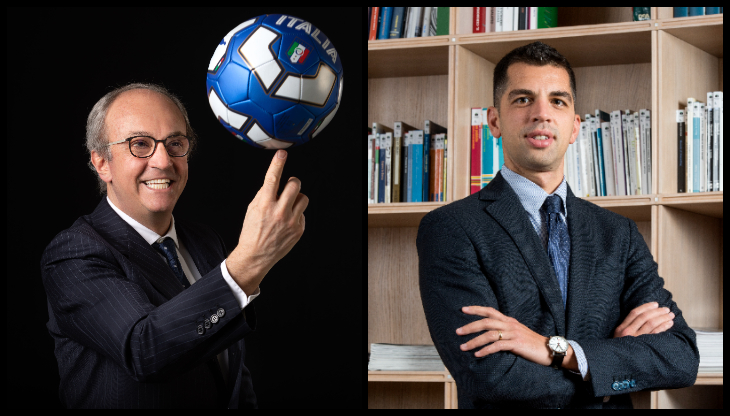
The first decade produced numbers that give the bridge some dimensions. The U.S. team had supported more than 150 Made in Italy brands by 2021. Revenue roughly doubled during the four years leading into that anniversary, and the firm expected its strongest year to date. It celebrated by moving to the 30th floor of 1 Rockefeller Plaza. The location came ready-made with symbolism: international business below, an ice rink and Christmas tree outside, an entire catalogue of New York associations available before anyone wrote a line of copy.
These are company achievements, not a solo act, and Lastrico’s own public writing is generous about teams. That instinct appeared again in 2024 when Barabino & Partners USA became an official communications partner of the National Italian American Foundation. The assignment widened the aperture from companies and products to a cultural and institutional community. It also connected Lastrico with NIAF president Robert Allegrini and a network spanning business, philanthropy and public life.
The room where Italy becomes plural
At NIAF’s 50th Anniversary Gala in Washington in 2025, Lastrico described a room of nearly 2,500 guests, with almost 100 members of the media and roughly 1,500 resulting articles. Among the organizations he credited were Ferrari, Enel, Leonardo, Stellantis, Exor, CNH, Ferrovie dello Stato, Sequoia Capital and Gonzaga University. The list reads less like a sector and more like a small economy.
This is where his earlier training returns. Coordinating stories across institutions, companies, journalists and public officials requires the same respect for stakes that investor relations demands. Each party brings its own vocabulary. Each wants recognition. None can be allowed to swallow the shared purpose. The communications executive becomes part editor, part diplomat and part air-traffic controller, with fewer windows and better tailoring.
A message can cross an ocean in a second. Meaning travels at the speed of trust.
The work also continues at product level. Barabino & Partners USA’s assignment for Grana Padano in the American market was renewed for 2025, combining communications with institutional relations at a moment when tariffs and trade policy complicated the setting for Italian food. Here the romance of provenance meets regulations, politics and shelf space. A cheese may carry centuries of history; the campaign still has to answer this week’s question.
Lastrico’s more recent writing sharpens the distinction. In 2026 he published articles arguing that public relations and corporate communication are not interchangeable, and that in the United States corporate communication is fundamentally about positioning. The point is characteristic. Activity is easy to display: a press release, an event, a social post. Positioning asks the less comfortable question of what all that activity adds up to in someone else’s mind.
The ambition inside the translation
Lastrico’s stated horizon remains the relationship between Italy and the United States. In early 2026, he welcomed Lombardy’s selection as NIAF’s Region of Honor, linking the program to the global attention around the Milano Cortina Winter Olympics and to opportunities for Lombard companies in America. It is an aspiration with commercial edges and civic ones: help Italian organizations compete, help American audiences understand them, and strengthen the institutions that keep the conversation going after a campaign ends.
His volunteer listing with New York Road Runners adds a smaller New York detail to the institutional résumé. It began in 2015, the same year his current leadership role began. There is no need to turn that coincidence into a grand metaphor. Still, both activities reward stamina, route knowledge and a reasonable respect for the people sharing the road.
There is an appealing modesty in the method, even when the settings include Rockefeller Plaza and a gala of 2,500 people. Begin by admitting that the audience does not live inside your story. Study what it sees. Respect what it knows. Correct what matters. Preserve what makes the subject distinctive. Then earn the right to be understood.
That is why the pizzagna anecdote sticks. It is funny, certainly. It is also a tiny case study in reputation. A country projects an identity. Another country receives it, cherishes it, changes it and serves it back with extra cheese. The communicator can sneer, surrender or get curious. Marco Lastrico chose curiosity, and made a transatlantic career from what it notices.