The awkward part of ordering flowers is that the buyer has to describe something they cannot yet see. Pink, perhaps. Some roses. Nothing too formal. Somewhere in that conversation, a florist must turn adjectives into stems, packaging and a price. Every clarification costs time. Every unanswered message gives the customer another opportunity to disappear.
For Singapore boutique Noelle Fleur, that was a software problem hiding inside a flower problem. In a case study published by Manus, the business describes using the agent to build a guided bouquet designer. Customers choose, preview and move toward payment. The florist still makes the flowers.
- Manus turns a brief into work across browsers, code and business tools.
- Its useful ingredient is execution: connecting the steps after an answer.
- Your prices, constraints and judgment still belong in the loop.
01 The bouquet is the brief
The builder asks shoppers to make nine choices or actions, from selecting flowers to generating a preview and checking out. It connects an uncertain purchase to something the customer can inspect. That is an appealing place to begin with AI: one recurring conversation, with a recognizable destination.
The interesting detail is what had to go into the instructions. Real item prices. Seasonal availability. Packaging. A sunflower’s color. The system also needed to distinguish items sold by the stem from those sold in bundles. These are small facts to a florist. To a software builder, they are the specification.

Read the example as a way to locate a bottleneck, rather than a promise about sales. A guided tool can collect decisions before a person joins the conversation. The useful question for another business is precise: which questions do you answer repeatedly, and could customers answer some of them themselves?
02 The computer behind the conversation
Manus launched its agent in March 2025. Its parent, Butterfly Effect, began in 2022 and had already produced the Monica browser assistant. The founding team includes CEO Xiao Hong, chief scientist Ji Yichao and chief product officer Zhang Tao. The company later moved its headquarters to Singapore.
The product’s position is easier to understand by following a task. A user supplies a goal. Manus plans work, browses, runs code and creates files. Its cloud computing environment gives the agent somewhere to execute those actions. Wide Research divides larger investigations among parallel agent instances.
- 01 / BriefGoal + real inputs
- 02 / ExecuteBrowser + code + tools
- 03 / ReviewCheck + revise + use
This puts Manus among general agents, with overlapping territory in ChatGPT agent and Claude-based computer-use systems. App-building work also overlaps with Lovable and Replit. The distinction to examine is the span of a workflow: how much research, construction and follow-through can happen in one place? A familiar chat interface tells you surprisingly little about that.
03 The second draft matters
The September 2026 release of Manus 2.0 introduced Studio, a desktop workspace for creation and revision, alongside event-triggered Automations and the personal-agent app Cue. Studio includes work on documents, websites, games and video. A video timeline lets users change individual pieces after generation.
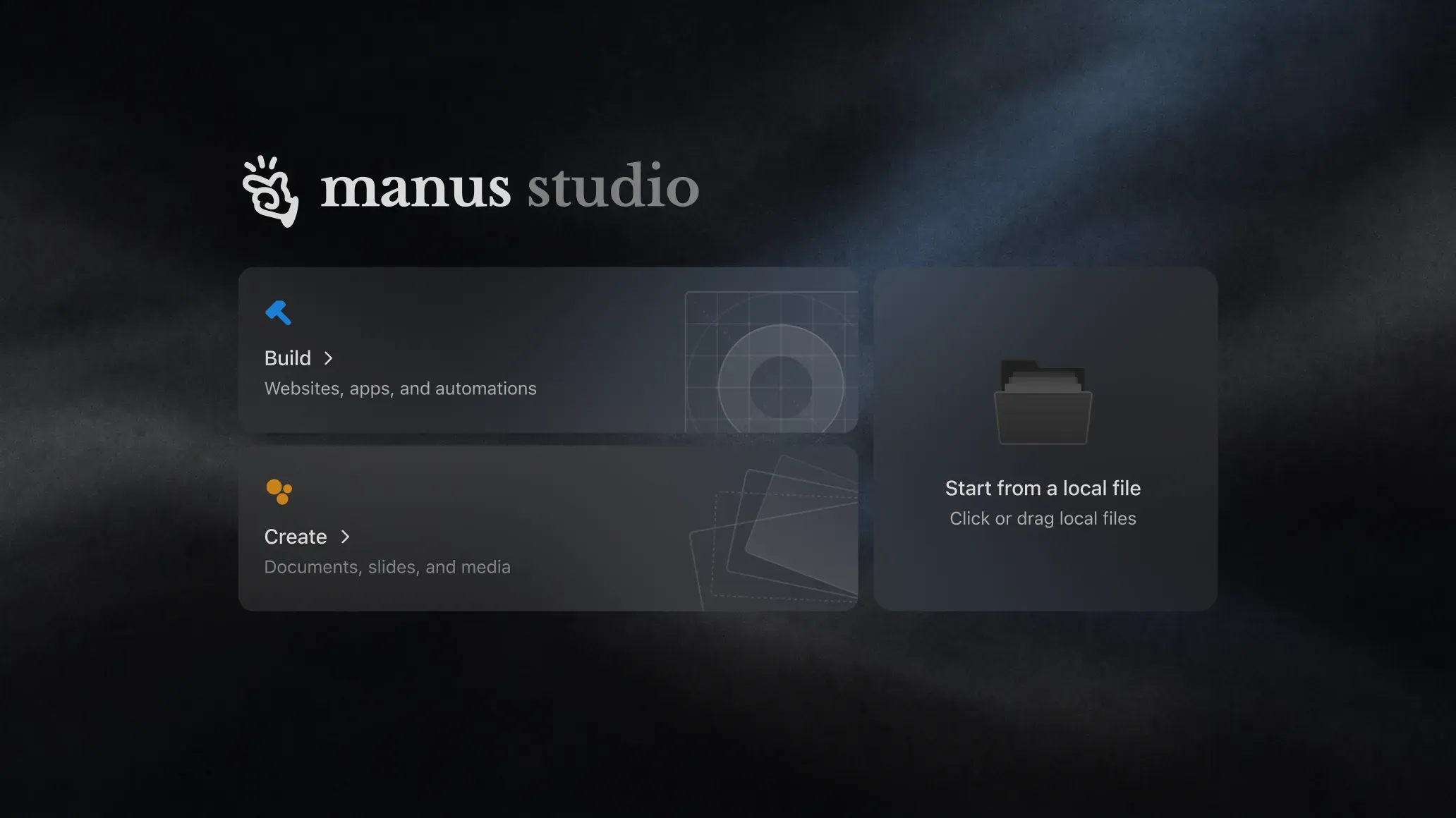
That second draft matters. A tool that delivers something almost right can create a peculiar new job: explaining the same correction repeatedly. Editable output gives the user another route. Keep the useful work, change the troublesome part, and continue.
Access is another practical constraint. Browser Operator works in an authorized local browser session, useful for services where the user is already logged in. Manus acknowledges that complex forms and drag-and-drop interactions can remain imperfect. Delegation works within the access and interfaces the task actually requires.
04 A meter is running
Manus sells subscriptions and uses credits to measure resources consumed by tasks. Length and complexity affect usage. An agent doing several steps incurs several kinds of work, which makes the final bill part of the product experience.
A persistent Cloud Computer has separate published monthly tiers of $10, $30 and $50. Manus Flex allows supported model-provider API keys: inference goes on the provider’s bill, while other services still consume Manus credits. OpenRouter, Fireworks and Modal are initial inference partners.
The engineering lesson is equally practical. Ji has described choosing context engineering over training an agent model, after earlier proprietary models were overtaken by newer systems. His team rebuilt its framework four times. Faster experimentation mattered. Keeping failed actions in the agent’s history gave it evidence for trying a different route.
“AI shouldn’t just think, it should also do.”
Red Xiao, Manus’s first annual letter
05 The company had to start again
In December 2025, Manus reported $100 million in subscription ARR and more than $125 million in total annualized revenue run rate. Those figures describe recurring business and revenue pace. They do not establish how much cash the company earned across a completed year.
December 2025
Meta announced an acquisition that December, reported at more than $2 billion. Chinese authorities ordered it unwound in April 2026. Manus resumed independent operations on September 1, acknowledging that some users had faced temporary access interruptions and backup-and-restoration work. Corporate upheaval had become a customer chore.
On October 8, Reuters reported a completed funding round exceeding $500 million, led by Boyu Capital and IDG Capital. That financing is distinct from the acquisition price. An agent can plan a workflow; the company providing it still operates inside a world of investors, infrastructure and governments.
06 Give it the rules of your world
The florist’s example offers a sensible starting point: choose a bounded job, supply real business data, and inspect the path to completion. A beautiful preview cannot resolve an unavailable flower. A working checkout cannot rescue the wrong price. Manus can help construct the machinery. Someone still has to decide what the machinery should promise.
That is the appeal of this company. It puts software creation within reach of people who already understand a problem. The opportunity begins with that understanding. In this case, it began with a bouquet.