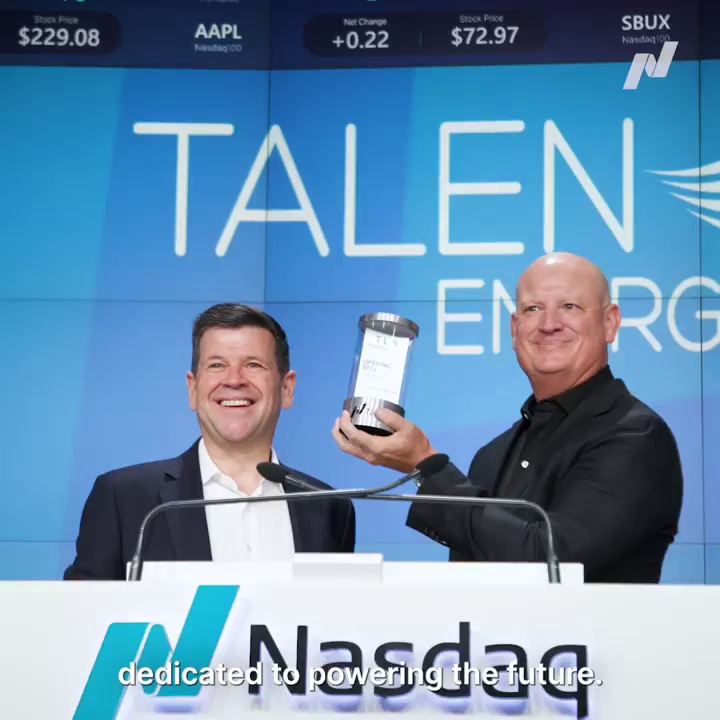
On July 10, 2024, Mac McFarland rang the opening bell at Nasdaq. Talen Energy was beginning its first day of trading on the exchange, and its chief executive had arrived with a company whose recent history included Chapter 11. The bell provided a tidy public moment for a business that had required considerably less tidy work. A little over a year earlier, Talen had emerged from restructuring. Now its name was on the screen in Times Square.
The more revealing address was in Pennsylvania. Beside the Susquehanna nuclear power plant stood a data center campus that Amazon Web Services had bought that March. The gross sale price was $650 million. Alongside the property transaction came a longer relationship: supplying the electricity that would make the computers useful. For McFarland, the campus connected two parts of his working life, the physical business of generation and the commercial business of finding a customer willing to commit.
There is something pleasingly literal about this corner of the artificial intelligence economy. Talk of the cloud eventually arrives at a piece of land, a transmission connection and a bill. McFarland’s part in that story is best understood through those unglamorous particulars. His career has passed through engineering, corporate development and companies rebuilding their finances. At Talen, those experiences met an industry with an increasingly urgent appetite for power.
Before the cloud, the calculations
Mark A. McFarland, known professionally as Mac, studied civil engineering at Virginia Tech, with an environmental concentration. He later earned an MBA at the University of Delaware and received his professional engineer license in 1995. The combination gives his résumé two useful vocabularies: how infrastructure works, and how a business pays for it. Neither qualification, by itself, accounts for a career. Together they offer a useful starting point for reading this one.
From 1999 to 2008, he worked at Exelon in roles that included senior vice president of corporate development. At Energy Future Holdings, he became executive vice president for corporate development and strategy while also serving as Luminant’s chief commercial officer from 2008 to 2013. He then led Luminant as CEO from 2013 to 2016. Commercial responsibilities and corporate strategy were already sharing space on his desk before data centers became the subject of his Talen announcements.
GenOn followed. McFarland served as president and CEO from April 2017 to December 2018 and also held the executive chairman role. He remained on its board until September 2022. These appointments put him repeatedly inside the independent power business, where operating a generating station and deciding what to do with its output are connected responsibilities. The machinery has to perform. The contracts have to make sense. A spreadsheet can be revised rather more easily than a plant.
A second life for an energy business
California Resources Corporation supplied another kind of assignment. McFarland joined its board when it emerged from bankruptcy in October 2020. He subsequently served as executive chairman, then chairman and interim CEO. On March 22, 2021, the company made him permanent president and chief executive. The progression matters: he arrived through the boardroom during a financial reset and then took responsibility for running the business that came out of it.
CRC’s agenda included reducing costs, reviewing its operating portfolio and improving cash generation. It also had a carbon management business, Carbon TerraVault. When CRC announced in February 2023 that finance chief Francisco Leon would succeed McFarland, it said McFarland would continue as a non-executive director and chair Carbon TerraVault’s board. Oil production and carbon storage appeared within the same corporate assignment. His route through the energy transition had room for existing assets as well as new uses.
Talen announced his impending arrival in April 2023. He took over in May as the company completed its restructuring, succeeding Alex Hernandez. The distinction in timing is worth keeping: McFarland became CEO at emergence. He inherited both a reset balance sheet and the task of deciding what to build on it. A company can finish a restructuring on a particular day. Establishing what comes next is a longer occupation.
The customer next door
In June 2023, McFarland described his priorities with the phrase “safety, operational excellence and maximizing shareholder value.” He paired those aims with managing credit, liquidity and risk. It was a fairly compact job description for an electricity executive. It also helps explain why the subsequent Amazon relationship was about more than the novelty of nuclear-powered computing. A large customer could change the commercial shape of power already being generated.
The March 2024 campus sale separated ownership of the data center assets from the continuing business of supplying electricity. Talen reported gross proceeds of $650 million, including $300 million initially held in escrow against development milestones. The distinction between a headline price and money immediately available is characteristic of the work involved. Even a transaction that fits comfortably in a news alert comes with conditions, repayments and an implementation schedule.
That July’s Nasdaq ceremony gave the transformation a photograph. McFarland rang the bell as Talen began trading under TLN. A listing and a campus sale are different milestones, but they describe the two audiences he now had to address: investors assessing the company and customers planning facilities that would need dependable electricity. The ceremony lasted a morning. The power relationship would be measured in years.
The grid gets a vote
The next turn was less photogenic. On November 1, 2024, the Federal Energy Regulatory Commission rejected proposed amendments to an interconnection agreement involving PJM, Susquehanna Nuclear and PPL Electric Utilities. The proposal sought to increase the co-located load from 300 to 480 megawatts. The technical description sounds narrow. For the developing relationship between power producers and data centers, it reached into a much larger question: how should a very large customer connect?
Commissioner Mark Christie’s concurrence emphasized that the filing had failed to meet its burden of proof on the record and had been rejected without prejudice. He also raised the broader implications of co-location for grid reliability and consumer costs. A nearby customer does not make those questions disappear. The arrangement still exists inside a system serving other customers, with rules governing how the system is used and paid for.
For a profile of McFarland, this interruption is essential. It keeps the Amazon transaction from becoming an effortless tale of an executive spotting demand and signing a contract. The commercial idea had to survive an institutional setting as well as a negotiation. Distance on a map was only one consideration. The route electricity would take, and the obligations attached to that route, needed an answer.
A longer contract, a different route
In June 2025, Talen and Amazon announced an expanded agreement. At full contract quantity, it covered 1,920 megawatts of nuclear power through 2042, with extension options. Deliveries would ramp over time, with full volume expected no later than 2032 and the possibility of accelerating. Those qualifications belong beside the number. A contracted destination and electricity delivered today are different measurements, even when both appear under the same announcement.
The revised structure also described a transition to a front-of-the-meter arrangement following transmission reconfiguration. Susquehanna would supply power to the PJM grid, Talen would act as Amazon’s retail electric generation supplier, and PPL would handle transmission and delivery. The parties were changing the commercial route through the electricity system. They were also preserving a relationship between an existing nuclear station and a customer building for future computing demand.
McFarland described the agreement as providing a “long-term, steady source of revenue.” That phrase is more revealing than a prediction about the future of AI. It expresses the supplier’s interest in a customer relationship that can support financial planning. The announcement also included exploring small modular reactors and pursuing higher output at Susquehanna. Those were development ambitions, distinct from the existing plant and the power purchase agreement already signed.
Delivery ramps over time. Full volume was expected by 2032 at the latest, with potential to accelerate. These bars compare agreement quantities, not present-day deliveries.
Nuclear at the center, gas in the portfolio
McFarland’s response to demand extended beyond Susquehanna. In November 2025, Talen completed its purchases of Freedom Generating Station in Pennsylvania and Guernsey Power Station in Ohio. Together, the natural gas plants added nearly 2.9 gigawatts of capacity. The purchases showed the breadth of the company’s approach: the Amazon relationship drew attention to nuclear power, while its expanding portfolio also relied on gas generation.
The expansion continued in June 2026 with the completed Cornerstone acquisition, bringing Lawrenceburg in Indiana and Waterford and Darby in Ohio into Talen. These were physical additions to the business, with their own operating and financing responsibilities. For McFarland, assembling a larger fleet meant carrying the same commercial questions across more assets: which customers to serve, which commitments to make and how much financial flexibility to preserve.
The portfolio makes his story more interesting than a simple conversion narrative. He had worked across electricity, oil and carbon management before taking Talen’s top job. Here, too, different technologies occupied the same business plan. A nuclear contract could extend into the 2040s while gas plants answered nearer-term demand. Each asset came with its own economics and constraints. A coherent strategy still had to accommodate those differences.
“long-term, steady source of revenue”
MAC McFARLAND · ON THE AMAZON AGREEMENT, JUNE 2025
Leaving a timetable behind
The division of work began changing in December 2025. Terry Nutt became president, taking responsibility for daily operations, and Cole Muller became chief financial officer. McFarland continued as CEO, focused on overall strategic direction. In September 2026, Talen set out the next step: Nutt would become CEO on January 1, 2027. McFarland would stay in office and on the board through December 31, then serve as a senior advisor until retirement in March 2027.
He described the company’s accomplishments as a “true team effort” and committed to helping with the transition. That ending suits a career spent moving between operations, commercial decisions and board responsibilities. The handoff has a date. Much of the business he is handing over has a longer calendar: customer demand ramping over years, recently acquired plants to run and an Amazon power agreement reaching through 2042.
The Nasdaq bell offers a crisp image of his tenure. The contract schedule offers a more useful measure. McFarland’s work at Talen has involved finding a new role for existing infrastructure, adjusting when the connection proved complicated and adding assets as demand grew. Behind the cloud sits a generating business, with people, equipment and obligations. His successor inherits the work of making those promises hold, long after the applause in Times Square has faded.
McFarland’s final scheduled day as CEO and director.
Terry Nutt is scheduled to take over as CEO.
McFarland’s planned retirement after an advisory transition.