The useful thing about a concert ticket is that it gets you into a concert. The peculiar thing is everything that happens when it cannot. A wedding appears on the calendar. A flight gets canceled. A child gets sick. The ticket, which behaved like a product at checkout, suddenly behaves like a tiny illiquid asset. You cannot return it to the store. You can only find a stranger, assess that stranger's honesty, transfer a barcode and hope the door scanner agrees.
Lyte was built around this absurdity. Founder Antony “Ant” Taylor traced the idea to the 2012 London Olympics, where he saw events described as sold out and venues that were visibly not full. Somewhere between the sale and the seat, intention had gone missing. Lyte's answer was not another Craigslist for tickets. It was an exchange attached to the official box office.
The three-click escape hatch
In its cleanest form, Lyte did one job beautifully. A fan who could no longer attend returned a ticket through the event's official exchange. Another fan joined a queue or placed a request. Because Lyte integrated with primary ticketing companies, the old credential could be canceled and a fresh barcode or wristband issued. The seller did not have to become a broker. The buyer did not have to become a detective.
The official-exchange loop
That distinction mattered. StubHub and other secondary markets had trained people to think of resale as a parallel bazaar. Lyte made it a feature of the event itself. Organizers gained pricing control, customer data and a chance to fill seats. Fans gained a legitimate exit. Primary ticketing partners could add the function without rebuilding it.
Distribution came through those integrations. In 2017, Taylor said Lyte moved from five partners to roughly 300 in a single year after expanding from Ticketfly to seven primary-ticketing platforms. By 2019, it named more than a dozen integrations, including Eventbrite, Front Gate and Elevate. The customer list ran from Coachella and BottleRock to Newport Folk Festival, Mumford & Sons and comic conventions. This was enterprise software disguised as a merciful button.
A small promise becomes a large platform
Returnability invited a broader question: if demand could be measured after the sale, why not before it? Lyte began taking card-backed requests for tours whose dates and rooms were not yet final. For an artist, those reservations could reveal whether a city wanted one night or two, a theater or an arena. For a fan, the request felt less punishing than refreshing a page while bots emptied the inventory.
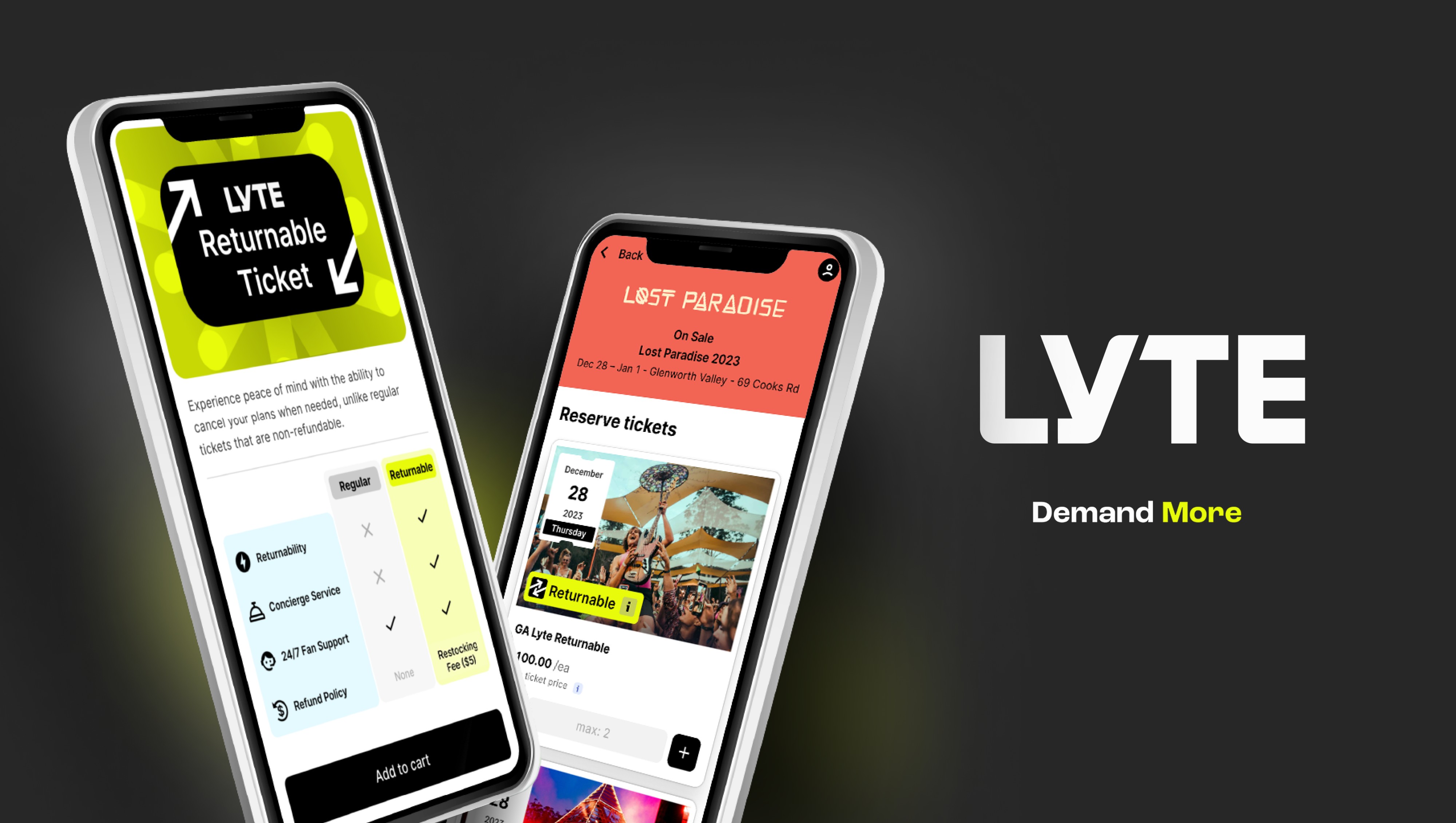
By November 2023, the company had named the larger ambition “One Marketplace.” Presales, onsales and exchanges would sit in one system. SmartPricing would react to demand. SmartFulfillment would route inventory to fans rather than bots. Event Forecasting would turn card-backed requests into a planning signal. A premium Returnable Ticket, advertised with a modest restocking fee, made flexibility something fans could explicitly buy.
The business model widened with the product. Lyte earned transaction fees and participated in marketplace economics, while promoters and venues paid for control over inventory and demand. Later court disputes showed that some event-supplied inventory also flowed through Lyte, with economic upside shared between the parties. That is a very different risk profile from licensing software. The platform was not merely observing money. It was moving, holding and settling it.
Capital for the expansion
The bargain with a long shadow
The most consequential expansion arrived in 2022. Festicket, a British festival travel and commerce business, had entered administration with more than £22 million in unsecured claims. Lyte bought the operating assets of Festicket and Event Genius for £100,000 after reportedly beginning with a £1 offer. The transaction brought 75 employees and an instant footprint across the UK, Europe, Australia and Latin America.
On paper, £100,000 for a global team and platform looked almost comic. But acquisition cost is only the number written on the door. Integration, payroll, infrastructure and customer expectations walk through afterward. Lyte could now sell tickets, VIP packages, merchandise and hotels. It also had to make a much larger machine cohere while the event industry was still absorbing pandemic aftershocks.

The strategic turn was explicit. In June 2024, Taylor wrote that exclusivity in primary ticketing enabled the behaviors Lyte opposed in the secondary market. The answer was no longer to plug a fair exchange into somebody else's box office. It was to become the box office. That logic is intellectually neat. Operationally, it replaces one focused promise with a stack of them.
What failed first was confidence
In September 2024, the website switched to a maintenance message. Taylor resigned. Court filings later said Lyte had ceased virtually all business operations and laid off virtually all employees. Lost Lands and North Coast Music Festival sued over more than $680,000 in combined alleged unpaid proceeds. Lyte's finance chief reportedly told a festival representative she could not commit to when payment would come, or whether it would come at all.
For a normal software company, an outage is a service failure. For a ticketing marketplace, an outage can freeze somebody's rent money, an artist payment, a vendor deposit or a fan's refund. Lost Lands ultimately said it would make affected fans whole. In January 2025, Lyte's UK subsidiary entered creditors' voluntary liquidation.
It is tempting to say the Festicket deal caused the collapse. Former employees reportedly regarded it as a turning point, and the chronology makes the suspicion understandable. The public record does not prove a single cause. It does show a company moving from a narrow exchange tool into primary ticketing, cross-border commerce and more complex settlement flows. At the exact moment Lyte needed its operational foundation to be most legible, customers could not tell where the money was.
The part worth copying
Lyte's original insight survives the company. A buyer hesitates when every ticket is final, and a venue loses when a paid seat stays empty. Make the ticket returnable, keep the exchange official and use requests as honest demand data. That loop improves the experience for both sides. It works especially well when the primary issuer can void the old credential and create a new one.
A five-point operator's memo
- Integrate at the source of truth. Reissue credentials instead of passing screenshots between strangers.
- Measure intent with card-backed requests, not likes, mailing-list signups or optimistic surveys.
- Sell flexibility as a named product. Customers understand a returnable ticket faster than a page of insurance exclusions.
- Keep customer and promoter funds segregated, reconciled and visible. Settlement design belongs in the product spec.
- Expand the promise only when operations can expand with it. More checkout options create more liabilities, not just more revenue.
The model is less useful when tickets cannot be digitally revoked, demand is too thin to produce a reliable match, local rules restrict dynamic pricing, or an organizer wants maximum scarcity rather than maximum attendance. It also fails when settlement depends on new transaction volume or when fans cannot see the payout timetable. A marketplace can tolerate clumsy typography. It cannot tolerate uncertainty about who owns the cash.
Eleven years in eight stops
London Olympic venues give Taylor the empty-seat problem.
An official exchange begins as the alternative to an uncontrolled resale market.
Five event partners become roughly 300 in a year.
Investors back “post-primary” ticketing as a category.
Reservations and flexibility become useful during pandemic uncertainty.
A £100,000 deal turns Lyte into an international commerce platform.
One Marketplace combines presales, sales, returns, pricing and forecasting.
Operations cease, staff depart and festival lawsuits follow.
Lyte wanted a ticket to behave like an ordinary purchase. Its own story demonstrates why tickets never quite do. They are promises attached to future dates, bundled with money that belongs to several people at once. The clever part is making all of that feel simple. The durable part is keeping it true.