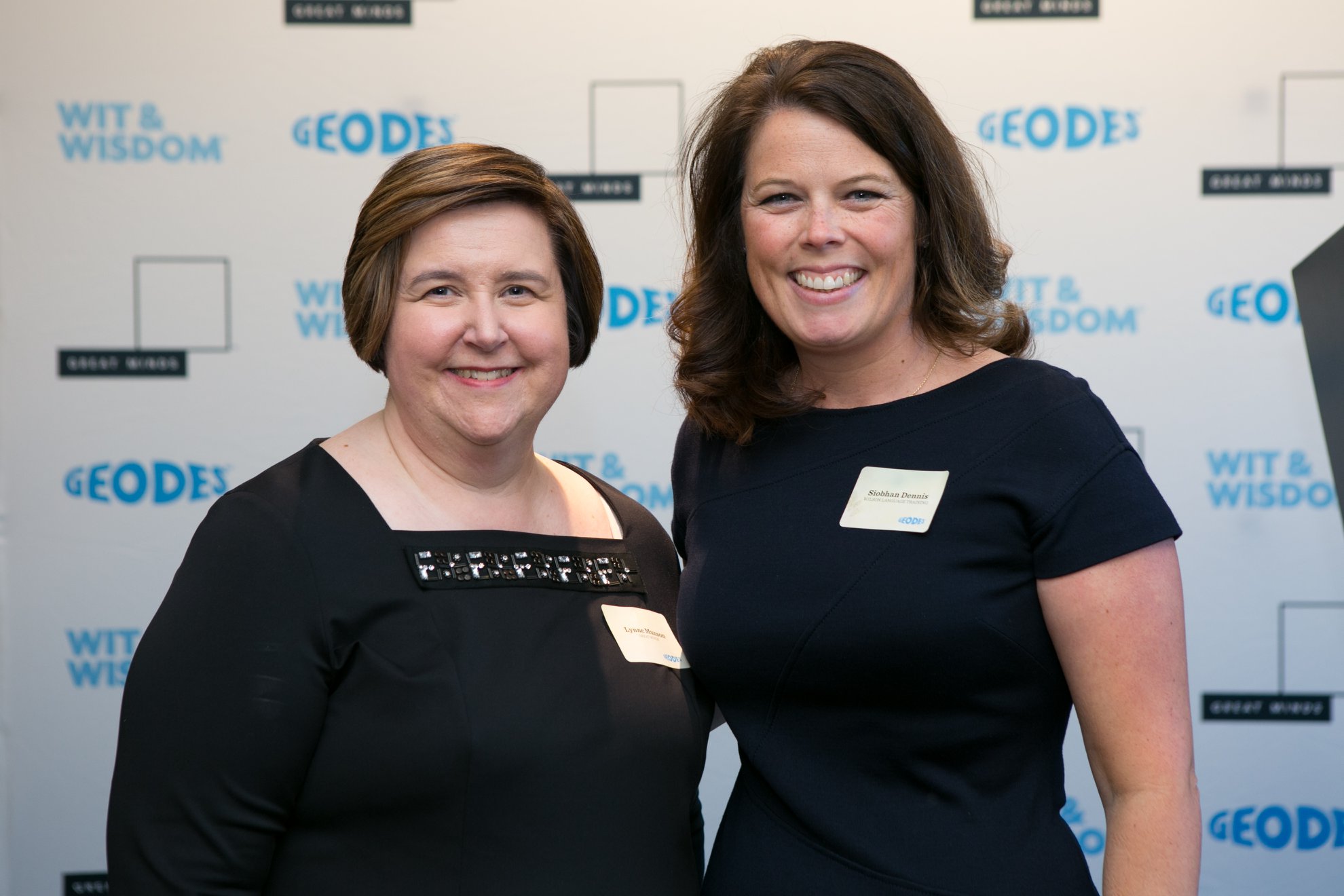
At a Chicago conference in 2019, Lynne Munson paused during the introduction of a new collection of children's books to thank her mother. Linda Munson had taught elementary school across the Chicago suburbs. Her daughter was now running Great Minds, the curriculum organization behind Eureka Math, and introducing Geodes, books intended to give beginning readers something worth reading about. Amid the writers, illustrators, editors, and education specialists, she made room for the teacher who had educated her first.
It was a small acknowledgment with a long history behind it. Munson's career had taken her through art criticism, a Washington think tank, a federal humanities agency, and the practical business of making school materials. Across those settings, she kept returning to a question that sounds almost impolite in an education meeting: what, exactly, are children being given to think about?
Geodes offered one answer. A child practicing the mechanics of reading could also encounter a ballet company, a landscape, or an unfamiliar animal. There was no need to postpone the interesting parts of the world until every sound had been mastered. The beginner, in Munson's view, deserved an invitation to the whole establishment.
A Botticelli before the lesson plan
Munson studied art history at Northwestern University. Her early working life belonged to the argument over cultural institutions: what museums showed, what universities taught, and who decided which objects deserved attention. She worked with Lynne Cheney at the National Endowment for the Humanities, then at the American Enterprise Institute. In 2000, she published Exhibitionism: Art in an Era of Intolerance.
The book grew out of her search for graduate study centered on close engagement with art. She wanted attention paid to the object itself. In a book-tour interview, she asked whether it was so terrible to feel a little intimidated by a Botticelli at the National Gallery, then become quiet and look carefully. Her criticism was political and argumentative; her preferred activity was rather less noisy. Look at the painting. Give it time.
That preference helps explain the later curriculum work. The reader, like the museum visitor, needs an encounter with something substantial. A child can examine an artwork, follow a historical account, or investigate a scientific phenomenon. The material has to be there before anyone can have a useful discussion about it.
From 2001 to 2005, Munson served as deputy chairman of the National Endowment for the Humanities. She helped create Picturing America, which brought art reproductions and teaching guides into classrooms and libraries. Her public service also included UNESCO meetings in Australia and Japan and a 2005 delegation to Afghanistan concerned with cultural reconstruction. Questions about access to culture had acquired administrative consequences.
The campaign that became a publisher
In 2007, Munson founded the organization that became Great Minds. It began as Common Core, a research and advocacy group promoting a broad liberal arts education. Its name would acquire an enduring capacity to confuse: the organization was distinct from the Common Core State Standards initiative. One was a group of people; the other was a set of educational expectations. Meetings presumably required some patience.
The founding concern was the narrowing of the school day. Reading and mathematics tests commanded attention, while history, science, languages, and the arts competed for what remained. Munson argued that students needed knowledge as well as skills. The objection was practical as much as cultural. Reading gives access to subjects; subjects give readers something to understand.
She pursued the argument in public, including a 2010 American Educator contribution with Laura Bornfreund examining the proposals of the Partnership for 21st Century Skills. The pair compared classroom suggestions with more demanding academic content abroad. Even the fashionable language of a new century, their argument suggested, needed to answer an old classroom question: what will the students actually learn?
Educators wanted help translating ambitions into lessons. The organization developed English language arts curriculum maps, connecting texts and topics with classroom work. Public review mattered. In 2011, Munson acknowledged teachers' concerns about being scripted and defended a process that welcomed their judgment. A curriculum could give direction while remaining open to correction by the people using it.
The mathematician needs a teacher
In 2012, New York invited the group to develop a comprehensive mathematics curriculum. EngageNY became the starting point for Eureka Math. The project brought mathematicians together with practicing teachers, making classroom experience part of the writing process. Mathematician Scott Baldridge identifies Munson, Nell McAnelly, Jill Diniz, and other colleagues among the team behind that work.
This is a revealing feature of Munson's achievement: she founded an organization in which expertise had to meet another kind of expertise. Knowing mathematics and knowing how a classroom responds to a lesson are related accomplishments, each with its own demands. A mathematically elegant sequence still has to survive the questions of actual children.
Carol Jago also helped shape the organization's early literacy work, serving on its board from 2011 to 2014. Lorraine Griffith became an important curriculum architect. The list of collaborators matters because Munson's project depended on turning individual teaching knowledge into materials other teachers could use. A founder could set the direction; she needed colleagues who knew the terrain.
Then came the less glamorous work of finding out where the materials were difficult. A fall 2014 listening tour visited 15 schools in Louisiana, New York, Arizona, and California. About 200 teachers, administrators, and parents offered feedback. Visits included observations, discussions, and parent meetings. An instructional program had left the page and was being cross-examined.
The feedback included praise for coherence, alongside concerns about pacing, lesson density, and the amount of professional support available. Teachers wanted more examples and more help adapting lessons. Munson's introductory letter treated curricula as documents that should respond to their users. That is a demanding promise for a publisher: the book can be finished, yet the work of understanding its use continues.
“The earliest books that students hold in their hands should not be disposable, in any sense.”Lynne Munson, introducing Geodes
A small book with a large itinerary
Geodes made the argument tangible. Great Minds collaborated with Wilson Language Training, combining its interest in knowledge with Wilson's expertise in foundational reading instruction. Children would practice sound-spelling patterns through books about the world. Beauty, content, and accessibility had to fit between the same covers.
The books' name supplied a pleasingly literal demonstration. At the 2019 unveiling, a classroom library came with a natural geode for students and teachers to examine. An unassuming exterior could conceal something worth discovering. Publishing occasionally allows itself a metaphor you can put on a desk.
Griffith's account of the early project describes an intended 176 books, with 67 milestones for each text. Accuracy, illustration, and alignment with the phonics sequence all required attention. The planned itinerary extended across six continents and 33 countries. Those numbers describe the original undertaking, rather than a claim about today's catalog.
The details were less abstract than the production schedule. Young readers could meet Bangkok's floating markets, learn about bees communicating through dance, or encounter the work of artists including Mondrian and Van Gogh. An adult-read section called More extended each book beyond the child's independent reading. Finishing a book became a reason to ask another question.
For someone trained to look closely at art, the attention to the physical and visual qualities of early reading materials feels consistent. An illustration has work to do. So does a carefully chosen topic. A child's limited decoding vocabulary need not dictate a limited intellectual horizon.
The lesson that did not sell
Munson has also described a curriculum effort that failed. The Alexandria Plan offered studies built around illustrated history texts, but educators wanted fuller lessons and were concentrating on mathematics and reading. Writing in 2023, she acknowledged that the organization had misunderstood demand and timing. A worthy subject did not automatically produce a useful product.
The episode complicates a tidy founder story. Conviction about what students deserve still has to meet teachers' working conditions. More content can mean more opportunity, but it also requires decisions about sequence, time, and support. Her response was to reconsider the product, rather than assume enthusiasm for history would do the implementation work.
Back to the family bookshelf
In January 2025, Munson stepped down as CEO after 18 years. John White, formerly Louisiana's state superintendent and Great Minds' chief success officer, succeeded her. She retained an emerita role and announced plans for an independent business bringing Geodes directly to parents and caregivers. She also intended to return to writing and advocacy.
The next audience changes the setting of her longstanding argument. A district adoption involves committees, budgets, and training; a family chooses a book to open together. Her announced plan put the same materials into that more intimate transaction. The question becomes what a beginning reader might discover with an adult beside them.
At the Chicago launch, Munson had thanked a mother who taught. Years later, her stated next step was to help parents bring substantial reading home. The distance between those moments is filled with institutions, products, and difficult revisions. At either end sits an adult taking a child's curiosity seriously, and a book with enough inside to reward it.