A professional network can contain ten thousand names and still leave you eating lunch alone. The missing ingredient is usually neither talent nor ambition. It is the small, awkward step between identifying someone useful and having a conversation with them. Lunchclub built a company around that step. It asked what you hoped to accomplish, found someone with a reason to meet you, and put a conversation on the calendar.
- Lunchclub matches professionals for one-to-one conversations around stated goals and interests.
- It began with in-person lunches, shifted to video in 2020, and later brought back an in-person option.
- A $4 million seed round in 2019 and $24.2 million Series A in 2020 financed its expansion.
- Its crucial metric was a meeting held, not a contact collected.
There is a certain vanity in the word networking. It suggests a grand web of influence when most people would settle for one person who answers an email. Lunchclub’s answer was a narrower product: curated introductions for founders, investors, recruiters, job seekers, prospective partners, and anyone who needed to get beyond the people they already knew. Onboarding asked users for objectives such as raising funding, finding a collaborator, exploring another company, or brainstorming with peers. The service combined those answers with profile information and public signals, then refined later matches from feedback after meetings.
The first match was the company itself
The beginning was less tidy than the name. Vladimir Novakovski and Scott Wu started work in 2017 under Elliot Technologies. Wu later described an early tool for scheduling catch-ups with people users already knew. Through a series of small shifts, the question changed from whom should I see again? to whom should I meet for the first time? That distinction is the entire business. The former is a reminder app. The latter needs a network, judgment, and enough trust to ask two strangers for half an hour.
Hayley Leibson supplied an unusually good origin story for a third founder: she first encountered Lunchclub as a user. She signed up in 2018 to meet other women entrepreneurs, liked the introductions, met Novakovski and Wu through the South Park Commons orbit, and formally joined them in January 2019. A company selling introductions had made a consequential introduction of its own. By September, Andreessen Horowitz had led a $4 million seed round.

A social network without the scrolling
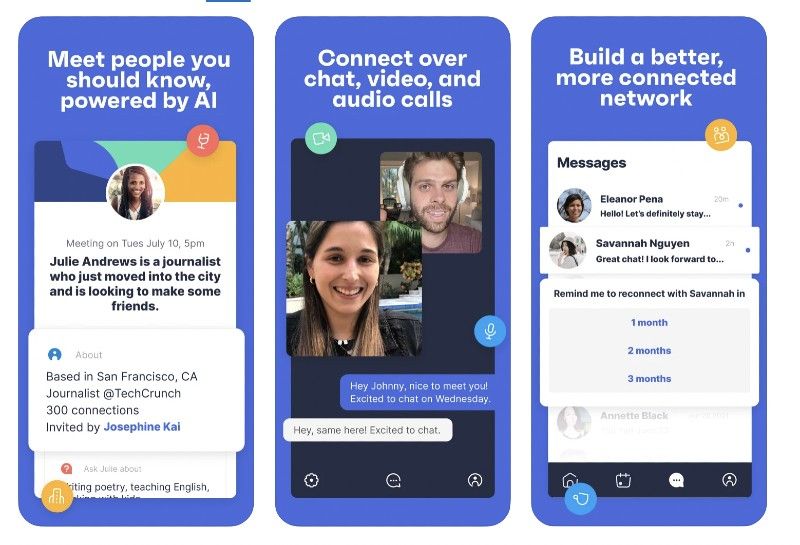
Lunchclub did not ask members to broadcast career updates to a crowd. It tried to get two people into a room, or later onto a call. In its early form, users received email introductions and suggestions for a time and place to meet. Its attraction was partly mechanical: the platform carried the burdens of selection and scheduling that make a cold message easy to postpone. Its machine learning claim mattered less as spectacle than as a promise that the other person might have a complementary reason to be there.
Describe your background, interests, and the kind of person you hope to meet.
The service suggests a counterpart and helps put one-to-one time on the calendar.
Feedback after the conversation informs later introductions.
That is a different wager from LinkedIn’s vast directory, Meetup’s groups, or Bumble Bizz’s discovery interface. Lunchclub chose a small number of arranged conversations. A good meeting could produce a mentor, a co-founder, an investor introduction, a hire, a customer, or simply an unexpected idea. The outcome belonged to the people in the meeting; the platform sold the chance that the meeting would be worth having.
Then lunch became impossible
In March 2020, a business whose name suggested a restaurant table met a world that had closed its restaurants. Lunchclub moved introductions to video. The pivot preserved the useful part of the product while discarding the venue. It also removed geography: a match no longer had to share a city, a commute, or a lunch hour. In the six months before March, investor Lightspeed said monthly active users had risen fourfold; after the video shift, it reported another eightfold increase. Those are investor-reported historical growth figures, not a measure of today’s activity.
The user figure is the CEO’s historical estimate; it is not a current count.
The financing arrived as the move to video took hold. Lightspeed and Coatue led the September 2020 Series A, which was reported at $24.2 million and put a valuation above $100 million on the company. In early 2021, CEO Novakovski said Lunchclub was nearing half a million users and its millionth match. The service launched mobile apps with instant video introductions, while virtual fireside chats gave members another reason to gather.
“Treat Lunchclub introductions like you would treat introductions from a friend or trusted colleague.”Lunchclub community guidelines
That sentence reveals a practical limit of matching software. It can suggest a person; it cannot make either participant generous, curious, punctual, or courteous. Lunchclub’s published rules discourage repeated rescheduling and remove persistent no-shows. They forbid using meetings as sales ambushes or romantic solicitations. These rules are product design in plain clothes. If people expect a pitch, the invitation stops feeling like a warm one.
The large audience and the small bill
For users, Lunchclub was publicly described as free in 2021, and the iOS listing still labels the app free. At the time, Novakovski discussed a points system tied to referrals and possible packages for partners such as recruiting platforms. Those were possibilities, not evidence of an established revenue engine. The cost of a meeting to the user was chiefly time: a profile, an open calendar slot, and the risk that the match would be poor or absent.
Wu’s later account supplies the less photogenic half of the story. He said the company made millions of meetings over roughly five years, but that growth and monetization eventually became difficult. He left in June 2022. The point is not that the early numbers were meaningless. It is that a service can create a great deal of activity while still struggling to identify who will pay, for what, and how often. A valuable introduction may be memorable precisely because it cannot be ordered like a subscription refill.
In 2021, Lunchclub tested a return to physical meetings in Miami, announcing a pop-up with Mayor Francis X. Suarez and a proposed $100,000 seed commitment for ideas formed through its network. It also launched in India, with reported ties to WeWork and T-Hub. The company was testing whether its model traveled across both geography and format: coffee, video, app, and back to coffee.
The appointment is the point
There is a lesson here for anyone building a network, with or without an algorithm. Ask people what they are trying to do. Find someone with a compatible reason to talk. Make the next step concrete. Protect the meeting from pitches and no-shows. Ask afterward whether it was useful. Lunchclub assembled those ordinary moves into a product; its distinctive insight was that the number of names in a database matters less than the number of worthwhile conversations that actually happen.
The limits are just as instructive. The system works best when members can spare time, state their goals honestly, and meet people outside their immediate circle. It is weaker when one side wants a quick transaction, when matches fail to show, or when a network grows faster than the trust that makes introductions pleasant. Lunchclub’s story leaves one modest, stubborn thought on the calendar: sometimes the best thing a social platform can do is get two people talking, then get out of the way.