Luke Kempski has held the president’s job at JPL since 2004. One of the more revealing things he has said about it concerns something he took several years to learn. In a 2021 agency interview, he recalled that it took roughly five years to recognize the need for a vision his fellow leaders could understand and act on. Experience had brought him to the top. It had not supplied every instruction for what to do there.
That admission makes a useful entrance into a career often described through longevity. Kempski joined JPL in 1989 as a video producer. He helped develop its interactive capabilities and eventually became its president and CEO. He also leads the learning-solutions business d’Vinci Interactive. The job titles have grown more imposing; the underlying question remains approachable. How do you help somebody understand enough to do something well?
His work has moved between cameras, websites, training, agency management and, lately, artificial intelligence. Each new medium has brought a fresh version of that question. A producer can finish a film. An executive who wants an agency to keep adapting has a less convenient assignment. The credits never quite roll.
Before the corner office, a production job
JPL began in Harrisburg in 1989, when Michael Horgan and Christian Masters bought the video-production department of J.P. Lilley. Kempski joined that founding-year operation as an employee. His route through the business is the gradual one: learn the work, help expand what the company can do, take on responsibility for the whole enterprise.
The company established an Interactive Technologies Group in 1995. Its capabilities widened through web development and other additions, and in 2004 Kempski moved from vice president to president as Horgan became executive chairman. In 2008, JPL Productions shortened its name to JPL, reflecting a broader communications business. The disappearing word tells a small part of the story. Production remained, while the company’s remit expanded around it.
Kempski’s education connects the two sides of his working life. He earned a bachelor’s degree in communications at Wilmington University and a master’s in training and development at Penn State. Penn State Harrisburg identified him as a 1995 master’s graduate when it awarded him its School of Behavioral Sciences and Education Alumni Achievement Award in October 2012. Communications and training make a practical pairing: getting attention is one task; helping someone use what follows is another.
Video producer
President
CEO
join ownership
The interview chair faces both ways
At d’Vinci, which he joined in late 2012 as it became part of JPL, Kempski has continued to explore that relationship. He is a co-host of Powered by Learning, alongside a wider team led by host Susan Cort. Here the executive spends time asking questions of people responsible for teaching, designing and improving work. The format gives his curiosity somewhere specific to go.
In November 2023, he interviewed Harrisburg University’s Charles Palmer about interactive media. The conversation moved through practical learning, virtual reality and gamification. Kempski drew a distinction between designing an entire game and using game elements to help someone practise a particular skill. The useful unit was the learning problem. A fashionable format would have to earn its place.
In January 2024, speaking with Thought Industries CEO Barry Kelly, he asked how training could help a supplier stand out among competing companies represented by a distributor. He also pressed on pricing and the quality of the learner’s experience. It was an agency leader’s line of inquiry inside a training conversation: what will the audience experience, and why should the organization invest?
A March 2024 conversation with Learning Guild CEO David Kelly followed learning into the working day itself. Kempski described the value of having help available when a particular problem appears, rather than leaving work for training and later trying to remember it. The setting changes, but his questions keep returning to application. The audience has somewhere to be after the presentation.
A team cannot act on a secret
The same concern appears in his account of managing JPL. In the 2021 interview, Kempski warned about drawing departmental boundaries so firmly that teams compete against one another. He described profit sharing tied to the agency’s overall performance, giving departments a reason to care about the same result. A company can have a splendid organization chart and still spend its day arguing across the lines.
He also described bringing in a third party every two years to interview clients about expectations, experience and how JPL compared with other agencies they used. The resulting perspective helped shape the agency’s direction. Clients could contribute something that internal agreement could not: a view from the receiving end.
These practices give substance to his earlier admission about vision. A direction people can follow needs more than the president’s private conviction. They need enough shared understanding to make choices without returning every question to his desk. His account is candid about the learning involved. The producer who became president had to learn how to help other people decide.
“We’re always changing and they keep pace with us”
Luke Kempski, on JPL’s accounting partner Martin Sacks
Learning without the permission slip
By December 2024, Kempski was writing about a smaller obstacle with a familiar shape: the approval required for each training request. JPL had participated in a pilot subscription to the 4As Learning Institute. The arrangement allowed managers and employees to access targeted professional development without repeatedly obtaining financial approval. A modest administrative change could put learning closer to the moment someone wanted it.
He described training needs across creative strategy, media, analytics and generative AI. JPL also runs internal Evolution Sessions, where colleagues share ideas, approaches and successful work. Outside instruction and internal exchange sit together. The person who has something to teach may be a specialist elsewhere in the industry or a colleague a few desks away.
In a subsequent Powered by Learning discussion with the 4As’ Sean McGlade, Kempski talked about helping team members apply their talents in different ways as technologies and delivery methods change. His stated ambition was concrete: allow people’s skills to develop alongside the work. An agency’s promise to evolve asks something of employees. Access to training is part of what the agency can give back.
Ownership gets three chairs
In January 2025, JPL announced that Kelly Seipe and Ryan Pudloski had joined Kempski as equity partners. Seipe became chief growth officer; Pudloski became chief technology officer. Both had already spent years inside the business. Seipe arrived as a senior account manager in 2015. Pudloski joined as a web developer in 2007.
Their paths offer a recognizable echo of Kempski’s own. The agency’s current owners came into it doing specific jobs, then took on broader responsibilities. Seipe’s remit includes growth across JPL and its higher-education enrollment marketing division, Paskill. Pudloski’s covers technology and the combination of creative, media and analytics in client work.
The ownership announcement described a commitment to the company’s long-term success. It also made that commitment tangible. The people responsible for growth and technology now had an ownership stake alongside the president. For an agency selling work that crosses disciplines, the arrangement puts several of those disciplines at the same table.

Back to the students, with a real brief
Kempski’s connection with learning also runs through Harrisburg University. In November 2023, JPL and d’Vinci announced a $250,000 investment over five years to support scholarships and the university’s marketing and communications goals. Their support brought naming rights for the Digital Media Studio in the university’s new academic tower. The arrangement linked a place to practise with professionals who could put that practice to use.
There is a related tradition inside the agency’s internship program. In 2023, interns from JPL and d’Vinci produced a volunteer-recruitment video for The Salvation Army Harrisburg. The four students came from High Point University, Juniata College, Rutgers University and the University of Maryland. They worked on a communications problem with an intended audience and a purpose beyond a classroom grade. JPL and d’Vinci had been donating services to area nonprofits through the program for more than twenty years.
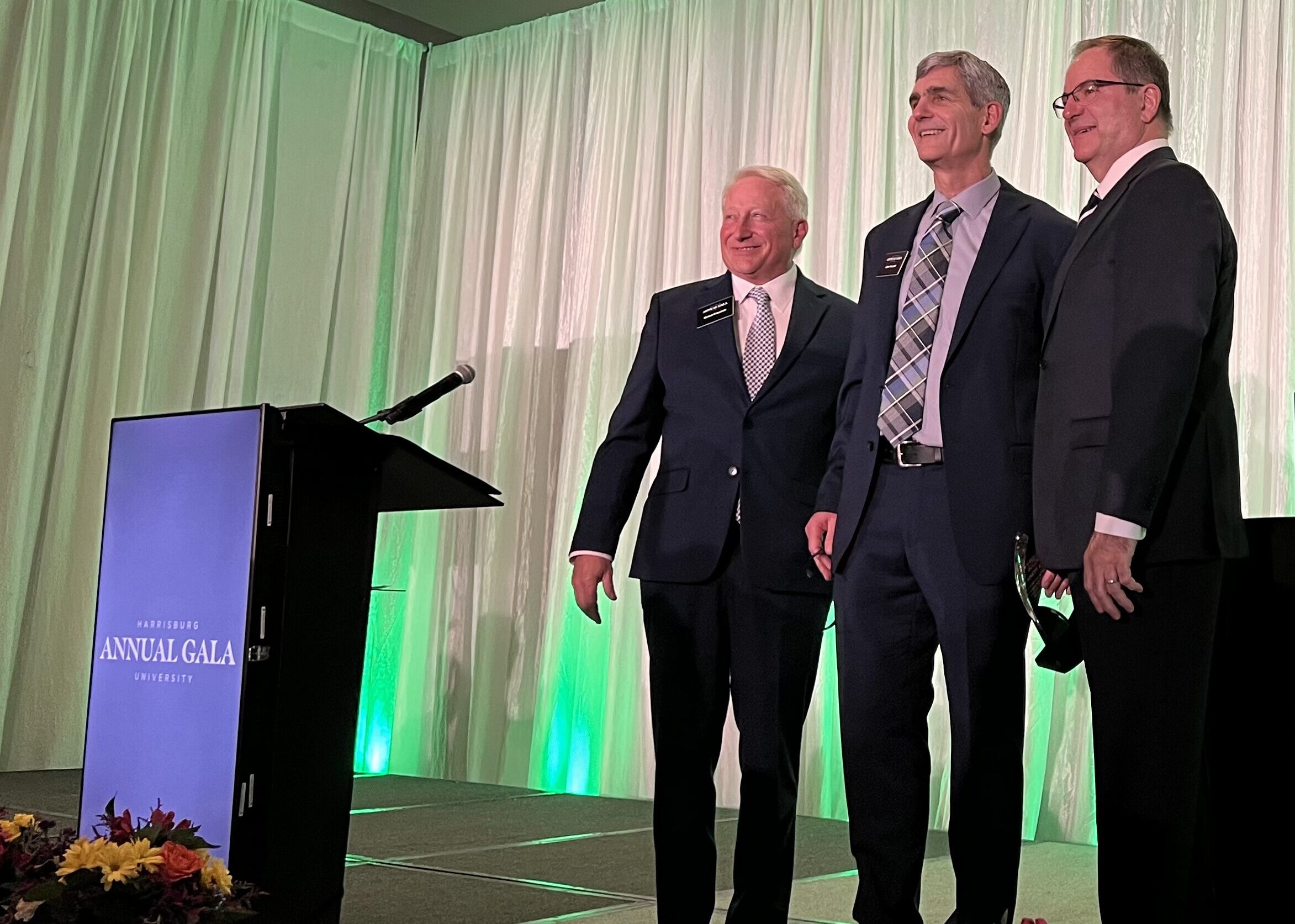
By April 2026, the university partnership had another visible result. At Harrisburg University’s annual gala, Kempski accepted its Corporate Impact Award for JPL. JPL Scholars Scott Stephens and Temiah Dixon helped produce the videos introducing that year’s award recipients. Students supported by the partnership had contributed to the event recognizing it. The award came with a rather persuasive demonstration.
A new tool, an old responsibility
Artificial intelligence now occupies part of Kempski’s attention. His LinkedIn profile lists a Generative AI for Advertising credential from the 4As Learning Institute, issued in January 2025. That detail fits the longer pattern: an executive advocating professional development also has a recent course on his own record.
On January 29, 2026, he joined authors Mike Taylor and Bianca Baumann on Powered by Learning to discuss applying marketing ideas to training. Learner personas, journey mapping and content strategy brought his two professional worlds into the same conversation. A campaign and a course both have to reach somebody with competing demands on their attention.
In his April 24, 2026 essay on AI accountability, he argued that access to the technology alone creates little distinction. JPL’s approach assigns responsibility to human experts, validates outputs, protects client data and discloses meaningful AI use. He had made a related point in the podcast’s hundredth episode: instructional designers must provide a human check on the technology. Speed is useful; somebody still has to answer for the result.
Away from work, Kempski runs races of different lengths in locations around the country. It is an appealing detail beside a career spent inside one evolving organization: he has stayed with JPL while continuing to seek new courses. At work, too, the next stretch is already in view. More capable colleagues. Students with a real assignment. New tools with a person accountable for them. After thirty-seven years, there is still plenty to learn.