At sixteen, Lukas Gentele had a business idea and an unusually demanding first audience: a German judge. He wanted to build websites for local businesses. Being a minor complicated the arrangement. So he presented a business plan in court to establish that he could run the venture independently. Before there were investors to persuade, there was a judge to convince.
It is a pleasingly bureaucratic beginning for someone whose work now concerns giving other people more freedom. Gentele is the co-founder and CEO of vCluster Labs, the company behind software that lets teams have their own Kubernetes environments without necessarily constructing a separate infrastructure operation for each one. His customers' problems involve permissions, boundaries and who gets to control what. He encountered a rather literal version early.
A website, a teacher, a first customer
His first experiments were less solemn. Around thirteen, he began making a website with a website builder, then learned to get past its limitations. PHP scripting offered ways to automate things he would otherwise update by hand. The appeal was practical: if the tool could not do what he wanted, perhaps he could teach it.
The site became popular at school. Among the material he shared was a recording of a teacher, which delighted classmates more than it delighted the teacher. Later, he built the school's official website. It was a tidy career progression: from unofficial school entertainment to a more respectable commission.
Local businesses followed. Gentele has recalled that he did not initially know how to send an invoice. The technical work had arrived before the administrative education. A one-person business gradually acquired employees and more involved software projects. The early attraction of making a page do something useful would survive several changes of programming language and business model.
“I didn’t even know how to send an invoice at first!”
Lukas Gentele, on his first business
The classmate he hired
At the University of Mannheim, Gentele studied computer science and information systems, eventually completing both bachelor's and master's degrees. His studies included enterprise information systems. Alongside that formal education, the business supplied a steady stream of less neatly packaged assignments: customers with software they needed somebody to build.
Fabian Kramm, his future co-founder and chief technology officer, was among the engineers Gentele met and hired while studying. Their working relationship began with getting projects done. Long before the pair needed to explain a new category of infrastructure software, they had the opportunity to discover how the other person worked.
Docker and Kubernetes drew them further into cloud infrastructure. These technologies made it possible to package applications and coordinate them across machines, but developing against Kubernetes could still be cumbersome. Repeatedly changing an application, deploying it and seeing the result involved enough friction to suggest a tool of their own.
Gentele also had an operator's extracurricular education. He ran his own mail server and worked with hardware in a co-located data center. He has described dealing with cables and setting up Kubernetes on bare metal. The cloud, in this version of the story, had an address and things that needed plugging in.
When strangers start using your tool
DevSpace began as an answer to the team's own development problems. They put it on GitHub. They had contributed to open source before, but running a project themselves was a new experience. Now the people using the software could bring back suggestions, report problems and take it in directions its creators had not anticipated.
One early connection mattered: Michael Hausenblas, then at Red Hat, helped people discover DevSpace through his newsletter. Distribution arrived through someone who thought the work was useful. For a small team accustomed to delivering commissioned projects, the experience changed the relationship between making software and finding its audience.
There is a particular intimacy to custom development. A client asks; a team builds; the client pays. An open-source project introduces a much larger, less orderly conversation. Someone can try the work without arranging a meeting. Someone else can improve it. A third person may reveal that the problem you thought you were solving has an unexpected cousin.
DevSpace launched in 2018 and later became a Cloud Native Computing Foundation Sandbox project. Gentele and Kramm had found a way of working that they wanted to keep. They still had to find the business that would support it.
The product that failed usefully
The route included a platform-as-a-service offering: a product intended to take infrastructure work off developers' hands. Gentele moved to Berkeley for the SkyDeck accelerator while the team was pursuing that direction, and subsequently lived in San Francisco. The geographic move was substantial. The commercial result was disappointing. The platform did not find the business they wanted.
Running it had nevertheless given them a close view of Kubernetes multi-tenancy. Multiple customers needed to use the same underlying system while retaining boundaries between their environments. The team could see why organizations often avoided this complexity by creating separate clusters. They could also see the overhead that accumulated when everyone received a separate installation.
Kiosk was an intermediate answer, automating parts of multi-tenancy. vCluster followed in 2021, taking the idea further by giving tenants their own Kubernetes control planes. The failed platform had made the underlying problem difficult to ignore. Gentele and Kramm could stop selling the original product while continuing to work on something it had taught them.
His account of that period is unusually comfortable with the word failure. The useful question became what their experience had revealed about infrastructure. A discarded product could still leave behind a worthwhile problem.
Everyone wants their own set of keys
A Kubernetes cluster has a control plane: the machinery that keeps track of the desired state of applications and coordinates their operation. Giving different teams independent control planes lets them work with their own settings, resources and upgrade cycles. Depending on the configuration, the underlying computing resources can be shared or assigned separately.
That distinction matters. A separate control plane does not automatically create a hard security boundary between workloads sharing the same machine. The infrastructure model has to match the people using it. Trusted internal development teams and unrelated paying customers bring different requirements.
Shared nodes for trusted internal tenants. Private nodes when hard tenant isolation is required.
The independence also enables uses beyond a permanent environment for each team. In testing, an environment can be created for a particular job and removed when the job finishes. That changes the economics of experimentation: access can follow the work, rather than remaining attached to a collection of machines somebody is reluctant to surrender.
The name catches up
In April 2024, Loft Labs announced a $24 million Series A led by Khosla Ventures. The project had become the center of the company's story. In August 2025, the company made the relationship easier to understand by changing its name to vCluster Labs.
Gentele's explanation was straightforward. People already knew vCluster. It was the name they encountered at events and the project around which the community gathered. Keeping a different corporate name meant repeatedly explaining a connection the audience had little reason to memorize.
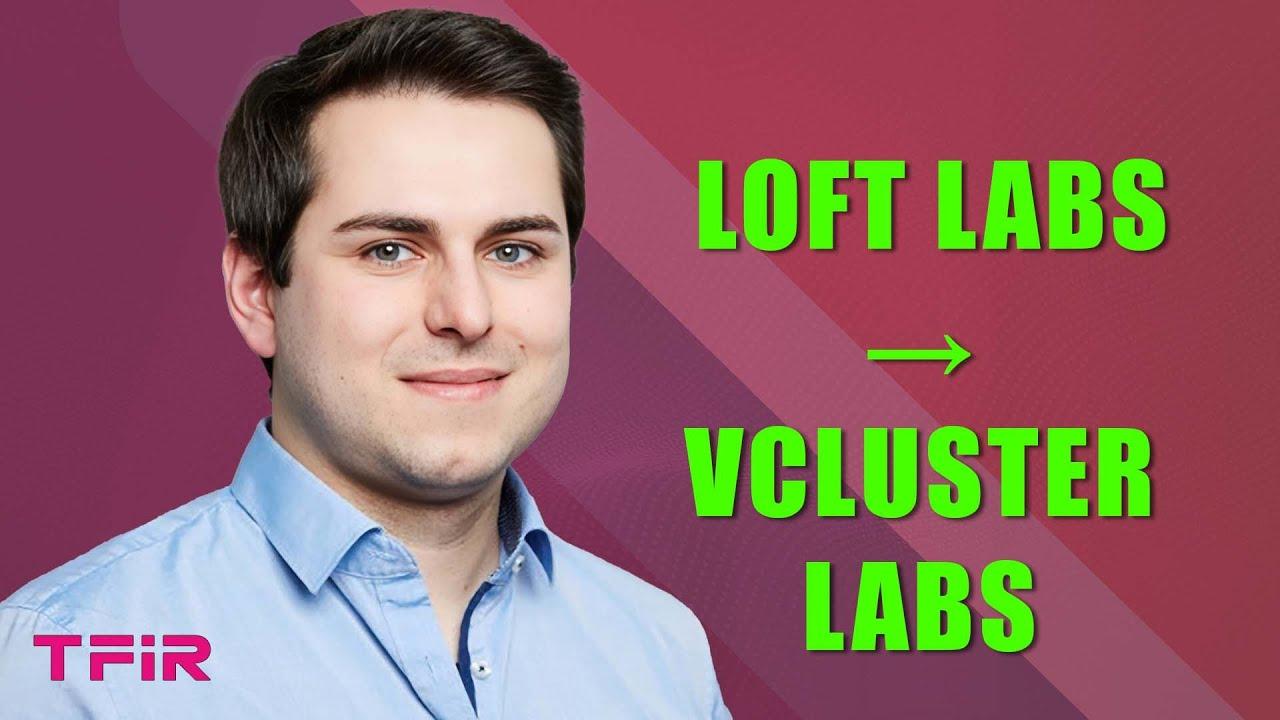
There is a modest business lesson in accepting the name people already use. Recognition is work the audience has done for you. Asking them to maintain an additional piece of corporate vocabulary can be an unnecessary favor.
Keeping room for the tinkerer
By April 2025, Gentele was based in Miami, traveling between the Bay Area, Europe and New York to meet customers and attend conferences. The founder who once sold local website projects now spent much of his time explaining infrastructure to people across different organizations and countries.
Growth brought a familiar open-source business question: how much should be freely available, and what should customers pay for? In January 2026, he introduced vCluster Free, giving smaller users access to many enterprise features within infrastructure limits. At launch, those limits were 64 vCPU cores and 32 GPUs, with no time limit.
He also explained why making those features free to use was different from releasing all of them as open source. A company needs revenue to keep funding development. Students, hobbyists and small businesses still need a way to use more of the product. The free tier was an attempt to keep that middle ground open.
Back to the machines
In March 2026, vCluster Labs introduced vMetal to automate the provisioning and lifecycle of bare metal GPU servers. The scope had extended down to the physical machines: discovering them, preparing them, assigning them and eventually repurposing them. The former data-center tinkerer was now leading a company building tools for that layer.
By September, Gentele was publicly pressing AI cloud operators to take tenant isolation seriously. His argument distinguished independent Kubernetes control planes from the additional boundaries required between customer workloads. The caution belongs alongside the promise of efficiency. Sharing infrastructure requires deciding precisely what can be shared.
On October 21, 2026, vCluster Labs announced work with Deutsche Telekom's Industrial AI Cloud using components of NVIDIA DSX OS. The deployment automates private customer environments in Germany. It brings Gentele's career back to his home country through infrastructure far removed from the websites where he began.
The scale has changed; the practical interest remains recognizable. Somebody wants an environment of their own. Somebody else must make it possible, repeatable and affordable. Gentele has spent years moving through the layers of that arrangement, from a school's web page to the machines behind an AI cloud. He started by asking for permission to run a business. His business now helps other people get on with theirs.
Follow the work
Conversations, writing and places to find Lukas.