A Lou Malnati's deep dish arrives looking almost inside out. The mozzarella goes down first. Sausage, if ordered, can stretch across the pie like a single disc. Tomatoes sit on top, where they can face the oven without scorching the cheese beneath them. Around it all is the part the company guards most closely: a low, flaky, buttery crust that has more in common with a savory pastry than the breadier walls of some Chicago rivals.
This is a meal that resists the usual chain-restaurant demand for speed. Menus warn that the bake takes about 30 minutes. Yet the wait is part of the agreement. The customer is not buying emergency calories. A family is settling in, tourists are checking off a Chicago rite, or a former Chicagoan is opening an insulated package a thousand miles away. The same pizza performs several jobs.
That is the business inside the pizza. Since Lou and Jean Malnati opened in Lincolnwood on March 17, 1971, the company has built three distribution systems around a recognizable core: full-service restaurants that stage the ritual, carryout kitchens that make it convenient, and a frozen-food operation that turns regional memory into national ecommerce. Catering, gift cards, fundraising and a rewards app fill the gaps between them.
The opening-day omen
Lou Malnati had worked in the family trade before putting his own name over a door. His father, Rudy, was involved with Chicago's earliest deep-dish restaurant in the 1940s. Lou and Jean chose an opening date with comic possibilities: an Italian opening a pizzeria in a Jewish neighborhood on St. Patrick's Day. Then a car crashed through the dining-room wall during dinner.
The story has survived because it sounds like a parable the family would invent: hospitality interrupted by chaos, followed by everyone carrying on. Less charming episodes came later. Road construction outside a second restaurant dragged on for 14 months. A third location, more than 50 miles from the company's northern hub, created such logistical strain that it closed and left the family owing vendors hundreds of thousands of dollars.
When Lou died of cancer in 1978, Jean and sons Marc and Rick continued the company. They also kept an annual charitable dinner alive, redirecting it toward cancer research. The company says its benefit has raised more than $5 million in the past 15 years alone. Its most useful inheritance, though, was not a sentimental slogan. It was the discipline to know which parts of the restaurant experience could change and which could not.
“Lou wanted his restaurant to be a model for hospitality, a place dedicated to family.”Lou Malnati's company history
The kitchen without a dining room
In 1981, Lou Malnati's opened in Wilmette with carryout and delivery but no dining room. It was an operational choice with long consequences. The company later said most of its pizzerias followed that model. A smaller box can reach a new delivery zone with less real estate, less front-of-house labor and less capital than a 200-seat restaurant. The dining rooms remain important, but they no longer have to carry all of the growth.
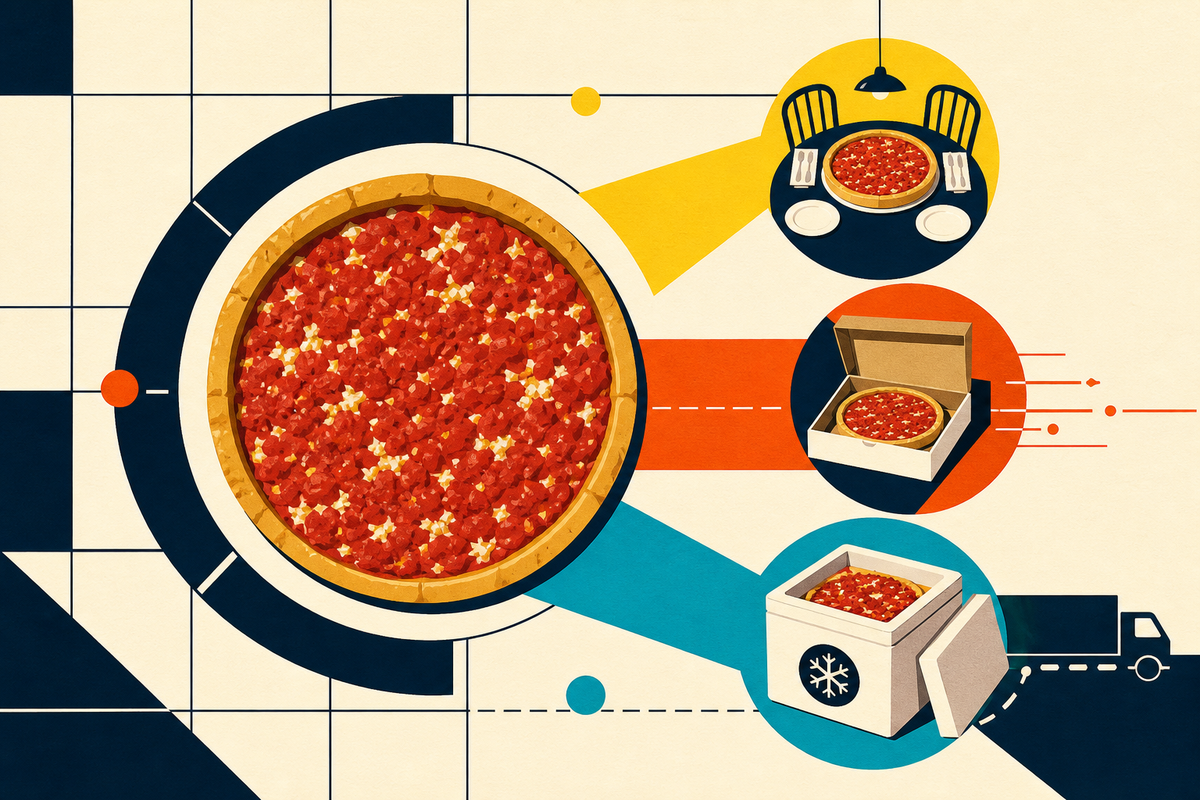
That split explains why counting Lou Malnati's locations does not fully describe the company. A full-service restaurant is a place for birthdays, out-of-town guests and the first deep-dish encounter. A carryout location is infrastructure for Tuesday night. In March 2026, the company called its planned St. Charles restaurant its 61st Chicagoland location. The 6,200-square-foot project is expected to seat about 200 and include a bar, patio and private dining. It is deliberately theatrical. Other stores can be deliberately efficient.
Dining room
Hospitality, groups, bars and private events turn a long bake into an occasion.
Local box
Carryout and delivery kitchens add neighborhood coverage with a smaller footprint.
Cold chain
Frozen pies convert regional affection into nationwide direct-to-consumer demand.
The customer problems are correspondingly plain. Families need a dependable group meal. Offices need catering that travels. Nonprofits need a fundraiser people will actually attend; eligible Lou Malnati's nights can return up to 20 percent of group sales. Chicago visitors want a legible piece of the city. Former residents want a taste that geography has removed. The company solves each problem without inventing a wholly new product.
The ingredient list doubles as strategy
Any pizza brand can claim quality. Lou Malnati's makes the claim unusually specific. It cites California vine-ripened tomatoes, an exclusive seasoned sausage and mozzarella from the same small Wisconsin dairy for more than 40 years. Teams have traveled to the tomato harvest and visited the dairy. The crust recipe stays secret, but the sourcing story is repeated in public because consistency is itself a product feature.
This is where Lou Malnati's differs from both national delivery chains and its Chicago deep-dish peers. Domino's optimizes for reach and speed. Giordano's is associated with a heavier stuffed style. Pequod's built a following around its caramelized edge. Lou Malnati's owns a particular combination: thin butter crust, tomato-forward construction, a broad sausage layer and an explicit family lineage. Competitors can sell a deep pan of pizza. They cannot easily borrow the accumulated association between this version and Chicago homecoming.
The employee figure matters because restaurant quality is an organizational memory problem. Dough can be measured, but hospitality and judgment are taught by people. Lou Malnati's says more than 15 percent of its workforce has stayed for at least a decade. It has also accumulated 16 consecutive Chicago Tribune Top Workplace recognitions and six straight national Top Workplace honors as of 2026, all tied to employee feedback rather than a dining critic's palate.
The culture has a civic mechanism, too. Restaurant teams can volunteer with organizations they care about, and the company says it donates $10 to the organization for every employee volunteer hour. Its Lawndale store opened in 1995 with a promise to return profits to children's educational and recreation programs in the neighborhood. The store reached profitability in 2011, and the promised money went back into the community.
Selling homesickness by the freezer pack
In the 1990s, the company began shipping frozen pizzas under the wonderfully urgent name Priority Pizza. In 2000, it joined with other Chicago food businesses, including Portillo's, Eli's Cheesecake and Lettuce Entertain You, to create Tastes of Chicago. The website made the city into a pantry: pizza, Italian beef, cheesecake and other regional foods packed for national delivery.
The clever part is that shipping does not require a Lou Malnati's dining room in every market. It creates national awareness, serves expatriate demand and tests appetite beyond the physical footprint. Frozen pizza is not a consolation product here. It is the portable edition of the brand, with baking instructions and the recipient's own oven completing the experience.
The business model now looks less like a chain and more like a portfolio built around one trusted object. Restaurant checks and digital orders are the base. Catering and private events increase group occasions. Gift cards and merchandise monetize affection. Rewards move customers into a direct channel, where offers can prompt another order without renting attention from a delivery marketplace. Tastes of Chicago extends the addressable market to the rest of the country.
Growth meets the family photograph
Outside capital has helped widen that portfolio. BDT Capital Partners invested in 2016 to support expansion into Arizona and the Midwest. In 2021, Meritage Group acquired BDT's interest. Bloomberg reported that the transaction assigned Lou Malnati's an enterprise value above $500 million, though the private company did not disclose terms. Marc and Rick Malnati remained significant individual shareholders, and the business continued to describe itself as family-owned.
In June 2025, Julie Younglove-Webb became chief executive. Her appointment placed an operator with experience at Auntie Anne's and other restaurant brands in charge of the next growth phase. It also made the central question impossible to avoid: can Lou Malnati's expand nationally without becoming a Chicago costume?
The early answer is cautious experimentation around a stable center. A 2025 Signature Pizza menu packaged established choices - the Malnati Chicago Classic, The Lou and a veggie pie - beside newer flavors such as Margherita Pesto and Mike's Hot Honey. In 2026, a Jeff Mauro collaboration combined Italian beef, sausage and giardiniera in an Italian Combo Beef-Za. By July, the company was preparing that pizza for nationwide shipping. The crust remained the platform; novelty lived on top.
Partnerships do similar work. Chicago Fire FC gives the brand game-day relevance, access to fans and a community tie through the club's youth foundation. Mike's Hot Honey lends a current flavor cue without requiring Lou Malnati's to reinvent itself. Mauro Provisions turns two Chicago foods into one shareable story. These are marketing programs, but they are also product-development shortcuts: collaborators supply novelty while Lou Malnati's supplies recognition.
Where the pan fits
Lou Malnati's occupies an unusual middle of the American pizza market. It is too regionally coded to behave like a generic national delivery utility and too large to be treated as a single-city cult restaurant. It competes on convenience in local neighborhoods, on experience in full-service locations, on authenticity with other Chicago institutions and on giftability in ecommerce.
That position has drawbacks. A deep-dish meal is slower, heavier and often more expensive than an everyday chain order. New-market customers may know the silhouette without understanding the distinctions among deep, stuffed and pan pizza. Every expansion also raises the risk that operational consistency becomes a blander substitute for family character.
Yet the company has an advantage most restaurant chains have to manufacture: people already attach stories to the food. The opening-day crash, the secret crust, the long-tenured employees, the Chicago relatives who insist on ordering it - these details turn a product into a reference point. Lou Malnati's does not need every American to eat deep dish weekly. It needs enough customers to choose this deep dish when the moment calls for Chicago.
The most transferable lesson is simple. A heritage brand can modernize the path without modernizing away the reason for the trip. Lou Malnati's added smaller kitchens, ecommerce, an app, private events and brand collaborations. It kept the long bake, the tomato top and the flaky edge. Fifty-five years in, the company is still selling the wait - it has just found more ways to deliver it.