At a Starbucks in New York, Loni Edwards was sitting with her French bulldog, Chloe, and a venti iced passion tea when a woman rushed over to take pictures. The visitor had recognized the dog. For someone accustomed to being the person who took Chloe’s photographs, it was a useful reversal. The audience on a screen had become a stranger standing beside her table.
“That was the point at which I realized she was famous,” Edwards recalled in 2016. The encounter had happened the previous September. Chloe’s online following had become something that could interrupt a perfectly ordinary trip for tea. Celebrity had arrived without bothering to explain the paperwork.
Today, Loni Edwards Lunau is the founder and CEO of The Dog Agency, a business built around the commercial lives of animal creators. She also founded PetCon and wrote How To Make Your Dog #Famous: A Guide to Social Media and Beyond. Her work has involved dogs, cats, a duck and a toad. The job description is unusual; the route into it is more revealing.
She had trained for a profession in which words carry consequences. Then she built a company selling handbags that charged phones. When pet owners began asking her to look at contracts, those experiences suddenly belonged in the same conversation. Chloe supplied the introduction. Edwards supplied the ability to read what came next.
Before the dog, a dying battery
Edwards had intended to become a lawyer. She graduated from Phillips Academy Andover in 2002 and Cornell University in 2006, then earned a JD at Harvard Law School. In Los Angeles, she joined a firm working in intellectual property litigation. Within six months, she was feeling the pull toward more creative work. Returning to New York gave her room to try it.
One early venture was Stitch Collective. Running between meetings around the city, she kept encountering an inconvenience that was becoming occupational: her phone would run out of charge halfway through the day. Without a fixed office, she depended on the device to keep working. Finding somewhere to plug it in became another job.
Her response was emPOWERED, a fashion business whose handbags incorporated phone charging. The idea joined something people already carried with something they increasingly needed. She obtained a utility patent for charging technology in accessories, bringing her legal training into a business with materials, manufacturing and customers.
At a 2015 discussion about emPOWERED, she described using contacts from Stitch Collective to help get attention for the newer company. Chloe sat looking out at the audience while her owner talked business. Even before there was an agency, the two strands of Edwards’s working life were sharing a stage. Her personal biography records the sale of emPOWERED in 2015.
The questions kept arriving
Chloe’s Instagram account began in 2013 as a place for photographs intended for friends and family. Edwards had wanted a companion while working on her fashion business. A separate account also offered a considerate solution to the possibility that some friends might have a finite appetite for dog pictures. The wider internet proved less restrained.
Brand interest brought Edwards into contact with other owners whose pets had attracted followings. They had received proposed agreements and wanted help understanding them. Her legal background made her a useful person to know at an event full of photogenic animals.
The agency emerged in 2015 from that repeated request. Owners were already making content. Brands were already interested. Edwards could connect the two and handle the negotiations that neither an adorable photograph nor a large audience could settle on its own.
By 2016, her advice to aspiring animal accounts included a thoroughly unglamorous instruction: publish regularly. A burst of ten pictures followed by a week of silence did little to establish a dependable presence. Behind the spontaneous charm was a person choosing photographs, writing captions and returning to the work. The animal might be the celebrity, but somebody still had to keep the calendar.
A toad with a point of view
Toby Toad helps explain what Edwards looks for. His owner, Savannah Mikell, photographed him in a dollhouse her aunt had built when she was a child. The tiny domestic setting gave the account a recognizable world: a toad at the kitchen table, a toad taking a bath, a toad apparently getting on with his day.
Edwards approached Mikell and Toby, an unusual move for the agency. What interested her was the combination of a distinctive voice, a steady stream of content and a clear idea carried through the photographs. A toad alone was a novelty. Toby had a recurring character and somewhere to put him.
That distinction makes her role more understandable. Finding animals that people enjoy looking at is one task. Identifying an account whose human can sustain a recognizable presence and work with a brand is another. The person holding the camera has to do a considerable amount of the heavy lifting, even when the subject fits comfortably in a palm.
The agency’s name has consequently become a little misleading. Its work extends across species and includes selected humans who work with pets, such as trainers and groomers. The relevant connection is a particular audience and the ability to reach it. Admission does not require a bark.
The lipstick does not have to be for dogs
Edwards also had to explain why a company selling things to people should hire an animal. A dog advertising a collar required little explanation. Pets appearing in campaigns for fashion, entertainment or household goods demanded a broader pitch. In the agency’s early years, she spent time making that case to brands outside the pet business.
By 2019, she could point to work involving Sony Pictures’ Alpha, Moncler’s dog outerwear and Neiman Marcus’s handbag and shoe books. Chloe had appeared in a campaign for Loft. These were different kinds of assignments, united by an audience that had already chosen to spend time with a particular animal.
The practical appeal is easy to see in a vacuum campaign: pets and the mess they leave are natural companions. With fashion or entertainment, the creative work becomes more important. A familiar animal can give an advertisement a character people recognize before they notice the product.
In July 2024, a profile of Lunau put the agency at more than 200 managed clients and a staff of ten. Those figures belong to that moment. They show how far the operation had moved from one owner being asked to read another owner’s contract. What began as an informal favor now required colleagues, coordination and a much longer list of names.
The Dog Agency, as reported in July 2024. A dated snapshot.
Please meet your internet acquaintance
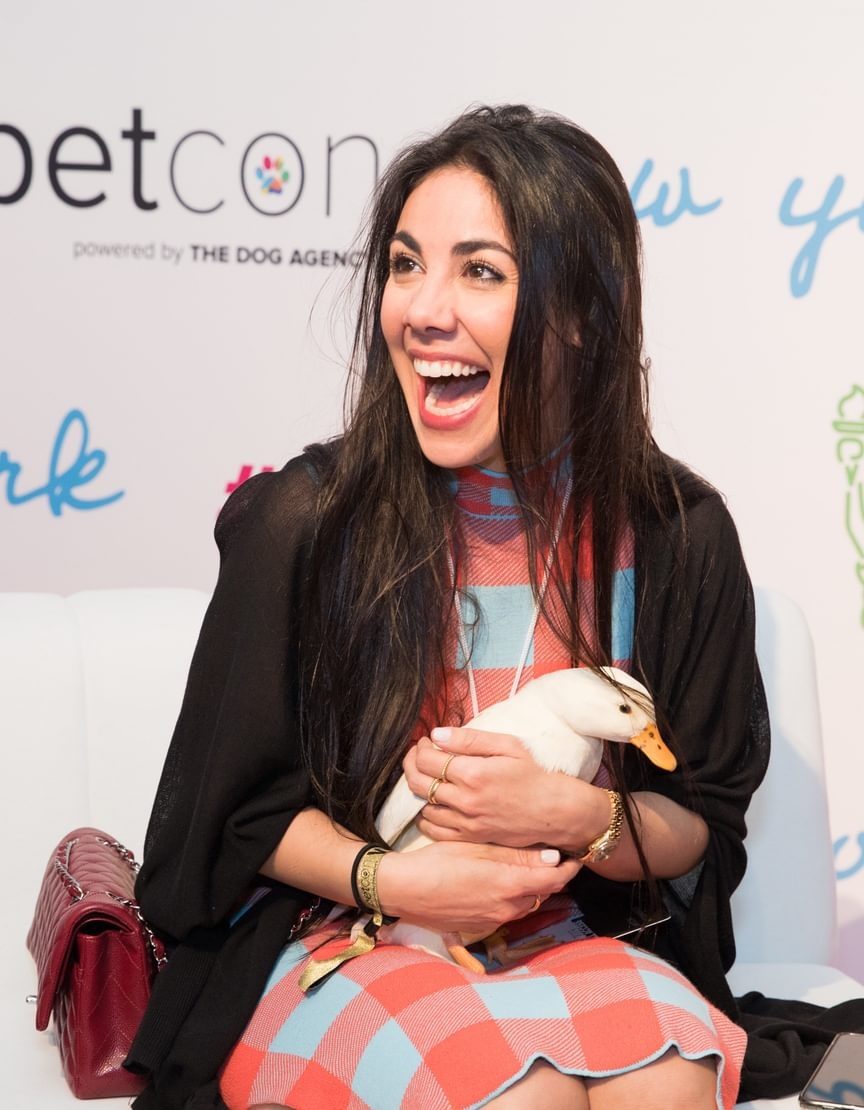
PetCon, launched in 2017, gave the same community a physical meeting place. Followers could meet the animals they knew from their feeds; owners could meet one another; brands could be present in the room. The premise had already been demonstrated at Starbucks. People recognized these pets, and recognition could make them cross a room.
In July 2023, the event arrived in Chicago’s West Town neighborhood at Morgan MFG. Animals and their humans traveled from the United States and Canada. Organizers expected more than 1,800 visitors across two days. A duck and a racing corgi were among the attractions, which is a more interesting guest list than many conferences manage.
“We’re celebrating our love of pets,” Lunau said that weekend. The meeting also made visible the work that tends to disappear inside a social feed: owners comparing experiences, businesses presenting products and fans taking time to be there.
An October 2025 account placed PetCon at Wallis Annenberg PetSpace in Los Angeles, with celebrity encounters, training and grooming panels, and a costume contest. Lunau was there too. The progression from an Instagram account to a gathering of people is one of the clearest measures of her career: she kept finding occasions for an existing attachment to become a shared experience.
The tote bag connection
There is an earlier version of that instinct in her relationship with Andover. Edwards has described the school as her first strong community, one she continued to turn to long after graduation. An alumnus helped her find her first job after college. Friendships formed there remained close ones.
When she began dividing her time between New York and Chicago in 2019, she went to an Andover event to meet people in Chicago. Another connection began in an Apple Store at Grand Central: she spotted a man carrying an Andover tote bag and went over to introduce herself. A school emblem had done the introductory work that a familiar dog could do elsewhere.
The anecdote is small, but it puts a person inside the founder biography. Edwards notices a possible connection and walks toward it. Building a business around pet owners makes more sense alongside that habit. A network has to consist of people who actually speak to one another.
“All of this exists because of Chloe,” she said in 2019. The sentence gives the dog her due while leaving room for the human’s part: recognizing what other owners needed, bringing earlier skills to bear and making the introductions last beyond a single encounter.
“All of this exists because of Chloe.”
Loni Edwards · 2019
Eventually, the dogs got a book
Writing a book was something Edwards had wanted to do. A publisher approached her in March 2020, and How To Make Your Dog #Famous followed in 2021. Its subtitle, A Guide to Social Media and Beyond, neatly describes how far her own work had traveled from the first photographs.
The 136-page book combines practical advice about establishing an online identity with stories from more than forty animal accounts. Tika the Iggy, Tuna Melts My Heart and Harlow and Sage appear among them. The variety matters: people arrive at these accounts for different personalities, different jokes and different kinds of companionship.
A guide also requires the author to turn experience into something another person can use. Edwards had already done that conversationally with owners asking about agreements. In print, the questions could reach someone outside her immediate circle. The book put the work of the humans beside the appeal of the dogs.
Her career has repeatedly moved through that gap between enjoying something and arranging for it to work. A handbag could carry a charger. A pet owner could need an agent. An online audience could want somewhere to meet. At the beginning was a woman taking pictures of her French bulldog. Then someone recognized Chloe in a coffee shop, and a very different working life began to come into focus.
How To Make Your Dog #Famous
A Guide to Social Media and Beyond · 136 pagesMore from her world
Visit & follow
- Loni Edwards’s personal website ↗
- LinkedIn · Loni Edwards Lunau ↗
- Instagram · @lonidee ↗
- Twitter/X · @Loni ↗
- The Dog Agency ↗
- PetCon ↗
- Chloe’s Instagram account ↗
Watch & listen
- CBS Sunday Morning · The animal stars of Instagram ↗
- ABC News · Turning your pets into social influencers ↗
- Dog Edition · Dog Influencers ↗
Read on
- Cornellians · Loni Edwards Lunau’s agency ↗
- ABA Journal · Her career in conversation ↗
- Andover · A doggone good job ↗
- Digiday · Chloe’s coffee-shop recognition ↗
- AlleyWatch · The emPOWERED years ↗
- The Daily Front Row · An interview with Edwards ↗
- WTVR · Meet Toby Toad ↗
- Fast Company · Inside pet influencer accounts ↗
- Chicago Sun-Times · PetCon in West Town ↗
- The Hollywood Times · PetCon 2025 in Los Angeles ↗
- The book · Publisher description ↗