In 2013, LightSail Education looked like a classic product of the iPad gold rush: a New York startup, a tablet full of ebooks, an adaptive reading engine and a reported price of $75 per student per year. It had just won a $500,000 literacy challenge from the Gates Foundation and the education prize at the first SXSW V2V competition. The pitch was handsome. Give every child a library that could watch them read.
Three years later, the number attached to the product was startlingly different. Public reports put the base software at $10 to $12 per student. Yet the company was serving more than 200,000 students across more than 700 schools and districts, had raised an $11 million Series B led by Intuit co-founder Scott Cook with the Bezos Family Foundation, and was talking about expansion beyond the United States.
The useful story is hiding between those prices. LightSail did not merely mark down a digital bookshelf. It sharpened the thing schools were buying: a closed loop between a child choosing a book, the software checking comprehension, the library adjusting the next recommendation and the teacher seeing what to do on Monday morning.
Reported annual price per student
Historical press reports describe different product packages. The comparison shows the direction of travel, not a like-for-like current quote.
The book is only the beginning
Founders Gideon Stein and Steven Gittleson started LightSail in 2012. Stein, its founding CEO, brought experience in education and entrepreneurship. Gittleson, the founding CTO and now CEO, had spent decades building large mobile and web systems. Their premise came from a stubborn literacy problem: students improve when they spend time with texts that are interesting and appropriately difficult, but teachers cannot continuously hand-curate a separate shelf for every reader.
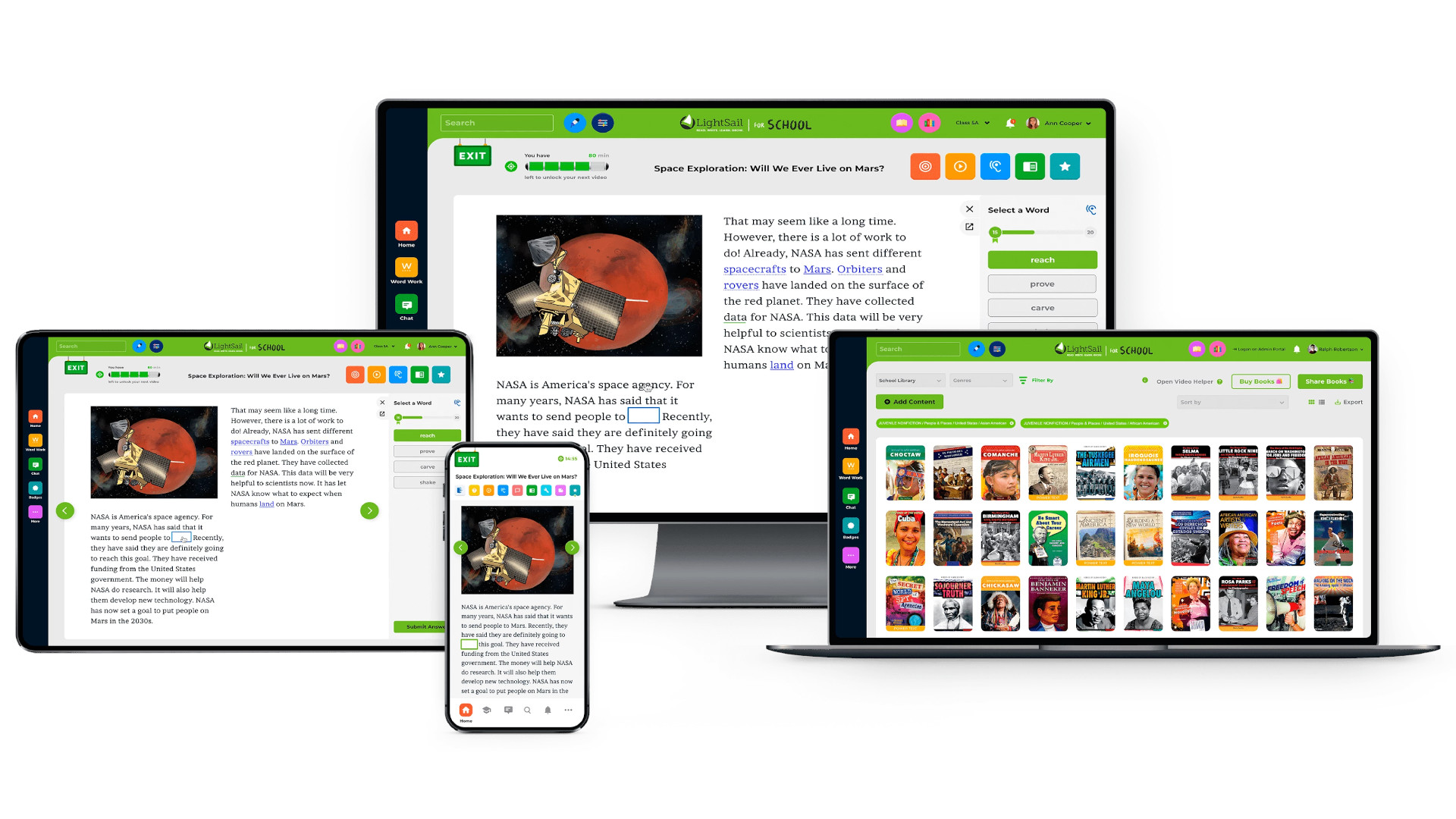
LightSail turns that premise into a sequence. A student begins with a benchmark and receives a Lexile measure. The library recommends books near that level, while preserving room for free choice. Inside the text, cloze questions - short fill-in-the-blank checks tied to the passage - test comprehension. The system records responses and reading time, then says it updates the student's Lexile level every 15 days. Teachers see the results in dashboards and can assign remediation or a different text.
That is more specific than the usual edtech promise of “personalization.” It gives the student a next book and the teacher a next move. LightSail surrounds the loop with vocabulary tools, read-aloud, annotations, video clips, badges, reading tournaments and a parent portal. Its Personalized Reader can change font, spacing, color, focus and decoding supports for struggling readers while the underlying text remains the same.
What gave way first
There is no public founder postmortem declaring the original model dead. The pricing trail tells a quieter story. In 2013, coverage described an iPad-first product with more than 18,000 ebooks at $75 per student. By 2016, the app had moved across platforms, offered more free and affordable content, and was reported around $10 to $12 for the base service. The first thing to give way was the tablet-era package and its economics.
That change matters because a district does not experience price as a single number. It sees licenses, devices, book rights, Wi-Fi, rostering, training, support and the political cost of asking teachers to change routines. Strip out a hardware assumption, unbundle premium content and lower the software entry point, and the same product becomes possible in far more budget meetings.
“Success is having millions of kids around the globe reading 30 minutes a day - whether that's on LightSail or even physical books.”Gideon Stein, co-founder
That quote also reveals a useful change in emphasis. The mission was not to maximize screen time or ebook ownership. It was to produce reading time and growth. LightSail's catalog expanded into tens of thousands of bundled texts and a much larger store of purchasable trade titles, but the software increasingly behaved like infrastructure around content. Content Builder let a teacher import a website, document, PDF or EPUB, remove clutter, add questions and place it into a class or district library. A book did not have to originate with LightSail to pass through LightSail's loop.
One platform, several classroom jobs
The product grew sideways from independent reading. Fluency Builder records students reading aloud, lets teachers mark errors with a digital running record and calculates words correct per minute. Writing modules guide planning, drafting, feedback and revision. Students can produce multimedia books and, with teacher approval, publish them to a class, school or broader LightSail library. Team Reading turns oral reading into a relay, complete with a digital baton and individualized display accommodations.
This is LightSail's difference from a plain ebook service. Sora or Epic can solve access. Newsela can supply leveled current-events content. Lexia and i-Ready can deliver structured skills instruction. Renaissance and myON connect reading data with content. LightSail occupies the busy middle: a customizable library with assessment living inside the text, plus fluency, composition, accessibility and classroom management around it.
The evidence deserves more care than the sales brochure usually gives it. A Johns Hopkins School of Education study examined implementation in three districts, including 17 low-performing middle schools in New York City. Its preliminary analysis connected more daily reading time in LightSail with stronger Lexile growth. LightSail later advertised that 30 minutes a day produced 3.9 times the gains. That is an association inside particular implementations, not permission to assume that opening the app causes the same result everywhere. The more defensible lesson is almost boring: students who used the reading system consistently tended to improve more, and the system made that consistency visible.
Visibility is valuable because silent reading has traditionally been hard to observe without interrupting it. A teacher can count pages or ask for a book report, but those are blunt snapshots. LightSail collects smaller signals while the student is already reading. The risk is equally clear: a dashboard can make a proxy feel like the whole child. Minutes, cloze answers and Lexile movement help a teacher ask better questions. They should not become the only questions.
Its customers are correspondingly plural: students, teachers, librarians, literacy coaches, administrators, districts and homeschooling families. The business model follows them. Schools buy per-student SaaS subscriptions and content bundles; customers can purchase additional trade books through the ebook store; implementation, professional development and premium technical help add service revenue. Family and partner versions create consumer and reseller routes. Current school pricing is quote-based.
The unglamorous moat: implementation
A literacy dashboard is worthless if the roster is wrong on Tuesday morning. LightSail wrapped the software in account managers, instructional coaches, custom library curation, workshops, network tests, data reviews and live phone or email help. Larger districts could use Clever for rostering. Premium support could include on-site device setup and Wi-Fi audits.
The company says more than 86 percent of its team has worked in schools, with 208 years of combined school experience. That statistic sounds like recruiting copy until you consider the product surface: book licensing, classroom routines, accessibility, assessment, device management and district reporting all have to cooperate. In K-12, support is not the decorative layer around SaaS. It is part of the mechanism.
LightSail applied the same pragmatism to its early market. Stein said the company started around New York because it knew the territory. Smaller districts could decide faster and communicate more closely. By 2016, reported customers included systems in New York, Los Angeles, Denver, Boston and Chicago, while international pilots or rollouts reached Latin America, Asia, Spain and South Africa. For schools with poor connectivity, the company developed offline deployment options rather than pretending every classroom had dependable broadband.
What another builder can steal
Copy the loop, not the library.
- Begin with a measurable job. LightSail connected reading choice to comprehension evidence and a next recommendation.
- Start close to the customer. Nearby, smaller districts gave the early team faster decisions and tighter feedback.
- Let outside content increase the software's value. Import tools turned LightSail from a catalog into a layer.
- Price the repeatable software separately from expensive inventory and implementation.
- Treat onboarding as product design. The feedback loop includes the teacher who must understand and act on it.
The playbook has limits. LightSail works when students have regular reading time, can find material they care about and receive sensible support. It works when teachers trust the measures, inspect the dashboard and have enough time to intervene. It works when devices, accounts and connectivity behave. A badge cannot rescue a reading routine that does not exist; an adaptive score cannot replace explicit instruction for every foundational skill.
Those conditions help explain the 2023 acquisition by MindPlay Education. MindPlay has decades of experience in structured reading intervention. LightSail brought the library, engagement and reading-across-content layer. One identifies and addresses skill gaps; the other gives students somewhere broad and appealing to apply those skills. The price was not disclosed.
LightSail survives as a product because its central idea is sturdier than the device fashion that launched it. A digital shelf is convenient. A shelf that notices what happened, helps the teacher respond and quietly reorganizes itself for the next visit is a system. The company's most useful lesson is that the system became easier to sell when it stopped making the shelf the whole story.