Every morning, Li Xin walks into a meeting in which the world is briefly made negotiable. Desk chiefs propose stories. Editors inspect the competition. A subject considered urgent at nine may have been displaced by ten. Li calls this gathering her “morning expresso” - an endearing spelling for an unsentimental ritual. The drink is strong; the news is stronger; neither waits.
Then come the hats. She is managing editor and managing director of Caixin Global, as well as a vice president of Caixin Media. On a given day she may move from an editorial budget to an intelligence product, from a reporter’s draft to a stage shared by a central banker or former prime minister. The titles sound corporate. The habit underneath them is journalistic: decide what matters, ask what is missing, test the answer.
Li’s particular problem is distance. Caixin reports from inside China; many Caixin Global readers encounter the country from outside it. A translation can carry a sentence across that distance, but not necessarily its weight. Institutions, policy signals, business customs and historical memory all travel badly without luggage. Li’s work has been to pack the bags.
“Trust has to be earned, by each piece of reporting, with time.”Li Xin
A career in crossings
She came from Chongqing, the vast inland city whose hills make even a short journey feel architectural. At Tsinghua University she studied English, a practical education in crossing meanings before she made a profession of it. A master’s degree in journalism at the University of Missouri added another newsroom tradition. Later came an Executive MBA from Cheung Kong Graduate School of Business. Language, reporting, management: the curriculum now looks almost suspiciously well plotted. Careers, however, are written forward and edited backward.
The early work was visual. After an internship at Xinhua, Li became a documentary producer at China Central Television from 2001 to 2004. Documentary production teaches a useful form of humility. Reality refuses to hit its mark. The scene one planned is often less revealing than the glance at its edge. An editor learns to arrange material; a journalist learns that the material may object.
The route to a global newsroom
In 2006, Caijing sent her to establish its first bureau in the United States. The assignment was bigger than finding an office and a telephone. A bureau is a claim that events elsewhere deserve to be seen through your own eyes. Li reported politics and economics, then returned in 2007 to run Caijing’s English website. China was becoming a larger global story; she was learning that a larger story produces a larger number of ways to misunderstand it.
Her move to the Chinese-language Wall Street Journal and Chinese Dow Jones Newswires offered a view from the other bank. She has spoken warmly of the standards, culture and daily professionalism she encountered there. When she returned to Caixin in 2016, she brought that education into a job with more pieces: news, research, events, products and the awkwardly grand task of helping a China-based newsroom speak globally.
The luxury of a second question
Li once pursued the same question in an interview with a Chinese official until the conversation ended. “You sound like you’re from foreign media,” the official told her. It was meant as a rebuke. It also revealed the peculiar geography of a good question: it can make the interviewer seem to come from somewhere else.
She does not romanticize confrontation. A sharp question can expose character, but force alone is not a reporting method. Curiosity needs caution. Skepticism needs evidence. Her preferred description of Caixin’s method is beautifully repetitive: investigate, verify, and verify again. The third verb is the point. In a media economy built to reward immediacy, repetition can be an act of resistance.
The old-fashioned method has commercial consequences. Li has noted the lure of better-paid jobs at powerful technology companies. She stayed with the difficult product. Some investigations take months; others take years. A newsroom that chooses such work must persuade readers that delay can be value rather than failure.
That is where editorial faith met a spreadsheet. In late 2017, Li and Caixin publisher Hu Shuli visited Financial Times chief executive John Ridding. They discussed the FT’s successful subscription model, and Caixin returned to debate a paywall of its own. Charging for online news in China was then an untested habit. There were complaints, adjustments and the unavoidable expense of building the machinery. Subscriber growth eventually followed. The principle was plain: if advertising could no longer finance patience, perhaps readers would.
Editing the space between languages
Caixin Global is not merely Caixin with English subtitles. The Chinese service publishes at greater volume across news, analysis, opinion, blogs and databases. The English newsroom selects stories for readers who may lack the surrounding knowledge a Chinese reader brings automatically. Selection is not a lesser editorial act. It is an argument about relevance.
Li describes the needed additions as framework, context and knowledge. These are quiet words for difficult labor. The English reader must be told enough to understand a policy without being buried beneath its genealogy. The Chinese story must remain recognizable after explanation. A perfect translation that leaves the reader perfectly confused is merely a bilingual failure.
Her ambition is equally direct: make Caixin Global a first choice for English-language news about China. She does not pitch this as a campaign to popularize Chinese media. She wants readers to see that China has muckrakers, rigorous analysis and independent-minded reporters. “Language shouldn’t be the barrier,” she has said. Nationality should not be a waiver, either. Trust asks the same price everywhere.
The room becomes a newsroom
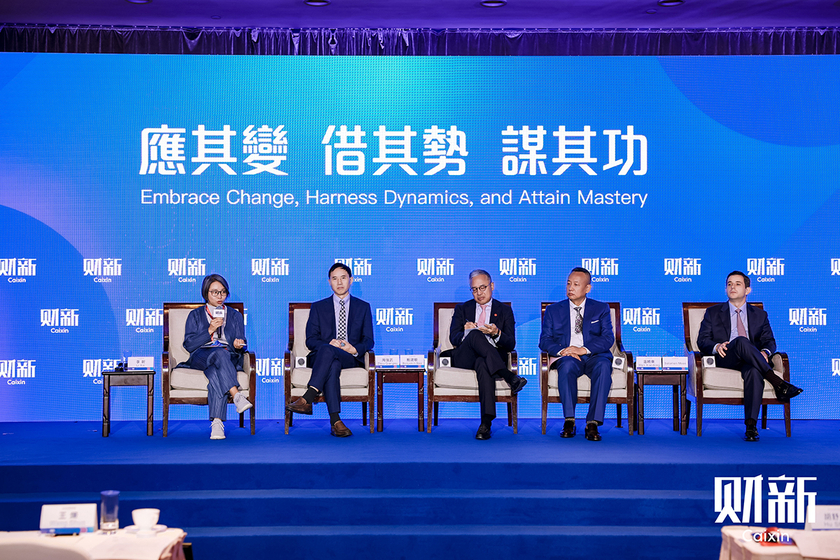
International forums might seem far from investigative reporting: flattering lighting, polite applause, small bottles of water aligned with military precision. Li treats them as another reporting format. The guest has an argument. The moderator finds its assumptions. The audience listens for the part that was not in the prepared remarks.
That logic helped shape Caixin’s Asia New Vision Forum in Singapore. Li wanted a place for Asian voices on China, Asia and the world, with Singapore serving as neutral ground for candid conversation. By 2025 the gathering had grown to more than 600 participants, 140 speakers from 12 countries and over 40 sessions. She moderated exchanges with publisher Hu Shuli, economist Larry Summers, investor Fang Fenglei and former CICC chief Levin Zhu. Outside, the Mandai Rainforest supplied uninvited lunch companions: birds and animals, a comic reminder that sustainability has stakeholders who decline name badges.
The scale matters less than the arrangement. Officials, executives, investors and scholars are invited into the same editorial space. This is bridge-building without the ribbon ceremony. It does not require agreement. It requires enough shared language to disagree precisely.
“There is no miracle in the media industry.”Li Xin
Li remains close to the page. In January 2026 she filed reporter’s notebooks from Davos, observing a forum whose old globalist confidence had given way to a more muscular politics. In May she wrote about the challenge Chinese companies face when moving from market entry to local trust. In September she examined Macao’s effort to diversify its economy and become a different sort of bridge to the world. The executive still reports. Perhaps the reporting keeps the executive honest.
Her public manner offers few theatrical flourishes. The traits she praises are curiosity, caution, perseverance and resilience. She recommends the poet Haizi. She speaks of passion as a shared language among young journalists. These details suggest a person who has not mistaken sobriety for indifference. Journalism needs feeling; it simply cannot use feeling as evidence.
The final paradox of Li Xin’s work is that a global platform is built through local acts: one editor challenging a premise, one reporter making another call, one moderator declining the easy follow-up. The information gap sounds vast because it is. The unit of repair is small.
Tomorrow morning, the desk chiefs will return with another proposed map of the day. The agenda will change. The hats will change. The requirement will not. A reader, somewhere else, will need more than a translated sentence. Li’s newsroom will try to send the sentence with its world attached.