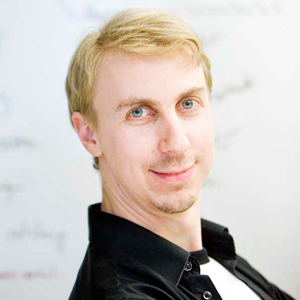
On a flight from Malmö to Mumbai in 2000, a young Swedish CTO pulled out a napkin and started drawing. What emerged was the property graph model - a structure for storing data as nodes and relationships, the way a human brain actually works. That napkin sketch became Neo4j. Neo4j became the world's leading graph database. And Emil Eifrem became the person who named an entire category of technology.
The Programmer Who Wouldn't Stop at 'Relational'
Emil grew up in Sweden programming - his first free software project launched when he was 16. By his late twenties, he was CTO of Windh AB, a Stockholm tech company building enterprise content management systems. The job involved storing vast amounts of connected data: documents linked to people, people linked to departments, departments linked to customers. Relational databases handled none of it gracefully.
"Relational databases are not good with relationships," Eifrem would later say. "What they actually are is tabular databases." The observation wasn't academic. He was watching engineers spend months fighting database schemas rather than building products. Every new relationship in the data meant painful joins, slower queries, and schema migrations that touched everything.
"Graph databases are modeled after how the human brain works."
Emil EifremThe flight to Mumbai was a meeting with an IIT Bombay intern. Somewhere above the Indian Ocean, the solution crystallized on a cocktail napkin: store entities as nodes, store relationships as first-class objects with their own properties. Query them by traversal, not by joins. The property graph model was born at 30,000 feet.
Seven Years Between Napkin and Neo4j
The idea took seven years to become a company. Eifrem continued at Windh, studied at Linköping University from 2003 to 2007, and refined the database technology in parallel. Neo4j (Neo Technology at incorporation) spun out in 2007, taking all the database IP. The company bootstrapped, stayed small, and built open source.
2009 nearly finished them. The startup had $2,000 in the bank. Payroll was due in six days. Their lead investor pulled out mid-deal. Emil and the team pivoted to consulting overnight - cold-calling clients, factoring invoices at steep discounts to get cash before checks cleared. They made payroll. Nine months later, the NoSQL wave was cresting, and Neo4j finally raised a seed round.
"You have to have that 'whatever it takes' mentality. If not, you're just not gonna survive."
Emil EifremThe 2011 Series A put the company on firmer ground. Eifrem built the team, focused on commercial customers, and leaned into what would become Neo4j's defining strategy: give the product away to developers, charge enterprises for the rest. "The key philosophy is to build a thriving ecosystem by giving the product for free to those with more time than money," he explained, "while charging enterprises for specialized features like LDAP and Kerberos integration."
The Panama Papers Changed Everything
April 3, 2016. Emil was living in Silicon Valley when the International Consortium of Investigative Journalists published their findings from 11.5 million leaked documents - the Panama Papers. The investigation had run on Neo4j. Reporters used it to map 320,000 offshore accounts across 214 countries, tracing shell companies through dozens of layers of ownership to identify the people at the center.
What graph databases do - following chains of connection through arbitrarily complex networks - was exactly what traditional databases cannot. The investigation became the biggest news story of that year. It won the Pulitzer Prize. Iceland's Prime Minister, whose undisclosed offshore stakes were revealed in the data, resigned within 48 hours of publication.
Emil describes this period as clarifying. "Billions of dollars of tax revenue that was previously hidden" were recovered across multiple countries. Several politicians and business leaders were indicted. Neo4j was suddenly not just a database. It was infrastructure for accountability.
An American Company with a Swedish Soul
Eifrem talks about Neo4j's culture with unusual specificity for a Silicon Valley CEO. The company's first core value: "We value relationships." It's both a product philosophy and an organizational one. Engineering hubs in Malmö and London coexist with California headquarters. He describes the combination as "an American company with a Swedish soul" - the Swedish pragmatism around deep technical work, the American ambition around market dominance.
"I'm not in love with startups like I'm in love with this startup."
Emil EifremThe 2021 Series F put a number on what he'd built: $325 million, at the time the largest single funding round in the history of the database market. The valuation reached $2B+. 84 of the Fortune 100 were customers. Every one of the 20 biggest US banks. Nine of the ten largest pharma companies. All ten top automakers.
Graph Technology as the Missing Link for AI
When large language models arrived at scale, Eifrem saw it immediately. LLMs are brilliant at language. They hallucinate facts. They lose context across long conversations. They lack persistent, structured memory. Graph databases, he argues, are the architectural answer to all three problems.
"Graphs function as the missing link for AI - providing structured memory, context, and ground truth that LLMs lack." In October 2025, Neo4j launched Neo4j Aura Agent and an MCP Server for agentic systems, alongside a $100M global startup program to back founders building AI-native products on graph technology. Over 300 startups joined within weeks.
"If we don't win this next platform shift, we may not have a business to protect."
Emil EifremThe bet is not subtle. Neo4j passed $200M in annual revenue in 2024. Generative AI customers grew six-fold in a single year. Eifrem had positioned the company - and the entire graph database category - as the memory layer of the agentic AI era.
Graphs4Good: The Personal Wager
Behind the investor metrics is something Emil talks about differently. A half-brother died of cancer at age 24. It shaped how he thinks about what technology is actually for. The Graphs4Good program, which he established within Neo4j, channels graph technology toward investigative journalism, pandemic response, and cancer research.
The numbers from that program: a vaccine manufacturer used Neo4j to optimize COVID-19 supply chains, potentially accelerating delivery by weeks. NASA publicly stated Neo4j could help humanity reach Mars two years earlier by mapping mission dependencies and system relationships. Over 20 cancer research projects have utilized Neo4j to advance the science toward cures.
"If all I achieved professionally was increase the probability of finding the cure for cancer by 1 percent," he said, "I would feel very, very satisfied." For a $2.2B CEO, it's an unusually specific north star. It's also what makes Emil Eifrem's story different from most founder narratives: the mission predates the money and, by all evidence, will outlast it.
What He Does Next
In his words: "save the world with graphs and own Larry's yacht by the end of the decade." The Larry is presumably Ellison. The yacht remains aspirational. The saving the world part - through cancer cures, AI infrastructure, and investigative tools that hold power accountable - is already underway.
At the HumanX 2026 conference, Eifrem delivered a keynote on moving enterprise AI from data to knowledge to action. The graph as the connective tissue of the intelligent enterprise. The same idea he drew on a napkin over the Indian Ocean 26 years ago - finally having the exact moment the world is ready for it.