Lee Chen was more comfortable with numbers than with people. This would be an unremarkable confession from an engineer, except that his next business depended on teaching engineers to excel at customer service. The reluctant pupil was the founder himself. A10 Networks would sell equipment to move and protect application traffic. Chen also wanted the people who built it to venture into the awkward territory on the other side of the specification sheet.
By 2011, the company counted Microsoft and Subaru among its customers and was doing business in ten countries. The premise had survived contact with the market. Behind it lay a much longer apprenticeship: evening classes, startups that stumbled, a demanding colleague, and the discovery that a technically gifted organization could still arrange itself very badly.
Chen's career runs through Centillion Networks, Foundry Networks and A10. The familiar milestones are there: an acquisition, public offerings, new products. The more revealing moments concern who did the work, who got to question it, and who had to listen when a customer was unhappy.
The working day had an evening shift
Chen grew up in Taiwan and earned his bachelor's degree in electrophysics at National Chiao Tung University in 1976. He arrived in the United States in 1979 with limited English and found work at Control Data Corporation. An employer willing to pay tuition helped turn that first job into another education.
He enrolled at San José State, working full time while studying electrical engineering in the evenings. The master's degree came in 1982. His account of the period has little room for the leisurely campus interval: work ran into the early evening, then came class. The two schedules occupied the same years.
He liked technology and wanted to chart a path of his own. A large company felt like the wrong setting for his temperament. The next move was toward startups, where there would be fewer layers between an engineering decision and its consequences. Some of those consequences proved expensive.
The trouble with the indispensable engineer
One early employer built networking technology that let personal computers share storage. Revenue grew quickly, inventory piled up, and a downturn left the business unable to secure more money. It closed. Chen had seen a promising technical business fail on circumstances a better circuit diagram could not fix.
He also encountered an engineer who kept reworking other people's contributions. The employee could produce excellent work. Everyone else's opportunity to learn and take responsibility shrank around him. Chen came away convinced that ability had to spread through a team. An expert who became unavailable could otherwise leave the organization stranded.
At Convergent Technologies, Chen moved from staff engineer into management and met Bobby Johnson. Johnson had a forceful temperament; Chen recognized some of his own determination in him. Their professional relationship would continue into later ventures. Learning to work with a difficult colleague had become part of the engineering education.
Review, review, review
Centillion built switches that connected different kinds of networking media. Bay Networks acquired it after roughly eighteen months for $145 million. Chen was a founding member and key engineer. Between that venture and Foundry, he also worked in Houston on a private internet project for oil-and-gas pricing and auctions.
Foundry began in March 1996 with a decision to pursue high-performance Gigabit Ethernet. Chen managed engineering; Johnson was CEO. Chen's description of the process was wonderfully unglamorous: “review, review, review”. Hardware and software engineers worked together. Interdisciplinary scrutiny was supposed to catch mistakes before customers inherited them.
He also wanted to remove the incentive to blame colleagues. Engineers needed room to contribute, disagree and learn. Chen recalled taking some of Johnson's criticism in private so the engineering team could continue its work. Managing the person above him was occasionally a service to the people below.
Foundry went public in 1999. Chen admired Johnson's financial discipline and ability to anticipate changes in demand. When the internet bubble burst, the company had already moved toward enterprise customers. Fiscal restraint, exercised while restraint was unfashionable, had acquired a practical use.
- 01CentillionConnect different network media
- 02FoundryBuild for Gigabit Ethernet
- 03A10Deliver and protect applications
Another company, another set of questions
By August 2004, Chen had spent eight years at Foundry. He felt he had worked across the groups he wanted to experience. He left without knowing precisely what the next company would do, although he expected engineering to be central. He wanted a personal challenge and a business with a global perspective.
A10 was founded that year. In his account of its early thinking, conversations with customers helped define the opportunity. Carriers were wrestling with rising traffic, electricity consumption and storage demands. Customers also disliked paying separately for software modules. Their complaints supplied both technical requirements and an opening in the business model.
Chen wanted a platform that could consolidate work and use power efficiently. The architecture emphasized multiple processors and cores. He said its operating-system kernel took two and a half years to develop. That is a substantial interval in which a founder must keep paying for a conviction that customers cannot yet buy.
The thinking joined two kinds of economy: what the equipment consumed and what the customer had to purchase. A feature list could look impressive while the electricity bill and licensing arrangement spoiled the experience. Listening widened the design brief beyond the box itself.
Send the engineer
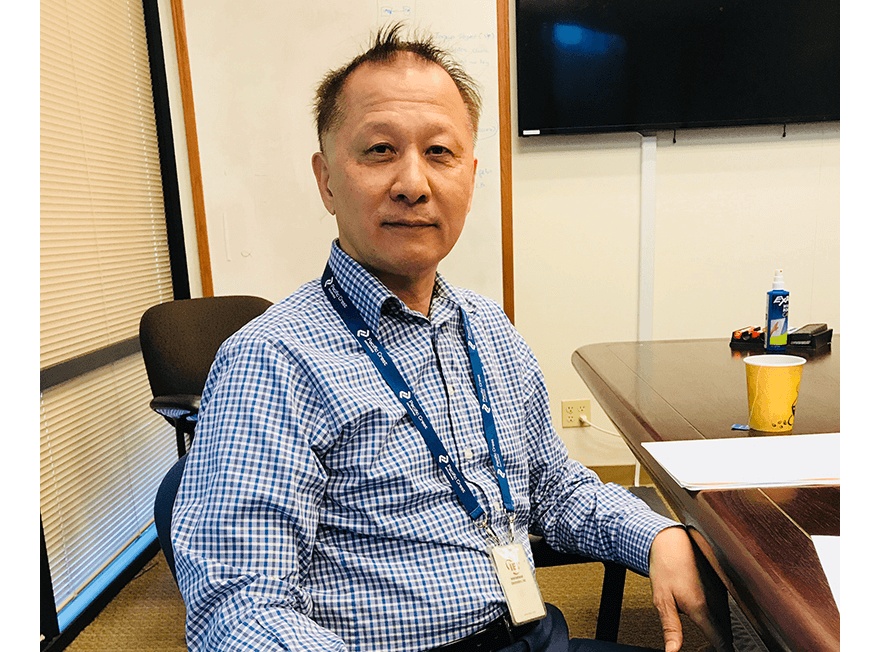
A10's approach made customer contact part of an engineer's job. Chen traveled to customer sites, asked for feedback and helped improve the product. Recruiting leaned heavily on referrals. He wanted the whole business to retain the willingness to experiment associated with a startup, even as it grew.
The arrangement made a useful demand of the technical staff. A customer could describe a problem in terms that were inconvenient for an internal division of labor. Engineers had to hear it anyway. Their involvement shortened the distance between a complaint and someone who could change the product.
Some early help came from familiar people. Chen said former Foundry engineers contributed to A10 after retiring, taking some equity and working for enjoyment. He persuaded another former colleague to come out of retirement for business development. Professional history had become a recruiting resource.
He also sought investors whose patience and connections suited the business. Mitsui's international distribution relationships appealed to him. In 2008, he described a preference for longer-term relationships and investors who would leave room for his technical judgment. Building globally required more than translating the sales brochure.
A10 formally introduced its application-delivery product in the United States and Japan in 2007. Chen identified Toyota, won late that year, as its first major customer. The company was beginning to test whether years of architectural work could solve the problems behind those earlier conversations.
His ambition was concrete. In 2008, he named reaching $100 million in revenue as a goal and said the immediate task was winning customers. His timetable was a forecast, with the uncertainty that forecasts carry. It put an ordinary commercial test beside the technical one: enough people had to choose the product, and the sales relationships had to support that choice.
The bill before the bell
The path to a public company included a costly confrontation with Chen's previous professional world. Brocade, which had acquired Foundry, pursued litigation against A10 and individuals including Chen. The dispute was settled in 2013. A10's financial commitment was $75 million, a figure that belongs beside the growth milestones.
The final judgment made an essential distinction: it entered judgment against A10 for that amount and in favor of Chen and the other specified individual defendants on all claims against them. The company's payment and the individuals' final legal position were different parts of the same resolution.
On March 21, 2014, A10 reached the New York Stock Exchange under the symbol ATEN. The offering sold 12.5 million shares at $15, raising $187.5 million. Its opening trade was below the offer price. By early afternoon the shares were modestly above it. Wall Street supplied a restrained reception.
Chen rang the opening bell and bought the first share on the exchange floor. His own account was visibly delighted. He thanked employees, customers and partners, then returned to the prospect of building a company that would last. The public celebration fitted into a much longer working calendar.
“An IPO is just one day amongst many”
Lee Chen, April 2014
A company with a life beyond its founder
The product questions kept changing. In 2016, A10 acquired Appcito, a startup working on application delivery across cloud environments. Chen and Appcito founder Kamal Anand explained the move in separate videos. The challenge now included customers operating between conventional data centers and newer cloud infrastructure.
Security also occupied more of his public attention. During a 2017 television appearance, Chen warned that cryptocurrencies could become a major target for attackers. In a 2018 interview, he emphasized security policies, automation and the particular sensitivity of gaming networks to delays and malicious traffic. A small interruption could carry real consequences for the user.
His time running A10 ended on December 2, 2019, when Dhrupad Trivedi became president and CEO. Chen initially remained chairman to help the transition. He resigned from the board in February 2020. The company continued with another executive responsible for its next decisions.
That handover gives his A10 chapter a clear ending. Its more personal thread reaches back to the engineer who preferred numbers and found himself learning customer service. He had spent years building teams capable of doing work together. Eventually, that work included hearing the problem in another person's language.
Keep the conversation going
- Lee Chen on LinkedIn
- A10 Networks website
- The seven-part career interview with Sramana Mitra
- Chen's account of A10's IPO day
- Watch: Chen on Appcito and the cloud, 2016
- Watch: the cybersecurity interview, CNBC, 2017
- The 2018 network-security interview
- A10's first trading day, Light Reading
- The 2013 stipulated final judgment
- The 2019 CEO succession announcement