The first thing Kunal Kushwaha contributed to the Kubernetes Java client was an absence. He deleted a file. For a student in Delhi who knew Java but had barely met Kubernetes, it was a reasonable place to start: small enough to understand, useful enough to submit, public enough for someone else to review. The contribution did not require a grand declaration of expertise. It required opening a repository and making a change.
That tiny edit became a kind of syllabus. Kushwaha went on to fix small issues, add examples and tests, and eventually contribute features. Years later he would tell students eyeing open source, “The best way to get started is just to get started.” The line sounds almost too simple until you remember how much ceremony a beginner can invent around the first step. Kunal had taken his before he knew the whole map.
Today he is the London-based founder of WeMakeDevs and a Senior Developer Advocate at CAST AI. His free coding lessons have traveled far beyond any lecture room he sat in, and his community now runs events where students can build in teams. To understand the scale of that work, it helps to return to the unusually modest beginning: a young programmer making himself useful one change at a time.
The syllabus outside the classroom
Kushwaha attended Maharaja Agrasen Institute of Technology in Delhi from 2018 to 2022. Before that, he had failed India's engineering entrance exam twice. He has described a university education that was largely self-directed. Instead of waiting for a course to supply every skill, he worked through free resources and open-source projects. There is a difference between admiring that independence from a distance and having to practice it while classmates are making their own plans. His story contains both the freedom and the uncertainty of writing a curriculum while following it.
The Kubernetes Java client offered an early laboratory. Java was familiar; the cloud-native world was not. He learned the unfamiliar system through the ordinary work of a repository: reading issues, inspecting examples, submitting changes and accepting review. A learner can spend weeks arranging the perfect sequence of tutorials. A project has a blunter way of setting the next lesson: something does not work, or could work better, and somebody needs to find out why.
University in Delhi; early contributions to the Kubernetes Java client.
A CNCF scholarship takes him to his first KubeCon in San Diego.
Free programming videos include a detailed Git and GitHub tutorial.
He announces a team-led WeMakeDevs relaunch after the community passes 100,000 members.
WeMakeDevs starts the six-city Bharat Builds Tour with AWS.
Other people helped open doors. Kushwaha was a mentee in the Linux Foundation's LFX program and received a CNCF Dan Kohn Scholarship that brought him to KubeCon + CloudNativeCon in San Diego. He later mentored students through Google Summer of Code and helped start CNCF Students. The sequence matters. In each stage he moved between asking for help and offering it, until mentorship became less a private favor and more part of the infrastructure around a newcomer.
“The only thing better than helping people is helping people who help people.”Kunal Kushwaha
He has recommended what he calls decentralized mentorship: ask researched questions in public forums, where a wider group can answer and the reply can help the next person. It is a practical approach for a community that cannot assign a personal guide to every student. It also asks something of the learner. Do the reading. Show the attempt. Let the question be visible. Those habits are less glamorous than a career roadmap and more reusable.
A camera, a lesson, an audience
During the pandemic, Kushwaha began posting free tutorials on YouTube. A Python video crossed 100,000 views, encouraging him to keep teaching. Then came the Git and GitHub lesson, published in August 2021. It starts with the basics and keeps going through branches, pull requests, rebasing and merge conflicts. Its length makes a mild promise: the creator intends to stay with the problem until a newcomer can actually use the tool. By September 2026, the video had more than three million views.
His Java data structures and algorithms bootcamp went further than a playlist. Its public GitHub repository holds code samples, assignments and notes, and has drawn tens of thousands of stars. A video can introduce an idea; a repository can keep the work close enough for someone to try it. That pairing helps explain why his teaching has lasted beyond an algorithm's day in the recommendation feed.
Numbers show reach; they do not tell the whole story of a lesson. One glimpse of its unlikely travels appeared in Bengaluru, when Kushwaha shared a video of a ride-hailing driver who had downloaded WeMakeDevs tutorials to study coding. It was a small encounter, recorded during an airport ride, yet it put the premise of free education in plain sight. A lesson can be taken wherever a person has time and a device. What they do with it remains their own work.
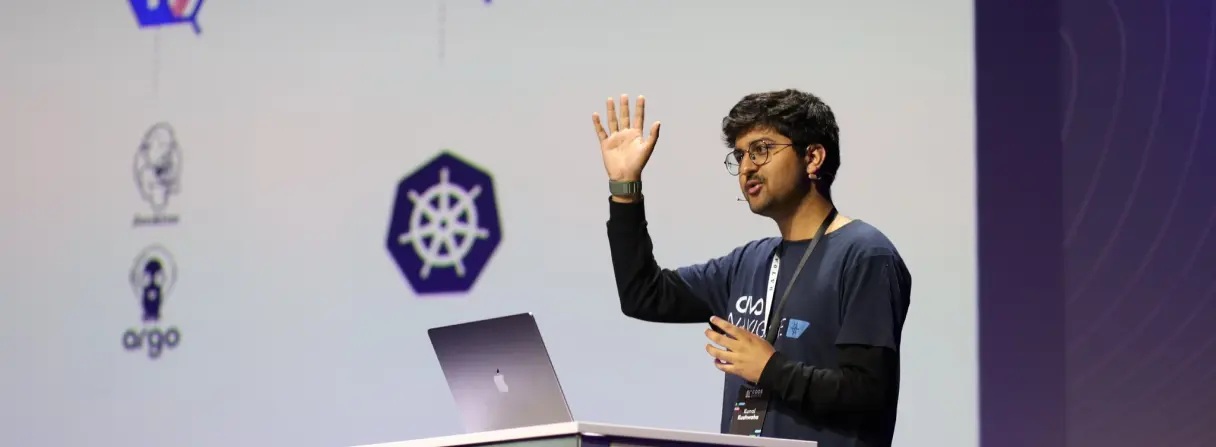
The teaching and the day job have fed each other. At Civo, Kushwaha worked in developer relations and later served as Field CTO. His public work has included cloud-native talks, community events and student outreach. He is a CNCF Ambassador and GitHub Star, and has been a KubeCon + CloudNativeCon track chair and Google Summer of Code mentor. He now works at CAST AI, leading developer relations work in the EMEA region around cloud-native systems and AI. The subjects change with the technology. The habit of explaining them to another person persists.
When the class becomes a community
WeMakeDevs grew out of the same interest in accessible learning, first known as Community Classroom. Its activities have included free courses, meetups and hackathons. The point of a gathering is different from the point of a video. People can compare attempts, find collaborators, and discover that the person beside them also spent half an hour confused by the same error. A community can make the solitary parts of learning feel less solitary without pretending the work is easy.
Kushwaha has said that projects made during the community's hackathons are hosted on GitHub. That detail gives an event a longer life than its closing ceremony. A team can return to the code, explain a decision to a new contributor, or show an employer what it actually built. A novice looking through the projects can also see the work behind the polished demo. The public repository is a classroom with the chairs left out: open at any hour, a little untidy, and often more instructive for it.
Growth created another kind of problem. In a 2024 post, Kushwaha said WeMakeDevs had passed 100,000 members, then admitted that balancing it with a full-time job had kept him from giving it enough attention. He assembled a team and personally funded a relaunch. It is an unusually useful founder update because it includes the less photogenic part of scale: other people need the authority to carry the work. A community centered too tightly on one person has trouble becoming a place where its members lead.
His own route from Delhi to London had already shown what networks could do. He moved on a UK Global Talent Visa and worked across startups and cloud infrastructure. Yet the move did not make his audience merely local. WeMakeDevs reaches learners across borders, while many of its programs remain closely tied to the ambitions and obstacles of Indian students. That combination gives Kushwaha a particular vantage point: he knows both the online room and the very real city a student logs in from.
The working idea
Give a beginner a real project, people to ask, and a public record of what they made. Then let the next lesson arise from the work.
In August 2026, WeMakeDevs announced the Bharat Builds Tour with AWS: six hybrid hackathons scheduled from September through December, with in-person weekends in Indian cities and an online path for students elsewhere in the country. The first event, First Commit, ran in September with a Bengaluru build day. The tour advertises mentors, cloud tools, prizes and hiring conversations for top projects. Its educational bet is more interesting than the prize list. A student who has watched a course can leave with a repository, a demo and a story about what broke before it worked.
The hybrid format is consistent with the road Kushwaha took himself. Geography should not decide who gets to attempt the assignment. A participant in a host city can share a table with teammates; someone online receives the same theme, deadline and judging process. Neither route guarantees a career. Both offer a concrete piece of work that can be shown to the next collaborator, mentor or employer.
There is a neat loop in the title First Commit. Kushwaha's own first useful change to a public project was simply a deletion. It would be easy to make too much poetry from that; software has enough metaphor already. But the sequence is real. The file went away. A learner stayed, learned the system, and eventually made room for others to enter it. When the tour asks students to ship something, it is asking them to cross the same small threshold. Open the project. Make a change. Let somebody see it.