A management workshop is an excellent place to lose a perfectly good afternoon. At an early Cognizant gathering, executives were asked to write down their vision for the company. Kumar Mahadeva’s contribution was brief: a company worth $10 billion to shareholders. It was an ambition that could be measured, expressed without a thicket of qualifications. Nobody needed a second sheet of paper.
There is something revealing about that preference for a measurable destination. Mahadeva helped build a business whose everyday work could sound stubbornly ordinary: developing applications, maintaining software, making systems behave. Its ambitions were considerably larger than its job descriptions. He expected an operation born within a corporate parent to become an enterprise that outside customers would choose.
To understand his part in Cognizant, it helps to look at the decisions beneath the eventual scale. Where should the company compete? Which attractive work should it depend on less? How much money should it spend to know a customer properly? Those questions gave its early years their shape, and gave Mahadeva’s colleagues something more durable than a rousing speech.
An engineer takes the long route
Born in Sri Lanka, Wijeyaraj Kumar Mahadeva took a route through Britain and the United States before the Chennai venture that became Cognizant. He studied electrical engineering at Cambridge, began his career in research and development at the BBC in London, and earned his Harvard Business School MBA in 1978. Engineering and management sat together in his education well before they met in his company.
His next employers exposed him to different forms of organizational ambition. At McKinsey he worked with technology businesses on strategy and operations. At AT&T he worked in strategy and corporate development. Dun & Bradstreet then put him in charge of India and China, with responsibility for developing business in the region. The eventual founder had spent years learning how established institutions made decisions.
The sequence matters without requiring a tidy claim that every earlier job foretold Cognizant. Research involves making something work. Consulting involves persuading somebody that the proposed work is worth doing. Corporate development adds the complications of ownership and resources. By the time Mahadeva helped start a software operation, he had encountered all three kinds of problem.
India offered a practical possibility: skilled software teams could serve businesses abroad. Improving communications made distance easier to manage. Dun & Bradstreet needed technology work done, and Mahadeva persuaded it to back a venture with Satyam. In 1994, Dun & Bradstreet Satyam Software began in Chennai. The name was a little cumbersome. The commercial question was straightforward: could this arrangement do useful work reliably?
A customer of one is a beginning
Initially, the venture worked for businesses inside the Dun & Bradstreet family. That gave it assignments and a reason to exist. It also set a boundary. An internal operation can demonstrate competence to its owner while remaining almost invisible to the wider market. Growing beyond that position means persuading people who have no institutional obligation to answer the telephone.
The company began pursuing outside customers in 1996. Corporate reorganizations followed, bringing the Cognizant name and, eventually, a public listing. In June 1998, Cognizant Technology Solutions went to Nasdaq. A business that had started as part of someone else’s organization now had investors examining its own prospects. Independence arrived through a series of transactions, rather than one theatrical leap.
Mahadeva’s experience with clients became relevant here. Outside buyers needed confidence in an unfamiliar supplier. The company had to make relationships that could survive more than a single assignment. A contract establishes what will be delivered; the next conversation often establishes whether the relationship continues. Cognizant’s formative challenge was learning to earn both.
The distinction between an internal team and an independent provider is easy to miss when looking backwards from a familiar company name. In the early years it was the central difficulty. The capabilities could already exist, yet the market still had to be convinced. Mahadeva’s task included translating operational ability into something another company would trust with its own working day.
The clock was everybody’s problem
Y2K supplied an opening. Businesses needed old computer systems to handle the change of millennium, and the deadline was unusually resistant to negotiation. In 1996, the Pacific Exchange faced a demanding compliance timetable for its options operation. Cognizant leased a communications connection to its Indian developers before winning the assignment. It finished a month early. This was a persuasive way for a small supplier to introduce itself.
Yet a deadline creates a peculiar sort of opportunity. Demand becomes urgent precisely because the work must eventually end. Mahadeva reduced Cognizant’s reliance on Y2K projects while customers were still spending on them. Their share of revenue fell from 49 percent in early 1998 to 26 percent in the first quarter of 1999. Application maintenance offered work with a longer future.
“We cut the ceremonial stuff and try to walk a mile in a customer's shoes.”
Kumar Mahadeva, 1999
There is a plain commercial logic to maintaining software that companies already use. Existing systems continue to need attention after a calendar emergency passes. The work rewards familiarity: with the code, with the organization using it, and with the consequences when it fails. The resulting relationship can deepen over time. Maintenance may have a modest wardrobe, but it gets invited back.
The margin he chose to spend
Mahadeva and his colleagues also made a choice about the economics of growth. Cognizant kept operating margins around 19 to 20 percent and put additional resources back into the business. It concentrated on selected industries and markets. That combination made focus a spending decision. Knowing a limited set of clients well required people, attention and expertise that could not simply be declared into existence.
The customer emphasis had operational consequences. The company invested in people who understood a client’s industry and could work near the client. It sought to add value through service rather than continually winning on the lowest price. The geographical distance between customer and delivery team made those investments especially consequential. Someone had to connect the commercial conversation with the work being done.
By 2003, Mahadeva was explaining a gap he saw in the market: offshore providers could execute instructions, but clients also wanted help managing a large transition. Cognizant was spending on consulting teams in the United States and Europe. He discussed local hiring and recruiting from business schools alongside technical recruitment. Explaining the change had become part of delivering it.
That expands the picture of the founder. His business depended on engineering ability, but he spoke about retraining, managing programs and making sure savings actually materialized. A buyer does not experience a project as a neat division between strategy and implementation. The invoices, employees and systems belong to the same organization. Cognizant’s proposition had to make sense across those boundaries.
A company that could change hands
The numbers at the end of 2003 show how far the venture had travelled. Revenue reached $368.2 million, up 60.7 percent on the previous year. More than four-fifths came from customers who had been with Cognizant for at least a year. Repeat business gave the client philosophy a measurable expression. A growing supplier was persuading existing customers to keep doing business with it.
The leadership around Mahadeva mattered too. Francisco D’Souza had known him at Dun & Bradstreet and called to volunteer when he heard about the Chennai venture. Mahadeva became a mentor, later drawing him back after a period away. Cognizant’s early development involved people whose careers could expand with the business. The founder’s judgement included knowing whom to bring into the work.
Lakshmi Narayanan offered another set of strengths. He had helped build the organization’s operations and delivery capabilities, and was president when Mahadeva announced his retirement on December 22, 2003. Narayanan became CEO; D’Souza became chief operating officer. Mahadeva stayed through April 2004 to help with the transition. The handover gave the company’s accumulated experience a new arrangement.
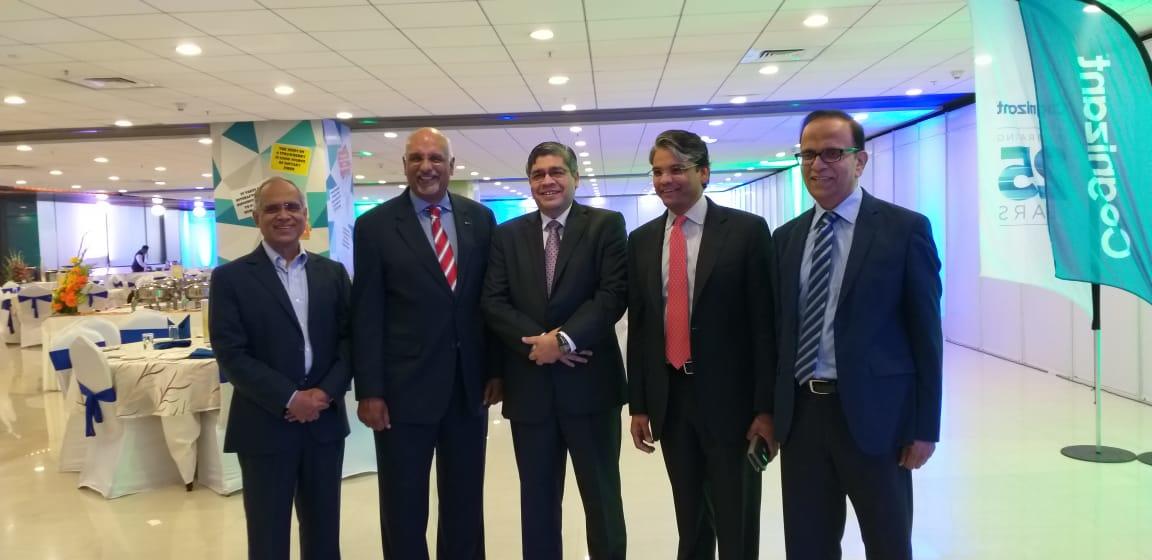
The anniversary photograph is a useful antidote to the solitary-founder portrait. Several careers occupy the frame. Narayanan and D’Souza would lead the company in turn, bringing their own approaches to what Mahadeva helped establish. A business that can accommodate different leaders has room to develop beyond any one personality. Continuity need not require everybody to behave like the founder.
Across the corridor, again
Mahadeva later co-founded Kubera Partners with Ramanan Raghavendran. Its cross-border investment approach concerned businesses connecting Western markets with India and Asia. The setting had changed from running a service provider to investing in other companies, but the geography remained familiar. Building across borders continued to mean understanding what each side could offer and what stood in the way.
In 2015 he joined the board of analytics company Antuit, adding another advisory role to his career. Harvard Business School also listed him on its South Asia Advisory Board in its 2018–2019 global activities report. His later work extended the relationships built through management, education and investing. He is now based in Miami Beach, associated with Mahadeva Family Office.
Looking back, the $10 billion workshop ambition has an appealing economy. A large destination, expressed briefly, left the difficult work to everyone’s working hours. Mahadeva’s contribution can be read in choices about customers, deadlines, spending and people. Software would change. Markets would change. He helped give Cognizant a way to keep asking what its customers needed next, and a business reason to listen carefully to the answer.