The future once arrived for Kristen Gwinn-Becker in the least romantic costume imaginable: a database. She was 20, living in San Francisco during the dot-com years, and working with nonprofits that encouraged her to learn the new tools piling into the office. Software. Web development. Databases. The city was busy inventing ways to put everything online. Gwinn-Becker, already a history graduate, began to see the peculiar shape of the problem that would occupy her career. The web could summon almost anything in a fraction of a second, while much of the past remained in boxes, described in catalogs designed for specialists, or visible only to the person who knew which door to open.
Her résumé already had the energy of somebody declining to choose between two good arguments. At 19, she had finished a B.A. in history at the University of Maine, becoming the youngest graduate in the university's history. She went on to study international peace at Trinity College Dublin and U.S. history at George Washington University. She also studied museum studies at Harvard. The scholarly life gave her primary sources, disciplined doubt, and the long patience of archives. San Francisco gave her code.
The combination sounds obvious only after someone has made a company from it. In the late 1990s, historians and programmers often occupied different professional planets. Gwinn-Becker liked both. She has called herself a "super tech geek, history geek," a description with none of the embalming fluid that sometimes clings to the word historian. Technology offered speed and reach. History offered stakes. She could make a database work, but she wanted the database to matter.
A clue in Eleanor Roosevelt's papers
History pulled her back toward graduate study. At George Washington University, she worked as an editorial fellow on The Eleanor Roosevelt Papers: The Human Rights Years, 1945-1948. Roosevelt's record presented a revealing archival puzzle. Franklin Roosevelt had presidential libraries and abundant institutional attention. Eleanor Roosevelt's materials were spread across collections. A person could be enormously consequential and still be difficult to encounter whole.
The problem was not simply whether a document had survived. It was whether a student, researcher, member, or curious stranger could discover it without already knowing the archive's private grammar. Traditional catalogs might file the famous baseball player Babe Ruth under his formal name, George Herman Ruth. A perfectly respectable record could therefore produce an absurd public result: search for the name everybody knows, find nothing.
“If it isn't accessible, it's as good as lost.”Kristen Gwinn-Becker
Gwinn-Becker's scholarship kept circling people whose significance had not guaranteed them an easy place in popular memory. Her 2010 book, Emily Greene Balch: The Long Road to Internationalism, was the first scholarly biography of the economist, reformer, peace activist, and second American woman to receive the Nobel Peace Prize. The book drew on letters, lectures, organizational proceedings, and a draft autobiography to restore Balch's ideas and temperament from the documentary record. Before Gwinn-Becker sold archival access as a service, she had lived the labor that access makes possible.
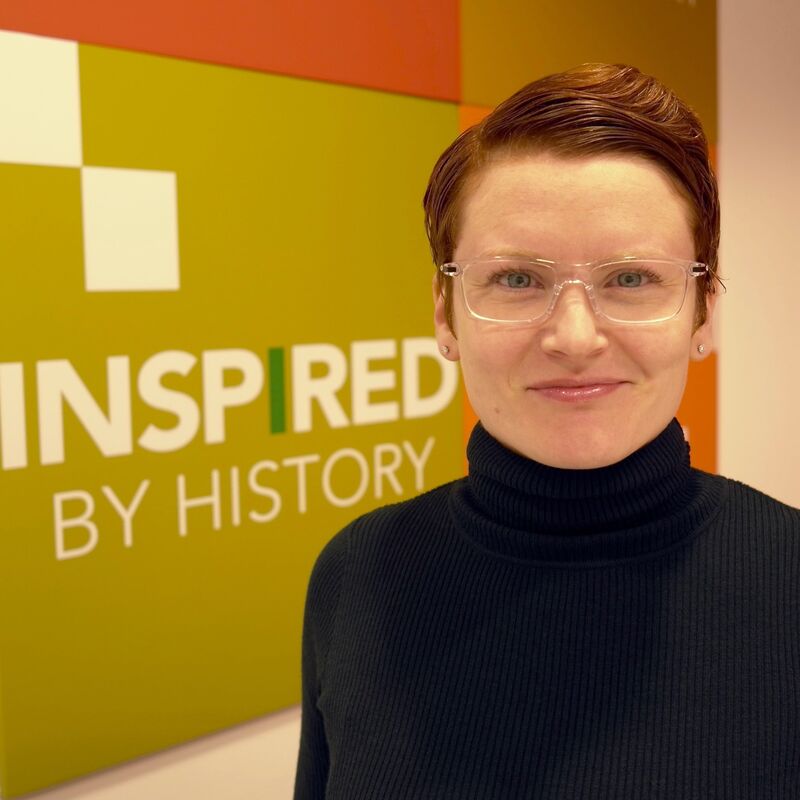
The scanner is only the opening act
HistoryIT emerged in 2011 from this double fluency. Its proposition was more demanding than "put the archive online." A scan is an image. A usable digital collection needs faithful capture, consistent metadata, relationships among objects, quality control, and a search architecture shaped around the language real people use. Digital preservation also requires stewardship so today's file does not become tomorrow's unreadable relic. The scanner begins the work. It does not get to take a bow for finishing it.
That last stage is the quiet revolution. Archives traditionally serve researchers trained to approach them. Gwinn-Becker wants collections to approach the public halfway. If someone types an informal name, a theme, or the word used by a community rather than the term chosen decades ago by a cataloger, the system should help. Metadata becomes less like a label on a drawer and more like a set of introductions at a crowded party.
HistoryIT has applied the model to universities, cultural institutions, private schools, sports organizations, religious institutions, fraternities, sororities, and professional groups. The raw material can be letters and photographs, films and scrapbooks, composite portraits and three-dimensional objects. The digital museum is both repository and stage: it protects an object while giving an organization practical ways to teach, fundraise, engage alumni, or explain how its values developed.
The histories hiding in plain sight
For Gwinn-Becker, access is personal. Growing up as a lesbian, she looked in history for people whose lives might help her understand her own. That search shaped her conviction that representation can exist in the record and remain invisible. A queer story does not always arrive inside a folder labeled queer history. It may sit in the archive of a sports team, a religious movement, a university, or a sorority. Her favorite discoveries are the "hidden histories" that complicate an institution's tidy account of itself.
This is where technical detail becomes an ethical choice. The words attached to an object influence who can find it. The relationships recorded in a database decide which stories appear together. Search is never merely a little box at the top of a page. It is a theory of what counts, translated into fields and filters.
“I'm a super tech geek, history geek. I love any opportunity to create this aha moment with people through history.”Kristen Gwinn-Becker
Her public manner carries the same useful collision. A University of Maine profile once introduced her as historian, technologist, author, businesswoman, strategist, and "general rabble-rouser." The phrase survives because it gets closer than the standard founder vocabulary. Her argument unsettles both complacent technologists and protective traditionalists. Faster imaging is not enough. Keeping boxes safe is not enough. A collection earns its future when people use it.
A mission learns to scale
By 2024, Inc. ranked HistoryIT No. 1,595 on its list of fast-growing private companies and reported that the company had preserved more than 4.8 million items in the previous year. The number offers satisfying magnitude, but the company's actual unit of progress is the encounter: a person searches, finds a photograph or letter, and sees a connection that the box had kept quiet.
Growth has made Gwinn-Becker speak as much about leadership as archival craft. In a 2025 conversation about mission-driven companies, she emphasized trust, clear vision, adaptability, and the need for people to raise problems early. She also discussed AI as a tool for efficiency that still requires human oversight. It is a historian's answer to a fashionable technology: useful, consequential, and never entitled to operate without context.
Her ambition has been memorably immodest in phrasing and precise in purpose: "We want to be the Google of history." She does not mean turning the past into a flat pile of instant answers. The work is closer to building doors at scale, each one marked in language a visitor recognizes, each opening onto an object with its context intact.
There is a founder lesson tucked inside the archive. The marketable idea did not arrive from trend forecasting. It accumulated across a strange, coherent life: college finished absurdly early, databases learned during an internet boom, peace studied in Dublin, Roosevelt's scattered record examined in Washington, and a forgotten Nobel laureate reconstructed from primary sources. None of the chapters was disposable. Together they produced a person able to see that the problem was neither history nor technology alone. It was the bridge.
The past needs a user interface
Gwinn-Becker often warns that history is in danger. Physical materials decay. Formats age. Institutions move offices and lose context. But the subtler danger is that evidence can sit safely on a shelf while public memory carries on without it. Inaccessibility invites simplification. What cannot be found becomes easier to ignore, and what is ignored becomes easier to replace with a convenient story.
Her answer is neither nostalgia nor a warehouse full of servers. It is a working relationship between care and use. Preserve the exact thing. Describe it patiently. Connect it intelligently. Then invite somebody in.
The dot-com promise was that the world's information would come to us. Gwinn-Becker noticed the past had missed the meeting. She has spent the years since sending it an invitation, one metadata field at a time.