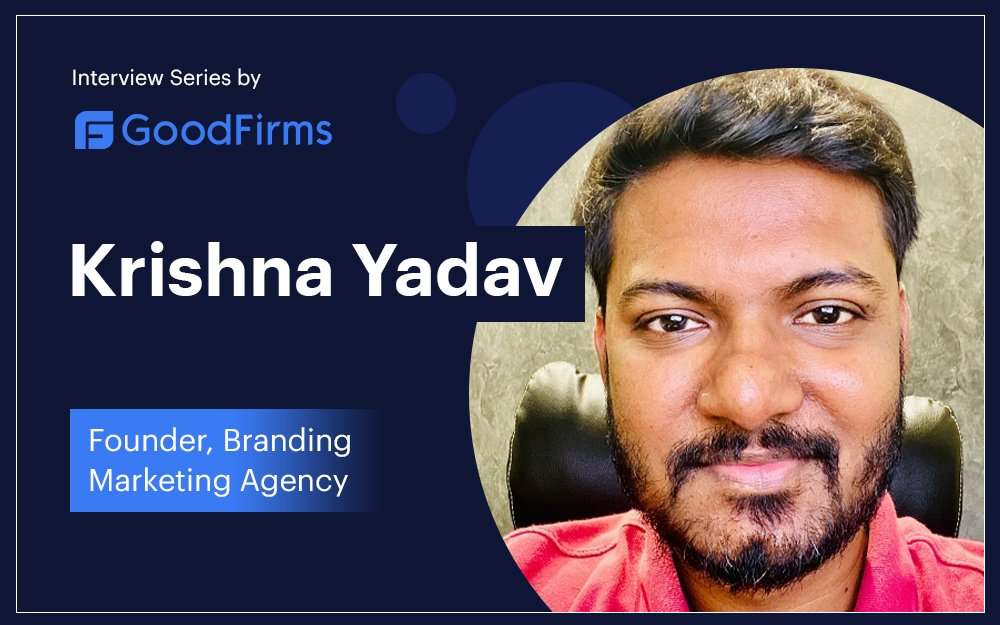
Before Krishna Yadav could help a business make a better impression, he had to consider the impression he made himself. He has described an earlier version of his working life in which speaking with clients felt uncomfortable and presenting an idea took more confidence than he possessed. For someone selling branding, that is an awkward discovery. The person explaining the importance of presentation is also being assessed across the table.
His response was to work on his communication and skills. In his account, the change belonged to the business as much as to its founder. There is something appealingly practical about that admission. A branding agency can redesign a website in relative privacy. Its founder must eventually join the meeting.
Yadav now leads Branding Marketing Agency, usually shortened to BMA, and is also the founder and CTO of Infibusiness Solution. His work sits where websites, search results and advertising meet the everyday needs of business owners. The interesting question running through his career is how to make a promise understandable enough that someone will trust it.
A company named for the work
Yadav started BMA in 2017. The name is almost excessively obliging: Branding Marketing Agency tells a prospective customer what it sells before anyone has opened a presentation. There is very little room for a mysterious origin myth in three words that could double as a search query.
The founding rationale was similarly direct. Smaller enterprises were struggling to grow online. Yadav wanted to combine search optimization, branding and marketing in packages shaped around an industry and a budget. His account of the business emphasizes customers whose needs and spending power differ. An agency serving them has to make those differences part of the work.
BMA’s stated markets include the United States, United Kingdom, Canada and Australia. Its specialties include local search, website design, social media and paid advertising. The company lists San Diego as its headquarters; Yadav’s professional profile places him in Vadodara, Gujarat. The geography of his working life therefore stretches beyond the city attached to the agency’s business listing.
That breadth becomes more concrete when the clients come into view. Carpet cleaning, electrical work, landscaping, appliance repairs and construction appear in his description of BMA’s customer base. These businesses have a useful habit of making marketing answerable to something tangible. A customer needs a room cleaned, an appliance repaired or a job quoted. The website has to help that happen.
An editorial illustration of the services, not measured customer conversion data.
The person behind the package
There is a technical side to Yadav’s career that the agency name alone would conceal. His professional identity at Infibusiness Solution includes the title CTO. His published biography describes experience with website development, coding, search optimization and content strategy. The combination matters because a brand’s presentation can fail in small, thoroughly mechanical ways.
A page might look composed and still take too long to load. A visitor might understand the offer and struggle to complete the next step. Someone has to care about both the promise and the machinery carrying it. Yadav’s writing repeatedly visits that boundary.
His education listings include Gujarat Technological University for 2012 to 2014, while another professional biography names Parul University. Outside work, his contributor biography describes a reader who enjoys painting. Those interests add a quieter detail to a public identity otherwise occupied with search traffic, websites and advertising accounts. A book and a painting can hold attention without issuing a call to action. A marketer is allowed the occasional afternoon off duty.
His presence as a contributor also gives him a way to explain the work beyond a sales conversation. Advice can be considered at the reader’s pace. A prospective customer can inspect an argument, follow its steps and decide whether the person making it understands the problem. For an agency founder, that is a useful form of introduction.
A website has to behave itself
In November 2021, Yadav published an explanation of Core Web Vitals, the measures used to examine aspects of a visitor’s experience on a web page. His discussion moved through loading, interaction and visual stability, then through the things that can slow a website down: images, video, scripts, fonts and advertisements.
The subject has a particular charm in a business devoted to appearances. The elegant typeface can be part of the delay. The attractive video can make the page cumbersome. The advertisement can interfere with the experience it was meant to finance. A website is capable of sabotaging its own good looks.
Yadav’s piece treated those questions as things a business owner could examine and improve. It explained the measurements in ordinary terms and directed readers toward tools for checking their pages. Read as part of his career, the article shows a founder willing to discuss the maintenance beneath the finished surface.
That is also a useful way to understand his occupation. Branding can sound abstract until a customer tries to use the brand. At that moment, speed, clarity and basic usability become part of the impression. The technical job and the communication job meet in the same impatient browser tab.
Attention comes with settings
Yadav returned to another practical subject in July 2023 with a G2 article about improving Google Display Network performance. The piece explored audience targeting, ad placement, remarketing and the possibility of wasting money on irrelevant or accidental clicks. Its emphasis was on the decisions inside a campaign.
The distinction is useful. Buying exposure is straightforward in principle; deciding where exposure belongs requires judgment. His article considered how advertisers could choose relevant environments, revisit people already familiar with a business and inspect settings that influence spending. Those are modest verbs: choose, revisit, inspect. They describe much of the work after the enthusiastic launch announcement.
For a founder serving smaller businesses, this is a revealing subject to teach. Money that drifts toward the wrong audience has an opportunity cost. The owner could have spent it elsewhere. A discussion of campaign controls acknowledges that attention has to be evaluated alongside relevance.
His G2 contributor biography places his clients across home services, IT services, software, marketing and advertising. The range is broader than the household-service examples associated with BMA. It also makes the recurring emphasis on context sensible. The same advertising decision can have quite different value depending on what a business sells and who is likely to buy it.
“The aim of the review is to make proposal language, deliverables and public pricing easier to compare.”
Krishna Yadav, August 2026
The fine print gets a marketing brief
In August 2026, BMA announced a free service for owners evaluating media-placement proposals. The offers in question used familiar television-network names in “As Seen On” language. Yadav’s concern was the distinction between paying to distribute a release and receiving independently reported coverage.
The proposed review would examine the distribution described, the deliverables included or excluded, available public pricing and the proposal’s stated terms for using media names or logos. This was a specific assignment for a marketing agency: help someone understand what a marketing purchase actually contains.
Yadav described its purpose as giving owners a structured way to ask questions before deciding. The announced service had defined limits, including that it did not grant permission to use another company’s name or logo. Its value rested in making the offer legible.
The announcement fits an enduring problem in his line of work. Marketing sells visibility, and visibility is easy to describe with an impressive collection of names. The buyer still needs to understand the transaction. Where will something appear? What has been purchased? What does the appearance signify? A familiar logo cannot answer those questions by itself.
There is a pleasing complication here for Yadav. His business helps customers make an impression, while this service asks them to examine an impression more closely. Both tasks require attention to how a message will be understood by the person receiving it.
BMA announces written reviews of media-placement offers, covering distribution, deliverables, available public pricing and stated logo-use terms.
How big can a small-business agency become?
Yadav’s ambitions extend well beyond an individual campaign. In an earlier executive interview, he set out an aspiration to work with at least two million US small businesses over the following decade. He also discussed plans for customer-support applications and adopting technology to improve service. The two-million figure was a goal he stated, rather than an achieved customer count.
The interesting part of that ambition is the operating question it creates. A company built around tailoring work to individual needs must decide how to preserve that attention as it grows. Software can make an exchange easier to manage. It cannot, by itself, decide whether an owner has understood the proposal or whether the work addresses the owner’s problem.
Yadav’s career keeps returning to that exchange. He has written about making a page work, controlling where an advertisement appears and clarifying what a media package buys. His own account of becoming more comfortable with clients belongs alongside those activities. Presentation has a recipient. The recipient gets to decide whether it is convincing.
A branding agency can spend considerable effort arranging the visible parts. Yadav’s more revealing subjects are the moments when somebody uses them: a page loads, a budget is spent, a proposal is read, a founder begins to speak. That is where his work becomes personal. Eventually, the carefully prepared message has to survive a conversation.