Kris Green has spent much of his working life dealing with an awkward fact about the internet: looking at a shop from another country is considerably easier than buying from it. The photograph travels instantly. The parcel has questions. Somewhere between the two, a customer must work out the price, the payment, the delivery and whether the whole arrangement is worth the bother. Green’s career runs through that gap.
He is the Toronto-based co-founder of Localised, a business that builds and operates ecommerce stores for brands entering foreign markets. Before that came years at Canada Post Borderfree and FiftyOne, later renamed Borderfree. The names changed; the commercial problem kept him occupied. Retailers could reach shoppers abroad. Making those shoppers comfortable enough to spend required another sort of work.
His public explanations tend to begin with the purchase rather than the software. What does the customer want? Can the retailer deliver it at a sensible price? What happens when a familiar brand arrives in an unfamiliar shopping environment? These are ordinary questions with expensive consequences. They also make a more revealing introduction to Green than a catalogue of executive titles.
An education in the unglamorous details
Green attended Western University from 1993 to 1998 and earned a bachelor’s degree in science. His early career included IBM Canada, where his work involved enterprise clients, ecommerce infrastructure and technology asset management. Later came sales, product development and finance roles at Canada Post Borderfree. He was learning the machinery behind the enticing shop window.
In 2007 he joined FiftyOne. By 2011 he was its chief strategy officer and executive vice-president of sales. Strategy and sales put him on both sides of the promise: explaining what international commerce could do, and understanding the operational work needed to deliver it. A customer’s enthusiasm was useful. A functioning checkout was rather more useful.
FiftyOne’s work with Gilt offered a concrete demonstration. The flash-sale retailer was opening international purchasing to customers who wanted access to its designer inventory. Green explained that overseas and domestic shoppers could use the same platform, with international payment and shipping choices appearing at checkout. Local currencies and inclusive charges helped turn a distant browsing audience into potential buyers.
There was a practical wrinkle in the flash-sale format. A sale launched on an American timetable could be encountered at very different hours elsewhere. Gilt’s operations team observed orders arriving throughout the day. Selling internationally meant learning when customers actually shopped, as well as arranging for goods to cross a border. The clock joined the currency converter in the retailer’s expanding collection of complications.

The warehouse knows something the homepage does not
In a 2012 interview, Green discussed the information retailers needed before shipping abroad. One surprisingly troublesome detail was where an item had been manufactured. Stock that looked identical to a shopper could have different origins inside the warehouse. Recording those differences mattered when goods entered international shipping processes. The attractive product page depended on facts that would never improve its photography.
His advice also covered the customer’s first experience of a new market: assess the assortment, understand the complete cost, and make delivery dependable. He encouraged retailers to learn from peers who had already expanded. The approach was practical and specific. The excitement of entering another country did not relieve anyone of the need to get the parcel there.
That attention to the full transaction helps explain the continuity in Green’s career. The work sat between technology, retail and logistics. A retailer could have an appealing product and still lose a sale through uncertainty. Every unanswered question gave the shopper another opportunity to close the tab. There is remarkably little ceremony involved in abandoning an international expansion strategy: one click will do.
A hoodie with a different calendar
By 2013 Green was speaking publicly about demand for American brands overseas. His point was that a brand could be wanted in countries where its products were difficult to obtain. Ecommerce offered a way to connect that appetite with inventory. Access, rather than a lack of interest, could be the obstacle.
The discussion appeared in an examination of seasonal clearance. A hoodie discounted in one market could still be seasonally appropriate somewhere else. Different climates and calendars complicated the apparently simple idea of surplus stock. Green’s contribution focused on the appeal of the brands themselves; the broader retail lesson was that a product’s opportunity could depend on where the customer was standing.
Two years later, while Borderfree was adding British retailers Dune and Austin Reed, he described its approach as putting international lenses on an existing website. It was a compact image for adapting a retailer’s established shop to visitors abroad. The service handled elements including currencies, taxes and shipping. The retailer could extend its reach while keeping an existing web operation at the centre.
FiftyOne had adopted the Borderfree name in 2013. Pitney Bowes acquired the business in May 2015. For Green, that period supplied a long view of international retail: infrastructure, product information, payments, inventory and customer expectations, all meeting inside a single order. His next venture would put a different emphasis on where the shopping experience began.
- IBM CanadaInfrastructure & enterprise clients
- Canada Post BorderfreeSales, product & finance
- FiftyOne / BorderfreeJoined 2007 · Strategy & sales
- LocalisedCo-founder · Country-specific stores
A store for the country, from the first click
Localised brought Green together with Peter Jones and Michelle Lim. Jones brought entrepreneurial and investment experience; Lim had worked at eBay and became Localised’s marketing chief. Green brought the cross-border operating background. The company’s published materials date its founding to 2017. Together they pursued country-specific stores for brands expanding abroad.
The emphasis extended beyond the final stages of a transaction. Localised’s present website describes building entire stores that look, feel and act local, starting with a brand’s product feed. It also describes the continuing work of running and promoting them. The scope matters: merchandising, marketing and customer care are recurring jobs, long after a launch date has disappeared from the calendar.
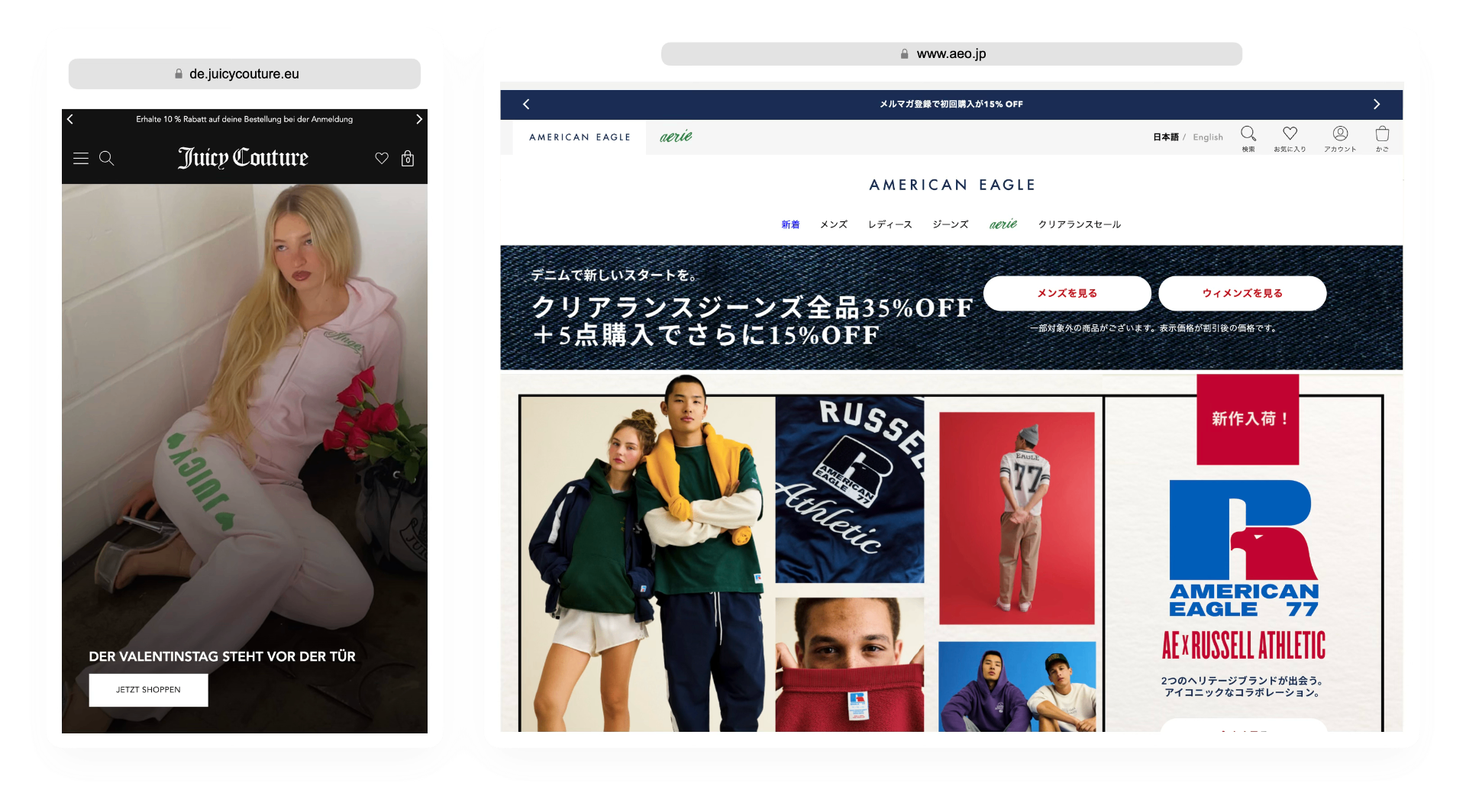
Consider the company’s published storefront examples: Juicy Couture presented in German, American Eagle in Japanese. They make the proposition visible. The brand retains its identity while the surrounding shopping environment addresses another audience. For Green, the relevant unit of expansion became the country’s store, with its own presentation and commercial habits.
This is a useful way to read his move from Borderfree to Localised. The earlier business helped an existing website accommodate international shoppers. The later venture placed country-specific experiences at the centre of its offer. Both approaches answer real retail needs. Green’s career connects them through a sustained interest in what happens when an overseas visitor tries to become a customer.
The money arrived with a shopping list
On June 15, 2020, Localised announced a $6.5 million investment from BGF and Jones. Green was named CEO. The customer list included Urban Outfitters, Anthropologie, Everlane and Crate & Barrel, with activity in Asian markets including Japan and Korea. The funding was intended to support further geographic expansion and development of the service.
Green’s ambition in the announcement was expressed through customer outcomes: visits, purchases, returning shoppers and new customers. He described helping brands connect with people through thoughtful ecommerce as the company’s purpose. It was a notably retail-minded account of a technology business. The platform was valuable to the extent that somebody found something worth buying and completed the purchase.
In June 2020 he also described Localised’s perspective in a short sentence: “We approach localisation from the perspective of the international shopper.” The sentence ties together the operational details of his earlier work and the broader store proposition. It supplies a clear test for any feature or service: does it make the shopping experience work for the person using it?
The attractive product page depends on facts that never improve its photography.
15 June 2020 · BGF & Peter Jones
A football shirt joins the journey
The business Green co-founded later moved into another arena of international demand. In July 2025, Localised and OneFootball announced an exclusive global partnership covering commerce for football clubs, leagues and related organisations. The agreement connected cross-border retail capabilities with OneFootball’s FanShop and wider direct-to-consumer plans.
The announcement envisaged merchandise reaching fans in more than 200 countries. That was the proposed scope of the partnership. Kits, accessories and memorabilia made the commercial logic easy to grasp: allegiance can cross a border without difficulty, while ordering the shirt may still require considerable patience. An audience spread across countries needs a shopping operation prepared to meet it there.
The 2025 announcement named Jones as Localised’s chairman and CEO. Green’s enduring connection is as a co-founder, with his earlier chief executive role forming a documented chapter of the company’s development. The distinction keeps the career story in focus as the organisation’s leadership and partnerships evolve.
The customer gets the last word
Across these chapters, Green’s work returns to the same encounter: someone wants a product from somewhere else. At IBM, the infrastructure mattered. At Borderfree, international transactions and delivery came into view. At Localised, the country-specific store became the organising idea. Each stage added more of the purchase to the problem he was trying to solve.
There is an understated ambition in that progression. International expansion is often described through maps, markets and projected audiences. Green’s documented work keeps returning to individual decisions: whether the cost makes sense, whether the payment works, whether the store feels usable. Those details are small enough to overlook in a presentation and substantial enough to determine a sale.
The shopper has no obligation to appreciate the engineering. A clear price and an intelligible store may earn no applause at all. They may simply earn an order. For a career built around helping retailers cross borders, that quiet conclusion has a certain appeal. The package arrives; the customer gets on with wearing the clothes.