The useful thing about a camera is that it rewards the person who notices what everyone else has edited out. King Nnamani has made a career from that extra width. On a conventional résumé, he is an untidy proposition: former college football player, communications graduate, interviewer, photographer, actor, director, consultant and founder. On an assignment, the jumble begins to look less like indecision and more like a kit. Every tool has its moment.
His full name is Francis-King Nnamani, though his recent professional profile shortens the first act to King. He lives and works from New York, where his company, King Curated Productions, turns that crowded list of disciplines into photographs, moving images and live-event content. The company's name carries a useful contradiction. A king is singular. A production is inevitably plural. Nnamani's public story is full of teams, rooms and chance introductions that only became consequential because he was prepared to do the work.
He arrived in the United States from Nigeria in August 2000. His own biography connects his Igbo background with attention to detail and discipline, two virtues that can sound ornamental until a deadline is running and a moment refuses to happen twice. New York supplied the pace. Sport supplied the rehearsal.
Number 90 changes fields
Football came first as the serious dream. Nnamani earned National Underclassmen Combine honors in three consecutive high-school years, then appeared for Hartwick College wearing number 90. The position was defensive line, an occupation that places little value on delicacy and considerable value on reading movement before it becomes obvious. He recorded a tackle against Brockport in October 2014 and appeared again in Hartwick's November game against Utica.
The sport also placed him in the two roles that recur throughout his later work: pupil and guide. From 2010 through 2014, he coached at Warwick Valley High School's children's football camp. At Hartwick, his academic record brought the President's Scholarship, the Philip S. Wilder Jr. Award for Academic Distinction and the Ad Altiora Achievement Award. The details complicate the familiar picture of an athlete waiting for the whistle. Nnamani was learning how to explain a movement to someone younger, how to carry a full schedule and how to accept correction in public. A production set asks for much the same humility, only the uniforms are worse and the cables are easier to trip over.
Professional football did not follow. The habits survived the cut. Nnamani later described sports media as the bridge between the old ambition and his creative work. This is one of the quieter truths about a pivot: most people do not discard the previous self. They put it to work in another department.
At Baruch College from 2016 to 2019, he studied digital marketing and corporate communications. His transcript of interests was already refusing to behave. The coursework included finance and statistics, advertising and video production, acting and playwriting. He joined the Wall Street Club and Baruch Investment Management Group and developed social marketing plans for the latter. The camera and the spreadsheet were never asked to quarrel.
There was another advantage to studying business in Manhattan: the city made the abstract immediate. Advertising was on the train, performance was on the sidewalk, finance occupied the towers and every café appeared to contain somebody rehearsing a pitch. Nnamani could move among these worlds without pretending they were separate countries. Corporate communications offered a grammar for the creative instincts he was already testing. Creative work, in return, kept the corporate language attached to actual faces.
The interviewer behind the lens
In 2018, Nnamani introduced himself to readers as a 22-year-old student who had previously created content for HuffPost, was contributing to Thrive Global and was creating for Red Bull. His interviews included photographer Natalie Amrossi, known as Misshattan, and Tom Jauncey, a co-founder of Beautiful Destinations. He was studying people who had already made businesses from images while making images of his own.
One published conversation placed him across from advertising executive Harry Bernstein, then the creative chief of Havas New York. Nnamani photographed Bernstein on a rooftop and asked about pressure, process and the habits of an entrepreneur. His conclusion was practical: opportunity could be anywhere, but preparation determined whether it remained an opportunity. The line has aged into a thesis for his own career.
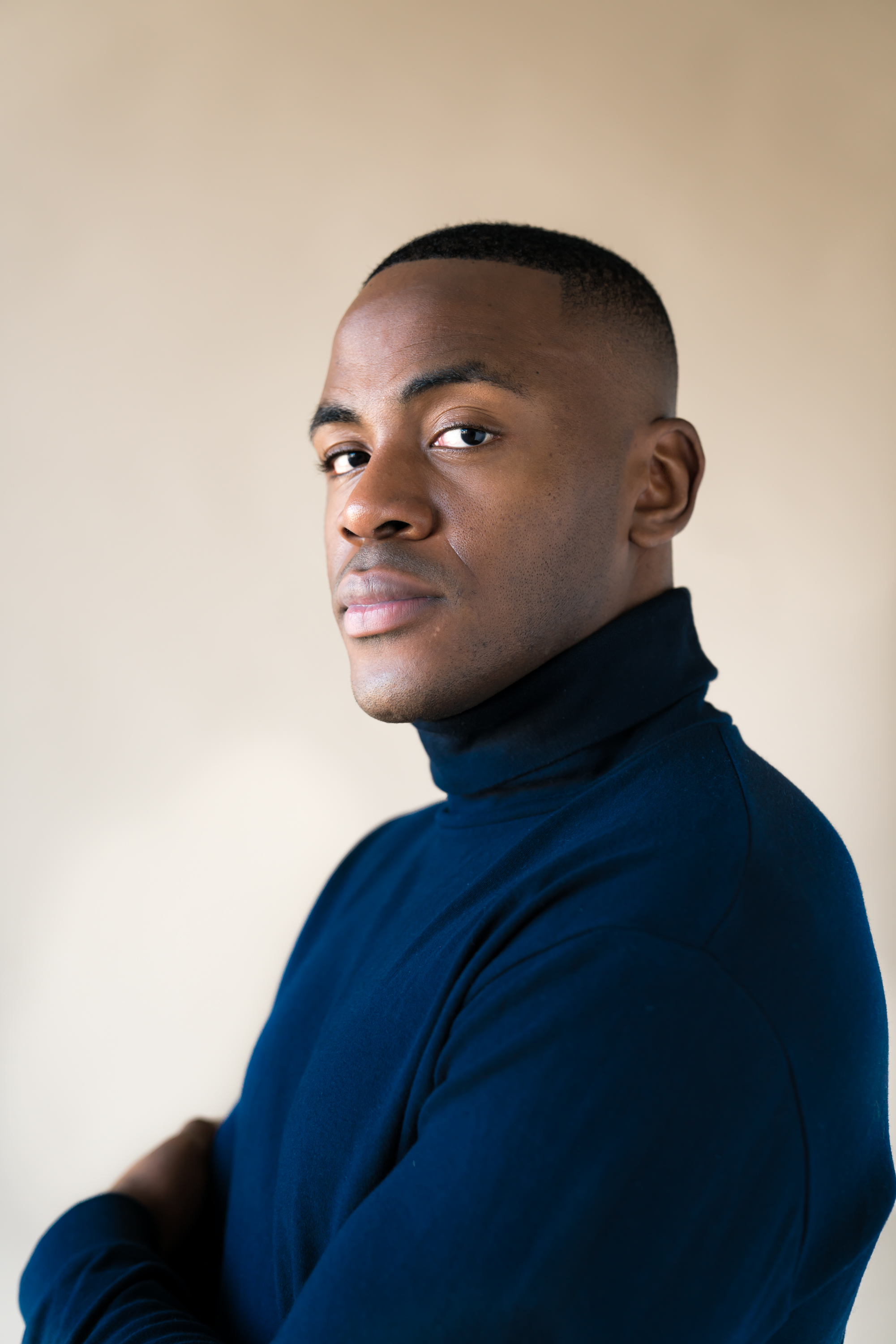
The same period produced a characteristically unruly answer to the question, “What do you do?” His site lists writing, acting, photography, videography and directing, with fitness interests nearby. There is an athletic reel on Vimeo and a later appearance in the commercial film Let's White Claw. There is also The Underdogs, a podcast project. He did not arrive at a tidy noun. He accumulated verbs.
For King Curated Productions, the breadth became a business model. The portfolio displays work and associations across consumer brands, publications and cultural organizations. More revealing than the logo wall are the assignments where his eye had to find a human beat inside a large institution.
A gymnasium, seen properly
Nnamani received the photography credit for PeacePlayers' 2020 and 2021 United States storybooks. The organization uses basketball to connect young people across geographic and social divides. Its programs operated in Brooklyn, Baltimore, Chicago, Detroit and Los Angeles. The books required pictures of a national program, but the pictures themselves work at arm's length: a corridor of outstretched hands in a gym, a player passing through, a group caught between instruction and laughter.
It is easy to make sport look grand. The scoreboard offers drama on demand. It is harder to photograph why a game matters to the people playing it. Nnamani's assignment asked for the second kind of attention. The former lineman was back around teams, only now his task was to stay outside the play and preserve the gesture.
That work supplies a clue to the career's apparent sprawl. Interviewing teaches a person to wait through the polished answer. Acting teaches an awareness of where a camera changes behavior. Athletics teaches repetition and anticipation. Photography turns all three into a fraction of a second. Production adds the unromantic requirement that the file must still arrive on time.
Four days become twelve
In December 2018, while still at Baruch, Nnamani put Dubai on a vision board. The goal was simple: work there one day. In May 2022, he booked a flight three days before departure for a project with an influencer and an opportunity built around a Floyd Mayweather fight. Then the fight was postponed by a week. His four-day visit became 12.
The arithmetic sounds like a travel headache. Nnamani tells it as the hinge. He stayed, absorbed the place and decided he wanted to return with a larger purpose. A later call brought him into work with the United Arab Emirates government, documenting ministers' meetings and engagements around the United Nations in real time for social and broadcast use.
The scale did grow. He worked around the UAE delegation during the 80th United Nations General Assembly in 2025. That November, he brought a team to a special project and contributed to a portion of the Abu Dhabi Awards involving Sheikh Abdullah bin Zayed Al Nahyan. The independent creative had become the person assembling other creatives, responsible for more than his own angle.
He describes this progression with a charming mixture of conviction and mischief: “Some may call it luck, I see it as the law of attraction. Delusional enough to see things through.” The second sentence rescues the first from becoming a slogan. Ambition requires a small, useful rebellion against the evidence currently available.
Still, vision boards do not charge batteries, negotiate access or deliver a broadcast clip while the meeting remains news. The romance of attraction rests on logistics. Nnamani's path worked because the young writer asking a creative director about preparation was also becoming the producer who could act on an abrupt call.
The slash marks earn their keep
There is a recurring question on Nnamani's biography: why take on so much? Why not focus on one skill? His answer is that versatility has value in a competitive environment. The more interesting answer sits in the work. His disciplines do not merely share a website. They hand information to one another.
The athlete reads motion. The interviewer reads people. The marketer reads an audience. The actor understands the charged little space between performance and self-consciousness. The founder reads a budget and a clock. Put them together in a diplomatic meeting, a community gym or a commercial set, and the hyphens stop looking decorative.
New York remains the base, but the work has widened beyond it. Nnamani began with a first-generation immigrant's belief in drive, pursued football hard enough to learn what an ending feels like, and found a second field where the boundaries move with each brief. King Curated Productions is the container he built for that motion.
A camera frame is an act of exclusion. Everything meaningful depends on what the operator chooses to leave inside. Nnamani's career has made the opposite decision about himself. He has kept the athlete, the student, the interviewer and the performer in view. The picture is busier for it. It is also his.