The letters had been sitting in a box for fifteen years when fire brought them back into the family’s life. In 1960, a blaze damaged the front of Kevin D. Pawley’s grandfather’s rowhouse in southwest Philadelphia. While salvaging his belongings, his grandfather found the box in a closet in an unused back bedroom. Inside were 433 letters exchanged during World War II. A household had almost lost part of its home and recovered part of its history.
The correspondence had connected four people: Pawley’s grandfather, William; his aunt Mary; his uncle Billie, serving in the Army; and his father Jack, a Marine. The letters crossed oceans and continents. They carried news, instructions, worries and requests. Years later, Pawley would compile and edit them into A Philadelphia Family Goes to War, published in 2018. His first book arrived after decades spent working with other people’s words.
There is an obvious temptation to turn an archive like this into a parade of grand occasions. Pawley keeps noticing the smaller things. Someone needs stamps. Someone dislikes the writing paper. Someone wants to know what is happening at home. History has a considerable appetite for dates and battles; a family would also like the postman to turn up.
Four correspondents. One family.
A book waiting in a box.
The stationery has something to say
Working through the correspondence, Pawley paid attention to the objects themselves. In his essay Letters, he reported that 70 percent of the compiled letters were original handwritten sheets. They had survived for roughly three quarters of a century. The handwriting, paper and marks offered their own evidence, alongside whatever each writer had managed to put into sentences.
Mary used stationery from Strawbridge & Clothier, where she worked for a time. At the beginning of 1945, she also wrote on paper decorated with red and green roses. By March, that supply was gone. Billie sometimes wrote in pencil on scraps. Jack, aboard the USS Texas, had access to the ship’s gold-embossed stationery. These differences made the correspondents visible before a reader reached the bottom of the page.
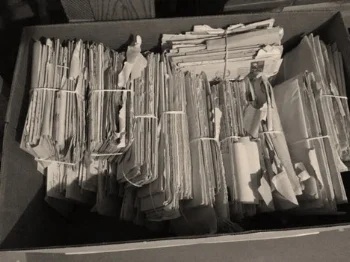
Even a smudge could preserve a little action. In one letter from the ship, Jack explained an interruption caused by rain, then the heat after he moved below deck. An ordinary writing session had left a trace of its surroundings. An editor could transcribe the words cleanly and still want the reader to know about the ink.
Pawley’s interest in those details makes the collection personal without requiring its reader to be a Pawley. An unfamiliar surname can remain unfamiliar. A request for decent paper is immediately legible. So is the tension between having something to say and being unable to send it, or between writing a reassuring letter and waiting for reassurance yourself.
An English degree, then a publishing life
His route to that box ran through Rutgers University, where he earned a BA in English, and a career that began in 1982. Publishing came early. He later worked across communications businesses before cofounding an agency in 2003. The job descriptions changed, but editing, writing, strategy and publishing remained part of the work.
In 2008 he cofounded Kay Square Press. It gave his interest in literature a separate business home. He sold the earlier agency in 2014 and left it in 2016. The next year he founded Kay Square Scientific, initially as a division of the press. In 2020 it became an independent corporation. Today he is its president and CEO.
Kay Square Press
Kay Square Scientific
family letters book
independent
The sequence is useful because it shows how much overlap there has been. His family book appeared after the new company’s launch, while the press continued its own work. The writer and the executive were operating on the same calendar. A book of wartime letters belonged to the same working life as building organizations and serving clients.
The English degree fits comfortably into this picture. A publisher must think about what a reader needs, what a passage means and how a collection holds together. In Pawley’s case, those questions eventually included people whose handwriting he knew as family handwriting. The professional task of arranging words had acquired unusually familiar names.
A local story earns its readers
Kay Square Press has a geographical purpose. It focuses on Philadelphia and the surrounding Delaware Valley, seeking artists and local stories that could reach a wider audience. Its range includes fiction and critical work about artists. Barbara Clement’s Main Liners novels sit in a catalog that also includes Kenneth C. Kaleta’s books and Pawley’s correspondence collection.
That gives the word “local” a generous amount of room. Philadelphia supplies people, settings and cultural connections. The eventual reader can be somewhere else entirely. A place becomes interesting through particular lives, and a publishing house makes decisions about which of those lives and imagined worlds it will put between covers.
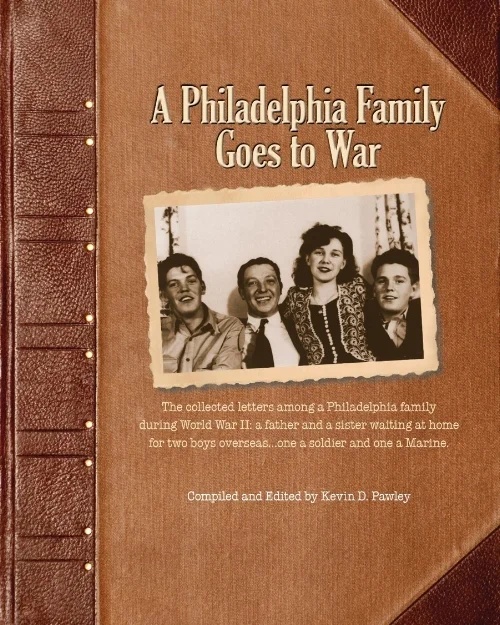
A Philadelphia Family Goes to War extends that purpose into Pawley’s own family. Its correspondents include people waiting at home as well as people serving overseas. Their everyday exchanges allow the home front to occupy the same story as the ship and the soldier. The collection makes room for waiting, which takes up a great deal of a family’s experience of war.
In Patience, Pawley follows one especially long wait. His father wrote home repeatedly before D-Day, while censorship prevented him from sharing where he was or what lay ahead. His grandfather listened to radio reports and pieced together news. A form letter signed by Jack eventually arrived well after the invasion. Receiving it mattered even when the news was already old.
The book has also found a place beyond the press’s catalog: the Battleship Texas Foundation includes it on its reading list. That is a fitting connection for a collection containing letters from a Marine aboard the ship. A family’s saved correspondence can help another reader approach the history of a vessel and its crew.
A bird interrupts the business biography
Read Pawley’s essays for a while and the archive shares space with paintings, songs, films and birds. His series is called There’s a Word for That. The titles often begin with a single noun. He uses that small opening to work toward a memory, an observation or a question that has stayed with him.
In Degree, a scarlet tanager crosses his yard and takes him back to childhood. He remembers seeing one with his mother, asking what it was, and being impressed that she knew its name. The memory preserves the bird, the shape of the yard and the feeling of standing beside her. Naming something had been part of the pleasure of seeing it.
His description includes a joke about the scale of the bird’s redness, measured against the difference between his own bank account and Oprah’s. An executive biography rarely finds a useful place for a scarlet tanager. An essay can give it the whole paragraph. Pawley seems happy to let the bird take the space.
In Birdsong, he describes making a deliberate effort to listen during a neighborhood walk. One call draws his attention; others emerge around it. Cars and construction interrupt. He has to return his attention to the birds. The interest here is in the act of noticing: something abundant becomes distinct because he stops treating it as background.
His official biography lists reading, writing and gardening as interests. The essays make that compact list more tangible. They supply the yard, the book, the remembered question. Those details are useful in a profile of someone whose public role could otherwise be reduced to a company name and three capital letters.
The future can write the verdict
In Creativity, Pawley considers the work that has moved him: van Gogh’s Starry Night, Joyce’s The Dead, a moment in The Godfather and Patti Smith’s music. He describes wanting to capture experiences with enough precision that other people might recognize something in them. His ambitions as a writer are concerned with sensation and memory, as much as with getting a story onto a page.
“I wish I had several more senses and talents just to exploit it all.”
Kevin D. Pawley, Creativity, 2017
He approaches reputation more cautiously. In Legacy, a friend asks how they will be remembered. Pawley’s work on the letters has complicated his own view of his grandfather, adding emotional detail to the outline of a tough Philadelphia policeman. He distinguishes the facts of a life from the simplified version that later generations may carry.
His response leaves that later verdict to the future. A person can decide how to behave now; the remembering belongs to other people. It is an apt thought for an editor who has spent time with a family’s surviving words. What remains may be a major decision. It may also be a sheet of rose-decorated paper.
The 433 letters survived because people kept them. Pawley’s contribution was to make a book through which strangers could read them. Alongside the founder and the publisher is a family member willing to examine the handwriting, follow the dates and notice what the paper retained. Sometimes a publishing life comes down to giving an old voice another reader.
Continue with Pawley’s words
- A Philadelphia Family Goes to War The book
- Discovery The recovered letters
- Letters Paper, handwriting and memory
- Legacy Family and the future
- Creativity Art and the wish to write
- Degree The scarlet tanager
- Birdsong A listening walk
- Patience Waiting for wartime mail
- Battleship Texas reading list The book’s historical setting
- Kay Square Press The publishing house
- Official professional biography Kay Square Scientific
- The Kay Square company history Founding dates and development
- Kevin D. Pawley on LinkedIn Professional profile