The farm map was already perfect. It had paddocks, animals, and a user interface made of magnets. It hung on a whiteboard in a shed in western Victoria, Australia, and versions of it kept appearing wherever Kevin Baum and his new co-founders visited. The farmers had designed the workflow. Nobody had put it in a pocket.
Baum was an unlikely person to notice. He grew up around Washington, D.C., studied biology at Stanford, and spent his early career around energy technology. Before AgriWebb, he had barely lived outside a city. He could bring technical training, commercial instincts, and the stamina of a serious rower. He could not bring generations of farm lore, so he did the more useful thing: he followed the manager, met the neighbors, and asked questions.
The trip to Australia began with an Oxford friendship. Baum met Justin Webb while the two were studying for MBAs and rowing. Webb came from five generations of sheep and cattle production. His family’s property, Eddington, was run with the familiar collection of paper records, double entry, and educated guesswork. Webb saw a business starved of usable data. Baum saw a piece of society’s basic plumbing waiting for better tools.
“In 500 years, I don’t think we’ll be on TikTok, but we will need energy and food and medicine and water and infrastructure.”Kevin Baum, on choosing durable problems
A career rows toward the useful
At Stanford, Baum had watched the first social platforms gather money, talent, and attention. The creative energy thrilled him; the destination did not. He later wondered aloud how addicting people to clicks improved the world. So he moved east and worked across renewable and conventional energy, from large projects involving Ford and Honeywell to smaller ventures trying to move laboratory ideas into the market. The work included projects connected to DARPA, the U.S. Department of Energy, and the National Renewable Energy Laboratory.
He liked the zero-to-one part, when the object was still a possibility and a small team had to make it real. Consulting left him close enough to watch that alchemy but often holding the report afterward. Graduate school offered a change. Oxford added environmental science, an MBA, a hardware startup, and one rather eventful Boat Race to a life already organized around long strokes and distant finish lines.
The rowing record is more substantial than a founder-bio flourish. Baum raced at the under-23 world championships, won an IRA gold in a four, and sat in Stanford’s varsity eight when it tied Harvard for silver in 2007. The finish was Stanford’s highest at the national championship then. His coach credited a small group of seniors, Baum among them, with changing the program’s culture. Five years later he represented Oxford in the Boat Race. Long before he managed teams across time zones, he had practiced the severe art of making individual effort disappear into collective rhythm.
Rowing supplied more than biography. It is difficult to make an eight-person boat move quickly if each person is staging a private performance. Baum’s account of AgriWebb has the same ensemble instinct. Webb brought finance and the family property. John Fargher, a fifth-generation producer from a vast South Australian station, supplied an intimate knowledge of the livestock customer. Baum brought technology commercialization and an outsider’s impatience with inherited software.
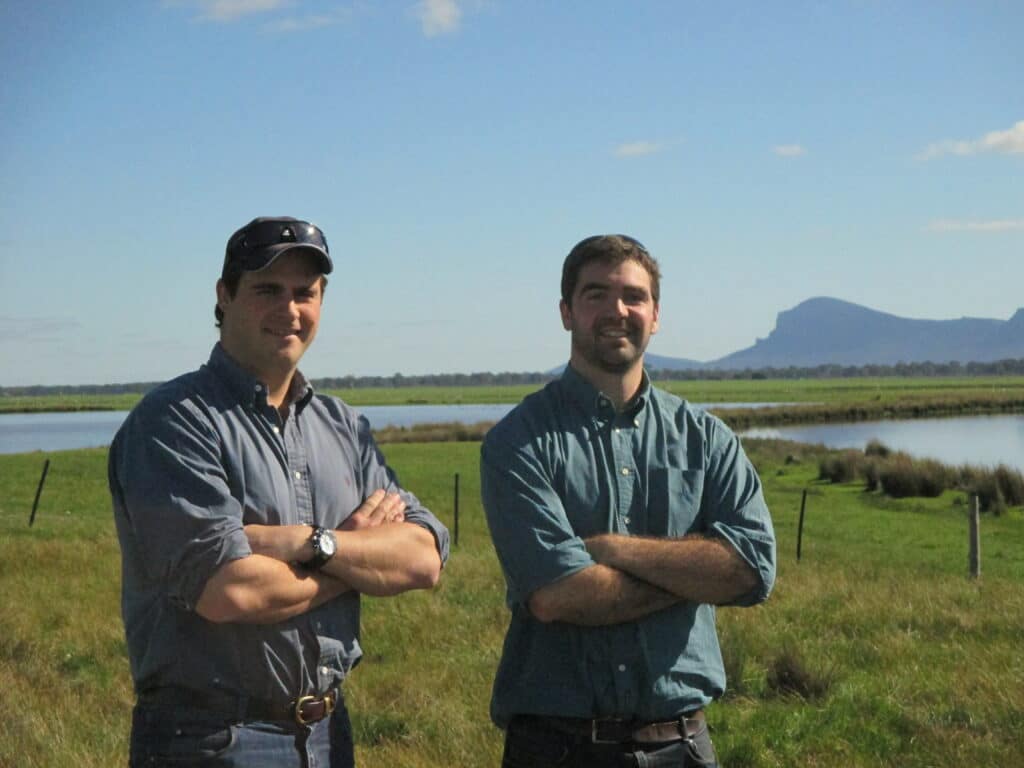
The whiteboard wins the design meeting
The early team briefly considered sensors. Hardware felt concrete and might have given farmers an obvious reason to enter a digital system. But a clever point solution could not explain the rest of the farm. A sensor knew its own reading. It did not know the breeding plan, the grazing rotation, the treatment record, the feed cost, or the paddock that had quietly become a problem.
The whiteboard knew more because the farmer had put the context there. Across those Victorian sheds, a hand-drawn map and movable magnets created a quick view of the operation. AgriWebb translated that scene into a mobile map, with herds as icons and records captured while the work happened. The product worked offline, an essential courtesy in places where connectivity could disappear beyond the gate.
The repeated whiteboard was evidence, not clutter.
New software felt familiar because the map already belonged to the farmer.
Immediate utility first; deeper analysis as confidence grows.
This is Baum’s most portable lesson. Founders are rewarded for describing a future that sounds nothing like the present. Customers, with irritating wisdom, prefer a future that understands Tuesday afternoon. AgriWebb did not ask producers to admire software. It let them move a herd on a screen as naturally as they moved a magnet on the wall.
Baum is a friendly narrator of his own inexperience. He dates university to the “Cretaceous period,” calls his pre-farm self a city boy, and remembers asking dumb questions in Australia. The jokes perform a useful bit of maintenance: they keep the expert from arriving before the student. Agriculture has a sensitive detector for visitors bearing answers. Baum’s credibility grew from admitting what he did not know, then returning often enough to recognize the same operational pattern from farm to farm.
A no at the gate
In 2015, Baum and Fargher made a three-hour drive to western Victoria believing they were about to close AgriWebb’s first sale. They had visited the farmer roughly six times. He liked what they were attempting and had become an advocate. The founders spent the journey winding each other up for the occasion.
He was waiting at the gate. Before they could settle in, he told them AgriWebb was not right for his farm. Baum and Fargher turned around and drove almost the entire way back to Melbourne in silence, which is a long time to reconsider one’s gifts.
Fargher called the next morning. The farmer stopped him. If people like him did not invest in people trying to change agriculture, the farmer said, change would never come. He bought the product and became the first customer. The first thirty endured bugs and missing pieces because they shared the direction of travel. Their patience was not passive. It became product development.
“Farmers make AgriWebb possible. We can’t do this without their belief in us.”Kevin Baum, on the company’s first users
From records to decisions
A notebook is excellent at remembering what someone writes in it. It is less skilled at warning that a paddock is underperforming, comparing the cost of two feeding plans, or showing how today’s rotation changes next season. Baum describes the larger shift as moving from looking backward to looking forward. Record keeping is the entrance, not the destination.
The adoption ladder / value grows without an entrance exam
He uses Excel to make the point. The spreadsheet contains thousands of features; even a power user may touch only a fraction. That does not diminish its value. A ranch with a hundred head and a company managing fifty properties can begin in different places. Adoption can unfold over years, with each new layer earning its invitation.
The immediate bargain is almost comically modest: stop writing a record in the paddock and typing it again at home. Capture it once, at the moment it happens. The accumulated bargain is larger. Treatments, weights, movements, pasture performance, and costs begin to describe the same business. A producer can find the weak link before a bad season makes it obvious. Sophistication arrives as a consequence of useful habits, not as a prerequisite for joining.
Data ownership sits beneath that invitation. Baum has said that every AgriWebb producer owns their data, with sharing controlled by the producer. The useful possibilities come through permission: a trusted nutritionist seeing current records, an accountant working from the same numbers, neighboring producers learning from anonymous patterns. Connectivity becomes collaboration only when the customer holds the key.
The next gate
Baum’s own job changed with the company. He has described a typical week as nonexistent, shaped instead by whatever the business requires. The steady part is setting employees up to succeed. He credits the complementary founding team and a staff united less by prior agriculture credentials than by belief in the work. In Boulder, that interest in company-building widened into mentorship through Techstars, the University of Colorado’s Deming Center, private coaching, and a visiting partnership with Antler.
The scope widened on the land, too. A 2026 partnership with Ducks Unlimited connected AgriWebb’s grazing records with grassland conservation work. It is an example of Baum’s preferred sequence: begin with producer economics, then make environmental gains legible through the same operating data. Better grazing plans can protect pasture and improve drought resilience while supporting the ranch’s bottom line. Sustainability, in this version, has to survive contact with the books.
In 2026, AgriWebb entered a definitive agreement to be acquired by URUS, a group spanning bovine genetics, reproduction technology, and data-driven herd management. The announced plan kept AgriWebb’s brand and management in place. It also extended the original integration problem: more useful connections among genetics, animal performance, farm operations, and the supply chain.
The corporate diagram is larger now, but the test remains pleasantly small. Does the product help the person in the field make a better decision? Does it return time? Can it improve profit while helping land remain productive for the next generation? Baum’s ambitions for digital agriculture have always had that double ledger, economic and environmental, because a farm cannot sustain one by neglecting the other.
There is a temptation to make technology stories about replacement: paper vanishes, software arrives, the old world is corrected. AgriWebb’s more interesting story is an act of respect. The whiteboard was not foolish. The magnets were not primitive. They were a good interface stranded in one shed. Baum and his co-founders learned its grammar, carried it into the field, and let the map travel.