After 27 years with the company she founded, Kelly Simpson-Angelini gave her next chapter a name: an Exploration & Impact Sabbatical. Her announcement included strategy, family, youth, travel, photography, music, and a determined appetite for learning. The woman who had spent decades helping organizations explain their ideas was giving herself time to find some new ones.
It is an interesting turn for a founder. Business biographies usually prefer a destination: a bigger title, a larger organization, a clean final number. Simpson-Angelini offered a set of interests instead. There was room in it for curiosity without a quarterly deadline, and for creative work without a client brief. After a career spent thinking about what comes next, she was making the question personal.
To understand that decision, it helps to go back to the habits she built along the way: making complicated ideas understandable, treating colleagues as people with lives beyond their jobs, and looking far enough ahead to notice when the familiar way of doing things has become a constraint.
A scientist finds an audience
Simpson-Angelini attended the University of Vermont from 1984 to 1988. She began her career as a research scientist at Pfizer, spending four years there. Research gave her an early professional vocabulary. Communications became the work she wanted to build around it.
In May 1998, she founded Simpson Healthcare Executives. Based in Old Lyme, Connecticut, the company became a scientific communications agency. Her career moved from doing research to organizing ideas for other people to understand. That change in emphasis gave her a business to run, as well as a subject to keep thinking about.
The distinction matters because expertise and explanation demand different kinds of attention. A specialist knows where the meaning sits. An audience needs a route into it. Simpson-Angelini made that distance part of her working life. Over the years, her responsibilities expanded across brand development, positioning, consumer behavior, market insights, and global strategy. The vocabulary grew; the problem of reaching another person remained.
She held both the CEO and chief strategy officer roles. One title concerns the organization in front of you; the other asks where it ought to go. Keeping both in view became a recurring feature of her public account of leadership.
The beliefs behind the decisions
In March 2019, Simpson announced BELIEFMAP, developed by Simpson-Angelini with the agency’s product innovation team. Its premise concerned the beliefs behind consumer behavior: to understand a decision, first examine the assumptions through which someone processes information.
That gives a communications business a demanding starting point. A message arrives in a mind already furnished with experience, expectations, and opinions. Some of the furniture has been there for years. A handsome presentation does not automatically persuade its owner to rearrange the room.
BELIEFMAP turned that interest into a named offering. It also helps explain the consistency beneath Simpson-Angelini’s different roles. Research, brand strategy, and leadership all bring you up against people interpreting the same information differently. Her work with the innovation team put those interpretations at the center of the assignment, before the finished message.
A diagram of the product’s premise, rather than a claim about measured results.
The book club belongs in the business story
By 2017, the agency’s working life included a book club, technology training, tuition reimbursement, lunch-and-learn sessions, and paid educational seminars. Employees could work remotely two days a week and dress casually. There was also a summer outing to Six Flags for employees and their families.
These details make the company easier to picture than a string of adjectives about culture. Someone had to choose the book. Someone had to approve the course. And somewhere, beyond the meeting room, there was a roller coaster full of colleagues and relatives whose relationship to the business did not require a slide deck.
The agency also supported a local family at Thanksgiving, providing groceries for the meal and a $500 grocery-store gift card. These were specific practices in a company whose leader repeatedly spoke about relationships and personal balance. They make her philosophy tangible without requiring anyone to mistake an employee picnic for a complete management system.
Her approach linked the experience of working at the agency with the experience clients would receive. Care for the people doing the work, in that view, belongs among the decisions that shape the work itself.
Along the way, she received a Connecticut Technology Council Women of Innovation honor in 2016, in the Entrepreneurial Innovation and Leadership category. Her work also included mentoring and coaching women inside and outside the agency. Those activities put another person’s development on the agenda alongside the company’s own. They fit a career in which learning appears both as an employee benefit and as a leader’s continuing responsibility.
Then somebody brought out the paint
A 2021 corporate retreat adds another detail. Artist Kelly Milukas ran a creative workshop for agency teams that included Simpson. The resulting photographs show colleagues holding up monochrome landscapes, working around tables, and tackling the same visual exercise together.
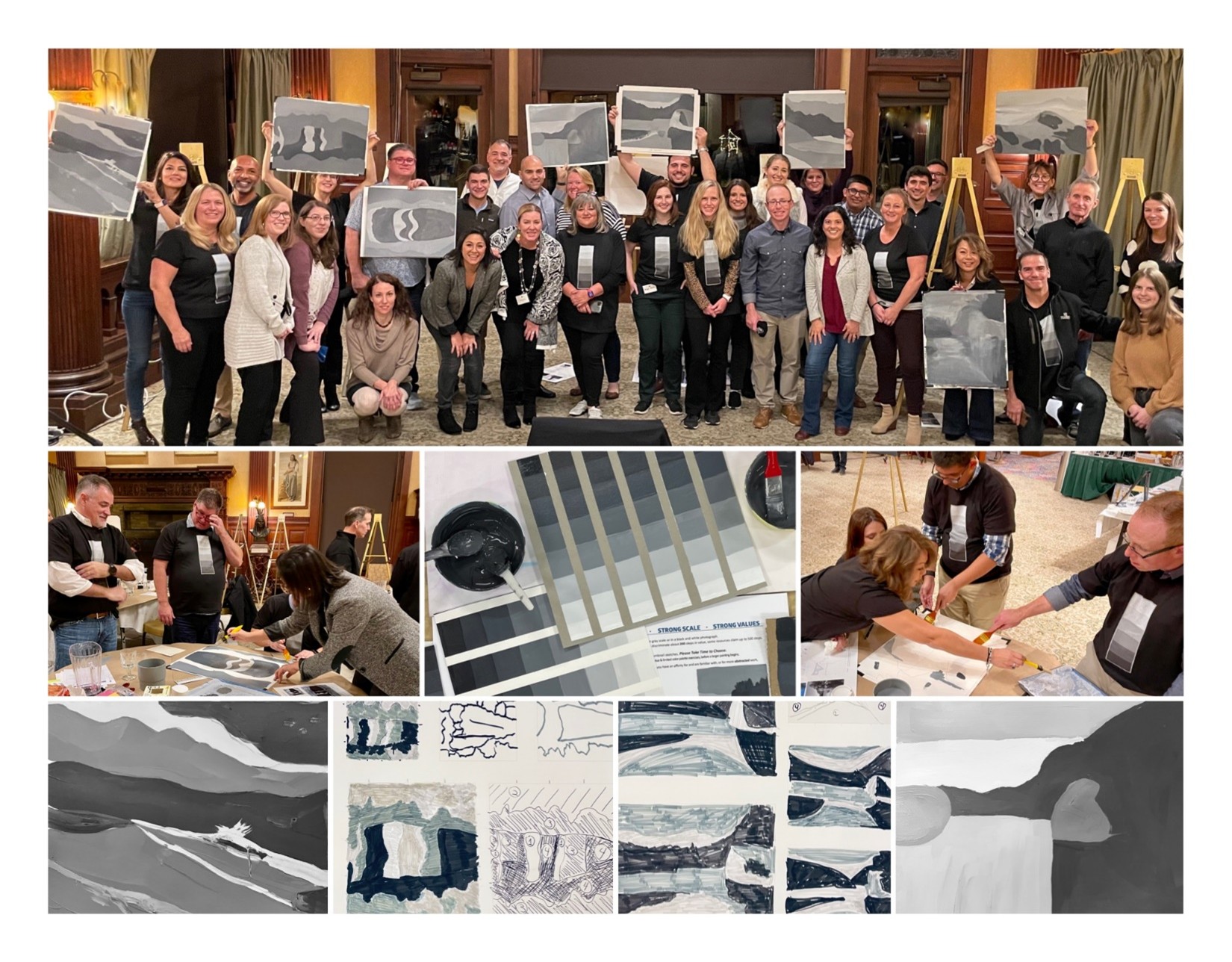
Simpson-Angelini connected the sessions to productivity and employee loyalty. Her explanation came down to being connected to other people. The paintings were something to make together, with a task unfamiliar enough to put colleagues on different footing.
“She connects us to our inherent creative side”
Kelly Simpson-Angelini, on artist Kelly Milukas
There is a modest comedy in asking accomplished professionals to negotiate a landscape in shades of gray. Titles offer limited assistance with a paintbrush. The photographs preserve that useful change of scene: people gathered around an exercise, with their attention on something they could jointly see and make.
Learning to look further ahead
Simpson-Angelini calls another part of her approach “futuring.” In describing it, she emphasizes identifying the forces that might shape a market, then watching those forces closely enough to act. Long-range thinking has to make its way back to a practical decision.
That is a useful test for any forecast. An impressive account of the next decade can leave Monday morning untouched. Her interest lies in connecting the larger view to things an organization can monitor, discuss, and respond to. The horizon earns its place in the meeting by helping people decide where to look.
In 2021, Simpson became a Certified B Corporation. The announcement placed employees, clients, community, and the environment within the scope of the company’s impact management. It gave the agency’s language about purpose an organizational framework. For Simpson-Angelini, whose leadership already emphasized the working experience of her team, it extended a familiar concern into a more formal commitment.
A successor with 23 years behind him
The next major change came with a familiar colleague. Scott Algiere was announced as Simpson’s incoming CEO in May 2022, with the appointment effective June 1. He had joined the business in 1999, one year after its founding, and had held finance, technology, and other leadership responsibilities.
Simpson-Angelini singled out his work moving the company’s secure data to the cloud in 2017. Her account of the handoff gave credit to an operational decision and to the person who had helped carry it out. Strategy, here, included the machinery that allowed people to get their jobs done.
Algiere was to report to her as principal. The announcement marked a change in responsibility within a long working relationship. For a founder who had combined executive and strategic duties, it was a significant redistribution of the job.
Her connection with the business continued into its IQVIA chapter. A July 2025 IQVIA event listed her as principal of Simpson Healthcare, an IQVIA business, on a panel about artificial intelligence and the future of brand marketing and communications. She was still following how new tools might change the work.
- 1998Founds Simpson Healthcare Executives
- 2022Hands the CEO role to Scott Algiere
- 27 yearsThe Simpson chapter she later described completing
A school closet enters the picture
Her more recent public activity introduces Uth Inc., a nonprofit focused on school-based support for students. Announcing it to her network, Simpson-Angelini thanked its team and board for helping bring the idea to life. The connection to young people also appears in her service as a trustee of The Williams School.
Uth’s model has two connected programs. Closets provide access to everyday essentials inside schools. Corps gives students responsibilities and projects through which they can contribute to their school communities. The organization describes itself as being in a pilot phase, with its program rollout beginning in fall 2026.
There is a practical cast to the design. Supplies need replenishing. Schools need dependable partners. Students need a way to participate without having to turn a private difficulty into a public announcement. Uth’s stated plans address those details through school spaces, supply partnerships, and opportunities for student leadership.
For Simpson-Angelini, it is a different setting for interests that recur through her career: understanding the person on the receiving end, connecting people with resources, and building an organization around an idea. The school-day setting makes the intended purpose unusually concrete.
Room for an unfinished answer
The sabbatical announcement leaves room for all of this, along with interests that need no organizational chart. Photography and music appear beside strategy and social impact. Travel becomes a way to encounter ideas. Learning gets time of its own.
A founder’s public identity can become closely attached to the company that carries her name. Simpson-Angelini’s account of completing that chapter acknowledges the people who helped shape it, then turns toward discovery. After years of thinking about audiences, teams, and future markets, she has given herself a broader field of attention. The next brief includes her own curiosity.