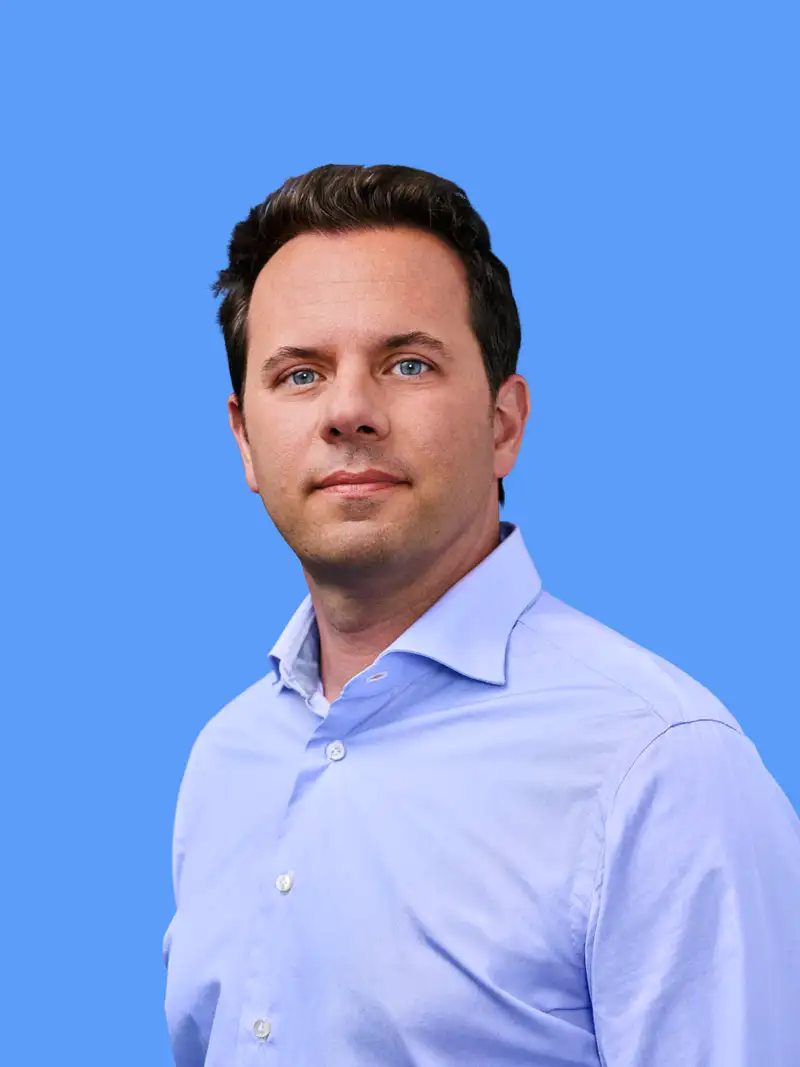
In Profile
The Engineer Who Learned to Bet on Engineers
When Karim Faris arrived at Atlas Venture in 2002, the Nasdaq had shed 75% of its peak value and the words "venture capital" carried roughly the same social cachet as "subprime mortgage." He went in anyway. That tells you something.
A decade earlier, he had been writing software at Siemens, helping build one of the first vehicle navigation systems for BMW - this was the early 1990s, before GPS was consumer-grade, before smartphones existed, when convincing a car company that drivers might want real-time maps was itself a sales job. From there he went to Intel, where he managed product for the i486 and then the Pentium processor. The Pentium was not just a chip; it was a cultural object - the thing that turned personal computing into a mass market. Faris was in the room for that.
Level 3 Communications came next, where he rose to Director of New Ventures, navigating the chaotic collision of internet infrastructure and corporate strategy. Then Harvard Business School. Then Atlas Venture, entering just as everyone was leaving. Then Google's corporate development team. And then, in 2009, GV.
"I find it very rewarding to team up at the early stages of challenging the status quo, and helping founders advance ideas into invaluable companies."— Karim Faris, General Partner, GV
GV - then called Google Ventures - launched in March 2009 with roughly $100 million in capital and a novel idea: what if the world's most data-fluent company became a venture fund? Faris was there from the first day. He has stayed through every iteration since. That continuity is unusual in a business where General Partners frequently defect, launch their own funds, or pivot to operating roles. His commitment is either a statement about GV's culture, or evidence that he is exceptionally good at the work - probably both.
His investment thesis is deceptively simple. He looks for companies that make data accessible, analyzable, and secure across systems. In enterprise software, AI, and cybersecurity, those three words act as a filter that has produced some remarkably prescient bets.
Investment Thesis
"Next-generation winners will be companies that make data accessible, analyzable, and secure across systems."
DocuSign is the canonical example. Long before electronic signatures felt inevitable, Faris saw the friction point: document workflows were a broken piece of enterprise infrastructure, and the fix was simply making signatures as accessible as email. GV backed it early. DocuSign went public in 2018 and became one of the canonical enterprise IPOs of the decade.
Duo Security is the other story people cite. The Ann Arbor startup built multi-factor authentication that felt - by design - as frictionless as a push notification. Security software had historically won by being good enough for compliance teams to approve; Duo won because end users actually liked it. Faris served on the board. In 2018, Cisco acquired it for $2.35 billion, at the time the largest cybersecurity acquisition in Cisco's history. The thesis: make security data accessible without making it annoying.
Cohesity represents the analyzable bet - a hyper-converged infrastructure company tackling the exploding complexity of enterprise backup and secondary data. Faris led the investment and joined as a board observer. The company has grown into a significant player in data protection, eventually merging with Veritas.
Portfolio Highlights
Backing Companies Before the Category Exists
Career Arc
From Siemens' Navigation Lab to Silicon Valley's Most Active Fund
There is a peculiar logic to Karim Faris's biography: every stop prepared the next one in ways that only become visible in retrospect. Siemens taught him that hardware is software's slow sibling - you can imagine the future precisely, but the shipping schedule is non-negotiable. Intel taught him that product management is about conviction under uncertainty; the market for the Pentium had to be made, not just served.
Level 3 Communications was a different education - infrastructure capital at scale, in an era when fiber was being laid under oceans and the business model kept changing underneath the engineering. Director of New Ventures meant betting on things that didn't exist yet, using an incumbent's balance sheet. Good practice, as it turned out.
Harvard Business School was, by his own arc, less a pivot than a credential for conversations he was already qualified to have. The real education had been hands-on, at every level of the tech stack.
-
1990sSiemens - Software engineer. Built one of the first BMW vehicle navigation systems - GPS for cars before consumer GPS existed.
-
1990sIntel - Product Manager for the i486, then the Pentium processor. Helped market one of the most consequential consumer chips in history.
-
Late 1990sLevel 3 Communications - Rose to Director of New Ventures. Business and product development at the edge of internet infrastructure.
-
2002Atlas Venture - Joined during the post-dot-com crash. Led tech and media investments when the sector was deeply unfashionable.
-
Mid-2000sGoogle - Corporate development team. Inside one of the most analytically rigorous organizations on earth.
-
2009GV (Google Ventures) - General Partner from the fund's first day. Still there. Enterprise software, AI, cybersecurity, frontier tech.
Who He Is
A Grounded Optimist in a City Full of Ungrounded Ones
In a venture ecosystem populated by people who describe themselves as "visionaries," Faris chose "grounded optimist" as his self-descriptor. The adjective does real work there. Optimism without grounding is a pitch deck. Grounding without optimism is a consulting career. The combination - being genuinely enthusiastic about what founders are building while being analytically honest about what it takes to get there - is what makes a venture investor useful to a company rather than merely decorative.
His focus on identity security, modern access management, and AI-native architecture reflects a very specific read on where enterprise risk concentrates in 2024 and beyond. As organizations sprawl across clouds, the perimeter dissolves; the new security primitive is not the firewall but the identity layer. Veza, Pangea, Push Security, and Anomali are all bets on that thesis, from different angles.
The parallel track - data analytics companies like FullStory, Incorta, and Cohesity - reflects the other half of his conviction: that most enterprises are drowning in data they can't act on, and the companies that solve that problem will be structurally important.
He publishes neural network papers as an undergrad, then builds GPS systems for BMW, then markets Pentium chips, then helps found one of the most influential corporate venture funds of the last two decades, while backing some of the most important security and data companies in the market. That is a career with unusual coherence for a field notorious for its intellectual distractibility.
"I'm a grounded optimist."— Karim Faris
Investment Focus
Where He Looks
Founder Lens
The Pattern He Keeps Finding
Faris is consistent about what attracts him to founders: unconventional thinking, mission-driven intensity, and a willingness to challenge categories rather than serve them. DocuSign challenged the assumption that legal documents had to be physical. Duo Security challenged the assumption that enterprise security had to be painful. Both were contrarian in the moment and obvious in retrospect - the classic venture pattern.
The access management and identity space he has concentrated on recently reflects the same dynamic. Most enterprise security buyers in the 2010s thought about identity as a checkbox - SSO, some MFA, done. The founders Faris backs are building on the premise that identity is the primary attack surface of the 2020s, and that the tools to manage it at cloud scale barely exist yet.
He reportedly takes an operational approach to board work - providing engineering support, technical expertise, and long-term partnership rather than quarterly governance. Companies in the portfolio have access to Google's infrastructure, engineering resources, and ecosystem relationships through GV. That is not a trivial advantage when you are building in competitive markets.
He has been a father of three throughout his GV tenure, based in the Bay Area. That is, in a field prone to mythology-building, a notably human detail.
Remarkable Details
The Specifics That Matter
Connect & Follow