The little rover had travelled roughly 240,000 miles and stopped a few feet short of its job. On March 6, 2025, the Athena lander reached the Moon’s south polar region, bounced, slid and settled on its side inside a crater. Beneath it, a garage carrying Lunar Outpost’s MAPP rover was pinned against the regolith. The machine built to drive across another world was suddenly a very expensive cupboard under a fallen house.
In Golden, Colorado, Justin Cyrus and his team watched the telemetry. A tidy success story had disappeared with the landing geometry. Yet signals were arriving. MAPP had survived launch, radiation belts, lunar transit and impact. Its flight computer was alive. The mission-control software held an uptime of 99.998 percent. Operators sent 268 commands and received 57,574 data points through a total downlink allowance of just six megabytes. Engineers are among the few people capable of finding 57,574 reasons to remain cheerful while their rover is upside down.
For Cyrus, founder and chief executive of Lunar Outpost, the episode compressed his whole proposition into one awkward tableau. Space exploration was moving from bespoke government missions toward commercial services. Small companies could now reach the lunar surface. They also had to survive the dependencies, compromises and blunt physics that came with sharing a ride. The Moon had accepted his hardware and rejected his schedule.
A URL with a very long fuse
Cyrus had been rehearsing for the moment since childhood. He grew up near Johnson Space Center outside Houston, in a family steeped in the space business. His father worked in the industry and, during the 1990s, held a role in Lockheed Martin’s Moon-to-Mars work. When Justin was five, his father gave him an eccentric present: the domain name LunarOutpost.com.
“I’ve had the domain name LunarOutpost.com since I was five years old.”Justin Cyrus
Most childhood domains age like childhood haircuts. This one waited. Cyrus studied electrical and computer engineering at the University of Colorado Boulder, where he began interning at Lockheed Martin during his sophomore year. He stayed, working mainly on satellites for military and defense applications. At Colorado School of Mines he added master’s degrees in electrical engineering and space resources, an unusual pairing that joins circuitry to the question of what humans might dig, process and use beyond Earth.
Lockheed offered scale, experienced teams and significant programs. Cyrus later described reaching a point where he could manage sophisticated radio-frequency work on military satellites, yet still feeling removed from the impact he wanted to make. In 2017, he looked for an under-served corner of the industry. Rockets were drawing capital and attention. Robotic work on the surface of other worlds had more open ground.
He co-founded Lunar Outpost with his older brother Julian Cyrus, AJ Gemer and Forrest Meyen. The company began bootstrapped. That fact matters because it encouraged a less romantic view of space hardware: build something that can earn its keep. Alongside lunar rovers, the team developed compact environmental monitors for use on Earth. Extreme-environment engineering could have terrestrial customers while launch dates wandered to the right.
One company, three planetary bodies
The strategy produced a curious planetary résumé. Lunar Outpost built air-quality instruments for Earth. Its technology contributed to the MOXIE experiment that produced oxygen from the Martian atmosphere aboard the Perseverance rover. Then MAPP reached the Moon. Cyrus could reasonably describe the company as operating across three worlds, though one of those operations had the posture of a stranded tortoise.
The ten-cent economy
Cyrus’s ambitions extend beyond driving. The animating idea is that mobility turns a remote landscape into a place where work can happen. Rovers can carry instruments, inspect terrain, move cargo, scout water ice and prepare surfaces. With sufficient endurance and autonomy, they can help establish power, communications and landing areas before astronauts arrive.
In 2021, NASA Administrator Bill Nelson handed Cyrus a check for ten cents. It was the first milestone payment tied to Lunar Outpost’s contract to collect a small amount of lunar material and transfer ownership to NASA. The sum was deliberately slight. The legal choreography was the valuable part. A resource economy needs an agreed way to say who collected what, who owns it and when that ownership changes hands. Ten cents bought a test of the verbs.
“For us, this is about being part of a precedent setting moment.”Justin Cyrus
That episode reveals Cyrus’s double register. He speaks about humanity becoming interplanetary, then pivots to service contracts, payload ratios and equipment life. The dream supplies direction; the invoice makes it repeatable. His preferred future is less an endless procession of flag-planting missions than a market in which a rover can be hired, tasked and used again.
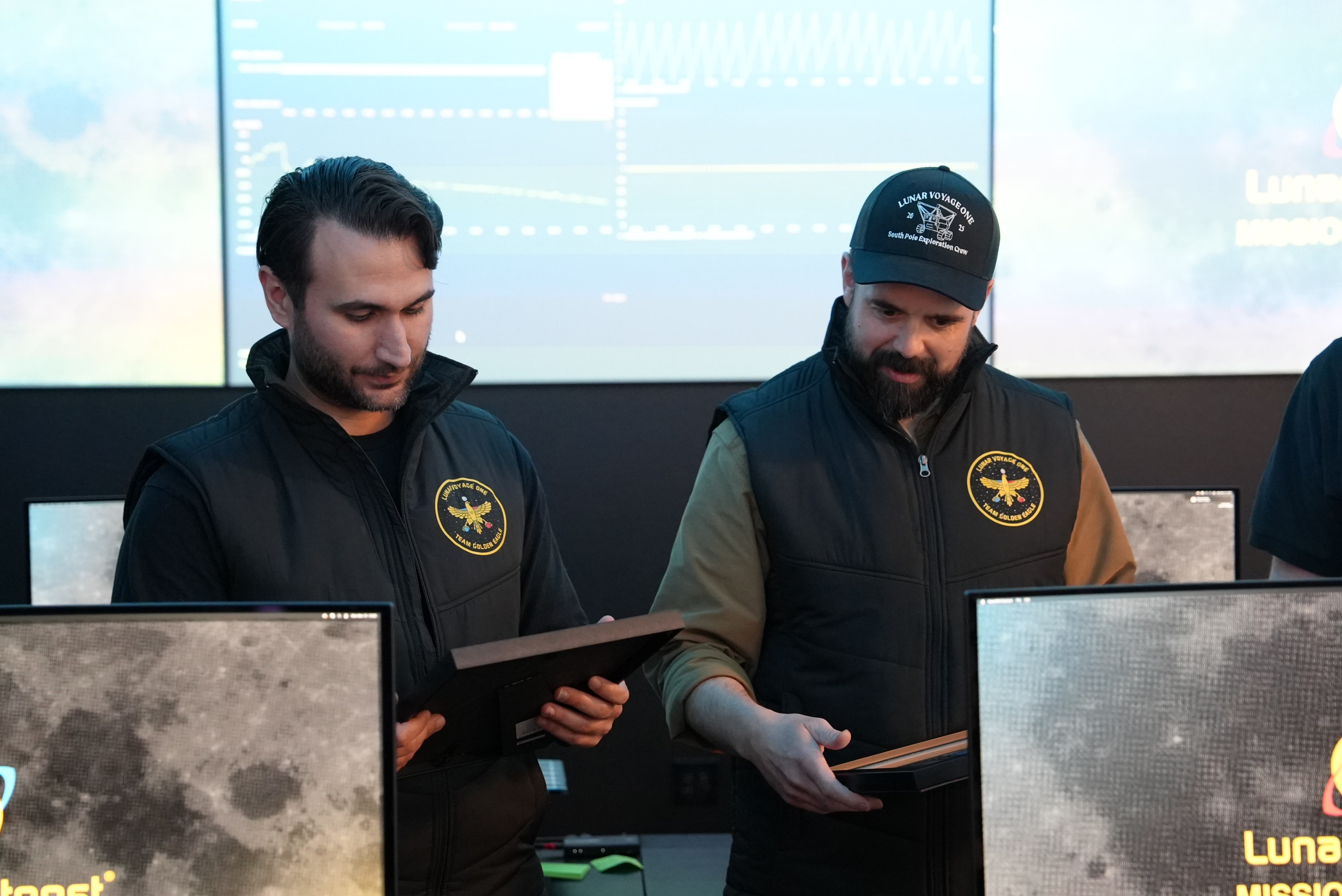
Lunar Voyage 1 tested that thesis with an unforgiving honesty. MAPP carried commercial and scientific payloads, including hardware for a planned 4G/LTE communications demonstration. The rover’s inability to deploy prevented the surface drive and the planned resource transfer. Lunar Outpost said its data showed MAPP was ready to operate if released. That claim cannot substitute for wheel tracks. It does establish that key systems survived a real journey and worked on the lunar surface, evidence no vacuum chamber can fully manufacture.
Three weeks to redraw the future
The larger vehicle in Cyrus’s plans is built for people as well as payloads. In 2024, NASA selected Lunar Outpost, Astrolab and Intuitive Machines for early work on lunar terrain vehicle services. Lunar Outpost assembled a team that included General Motors, Goodyear, Leidos and MDA Space. Its original crewed concept, Eagle, looked like a purposeful off-road vehicle stripped for vacuum.
Then NASA changed the brief. According to Cyrus, the agency delivered revised requirements during a 2026 event, asking for something lighter and more pared back. Lunar Outpost returned to the drawing board. In three weeks, the team designed a vehicle called Pegasus and built a human-in-the-loop mock-up. Former astronaut John Grunsfeld climbed in and provided rounds of feedback. It was a useful inversion of the usual aerospace picture: instead of spending years defending a design, the team discarded weight and rebuilt around the person who would sit in it.
In May 2026, NASA selected Lunar Outpost and Astrolab for high-achievability mission task orders. Each received a $220 million base award, with Pegasus slated for a 2028 delivery mission under the agency’s current plan. Pegasus is intended to operate with astronauts aboard, by remote control from Earth, or autonomously. The modes reflect the economics Cyrus has promoted all along. A vehicle that works only during a crew visit spends too much time posing as lunar furniture.
Lunar Outpost starts as a bootstrapped space-robotics company.
NASA makes a ten-cent milestone payment linked to a lunar-resource contract.
MAPP reaches the Moon, survives, returns data and remains trapped under its lander.
A $30 million Series B and NASA’s Pegasus selection arrive in the same month.
Pegasus is planned for delivery to support crewed and uncrewed lunar operations.
The NASA decision came during a consequential month. Lunar Outpost also announced a $30 million Series B led by Industrious Ventures, with participation from existing space investors. Weeks later, the World Economic Forum named the company to its 2026 Technology Pioneers cohort. Recognition is pleasant; manufacturing is expensive. The money is meant to scale production and deployment across a growing list of lunar and cislunar missions.
Beyond the buggy
Cyrus now describes Lunar Outpost as an infrastructure company. The distinction broadens the assignment. Future robots might grade surfaces for landing pads, move equipment, map terrain, support power systems and work together around habitats. On Earth, a city is never built by the taxi company alone. On the Moon, however, the first taxi may also survey the road, carry the radio and inspect the building site.
This ambition depends on alliances. NASA supplies requirements and an anchor customer. Launch and landing providers supply transportation. General Motors brings vehicle engineering, Goodyear contributes tire knowledge, and other partners add human-spaceflight and robotic experience. Cyrus’s role has evolved from hands-on electrical engineer to a translator among these institutions. His public language still carries an engineer’s preference for systems, yet he has become equally occupied by capital, policy and the difficult art of making several large organizations arrive at the same crater on time.
Family remains woven through the enterprise. Julian, his older brother, co-founded the company and serves in leadership; younger brother Austin has worked there too. The domain their father bought outlived its childhood novelty and became the sign above a real factory door. There is something almost suspiciously neat about that arc, which is perhaps why the tipped lander belongs in the story. It rescues the tale from destiny. Dreams do not make hardware immune to sideways arrivals.
Cyrus has said his life’s mission is to use space resources to help humanity become interplanetary and improve life on Earth. The sentence contains enough work for several lifetimes. His more immediate measure is concrete: another rover, another payload, another chance to turn survival into motion. MAPP reached the Moon and stayed in its box. Pegasus is being built so people can climb aboard.
The difference between those two machines is the distance Lunar Outpost still has to travel. It is also the distance it has already crossed - from a five-year-old’s domain name to a mission-control room receiving data from a crater. The Moon offered Cyrus no polished ending. It gave him something more useful: a result, a bill of corrections and a reason to return.
Follow the next tracks
Mission updates, interviews and the people building Lunar Outpost’s next vehicles.