Selling a franchise puts you beside someone else’s decision. Buying one puts you inside it. Joshua Kovacs made that second move with an office-coffee business, his father, and a longtime friend. The territory was Washington, DC, with expansion into Northern Virginia. Kovacs would manage from New York; Mike Kovacs and Tyler Burdett would handle local operations. It was a fairly literal way to bring the business home.
By then, Kovacs was already building Oakscale, the franchise development company he founded in 2017. His professional work involved finding people willing to operate somebody else’s concept. Coffee offered him the chance to become one of those people. A franchise agreement can look wonderfully tidy on a desk. Once it belongs to you, the next customer becomes rather more interesting.
The decision supplies the thread through his career. He has worked near the sale, built a company around the sale, and taken responsibility for what follows the sale. In 2026, that route brought him to the chief executive role at Break Coffee Co., the workplace-coffee brand previously known as Xpresso Delight. The familiar machine in the breakroom turns out to have a surprisingly long professional backstory.
The agreement becomes your own
The February 2020 announcement of the DC-area venture described Kovacs as a new multi-unit franchisee. He had been involved in developing Xpresso Delight, working with its US leader Nigell Lee. Now he was buying into the model himself. Virginia was described as his home state, so the expansion had a personal geography as well as a commercial one.
There is a useful distinction between knowing how to explain a business and having to keep it running. The first requires clarity about its appeal. The second adds the obligations that arrive after enthusiasm has done its job. A prospective owner can admire a recurring revenue model. An operating owner needs the recurring part to happen, which requires customers who continue to want the service.
Kovacs’s present-day coffee work still includes that local dimension. Break Coffee’s North New Jersey page identifies him as its owner and operator there. The service places coffee equipment in workplaces, supplies beans, and attends to the machines. The client pays according to cups poured. For an office, the result is conveniently close to the desk. For an operator, it is an account that has to be earned and maintained.
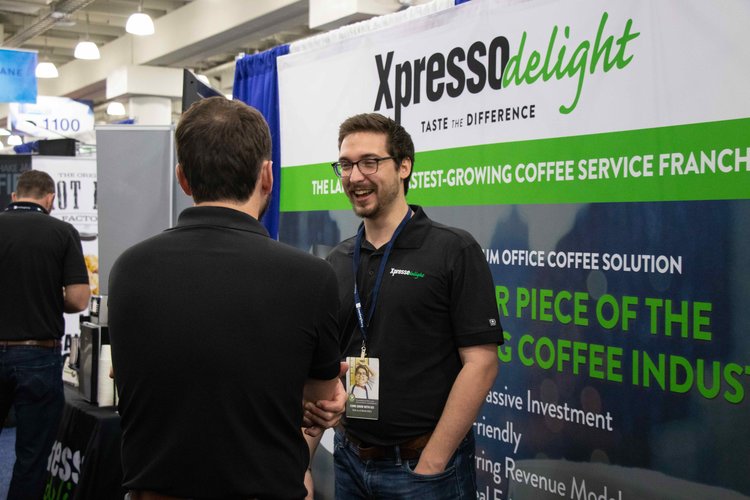
An early start, then a company of his own
Kovacs has said his franchise career began at 18. Before Oakscale, he worked in franchise sales at Fransmart and served as vice president of programs at Engineering for Kids. Those roles put him in different corners of the same industry: selling an operating opportunity and working within an education concept. His career was already crossing categories before he built a firm to do it.
His public professional record also includes Georgetown University in 2014 and a Certified Franchise Executive credential issued in February 2015. The letters CFE belong to the International Franchise Association’s professional credential. They sit neatly beside his name; the larger story concerns what he chose to build with the experience behind them.
Oakscale opened in 2017. Two years later, it announced a $1.2 million seed round, with investors from technology and franchising. Its task was to help emerging concepts find suitable franchise owners, with digital marketing and sales development forming part of the same process. Metric Collective incubated the business. The underlying ambition was to give a smaller brand more of the machinery required to expand.
“The long term vision for Oakscale is to own that process from A to Z.”
Joshua Kovacs, 2019
That ambition has a practical consequence. If a company takes responsibility for the whole development process, it has fewer places to send an awkward question. Generating interest, qualifying a candidate, and moving toward an agreement belong to one connected piece of work. The handoffs matter because a person considering a franchise is making a consequential choice, often with a new professional life attached.
A thousand leads still need a conversation
A June 2025 snapshot gives a concrete view of the development work: two Oakscale salespeople handling 1,000 leads a month and holding between 300 and 400 new conversations. The reported contact rate was close to 40 percent. These figures describe the workflow at that point in time.
Kovacs’s position was straightforward: a team facing more inquiries should invest in technology. FranFunnel was part of a wider collection of tools that included HubSpot and communications software. The point was to increase the team’s ability to respond. A name arriving through a form is still a person waiting for an answer.
The interesting part of these numbers is the space between inquiry and conversation. An internet lead does not yet tell you whether someone can run a business, afford it, or wants the daily work involved. Technology can help begin the exchange. The exchange still has to establish enough understanding for both parties to make a useful decision.
The cookie customer and the former boss
Coffee is only one part of Kovacs’s development career. Oakscale’s work with Floozie Cookies brought a London-born stuffed-cookie concept into a partnership aimed at the United States and Canada. Chef Kimberly Lin created the product; TGP International supplied restaurant-concept experience. Oakscale brought franchise development to the arrangement. The proposed expansion was a plan, with all the work of execution still ahead.
One connection makes that partnership more personal. Ryan Durishin, the restaurant franchise salesperson leading Oakscale’s North American Floozie efforts, had previously been Kovacs’s boss. Bringing a former supervisor into a founder’s team gives the ordinary career ladder an agreeable bend. Experience can change seats without needing to lose its usefulness.
Bang Cookies supplied a different introduction. Kovacs was a customer before he worked with the brand. His own description of that sequence is brief enough to leave the cookie intact: “Before I started working with Bang Cookies, I was a customer.” Familiarity with the product came first. The business relationship came later.
Enjoying a cookie and developing a franchise around it are separate stages of attention. The customer asks whether it tastes good. The developer has to consider whether another operator can reproduce the experience and sustain the business. Oakscale’s published approach to evaluating emerging brands includes operating economics, repeatable operations, supply chains, customer enthusiasm, and executive teams. Dessert has acquired a rather serious committee.
A service business with a coffee habit
The coffee model brings the same operating questions into a less theatrical setting. Break Coffee’s offer centers on equipment and ongoing service in workplaces, without requiring a café storefront. Its franchise materials describe a home-based operation and limited staffing needs. A visible counter is optional; a relationship with the customer remains essential. The office is effectively the place where the product meets its regular audience.
Another Oakscale executive, Anthony Spagnola, also became a Break Coffee franchisee with his wife, Dominika. His description of the division of work puts billing, collections, and coffee distribution with the corporate team, while local owners focus on sales and customer service. That allocation helps explain the appeal of the concept to a franchise developer: it makes the operating responsibilities easier to identify.
Kovacs’s work on Payroll Vault offers a parallel in business services. A March 2026 Raleigh announcement described a new owner bringing finance and compliance experience to a local payroll franchise. Kovacs, quoted as Oakscale president, managed franchise sales for the brand. Coffee and payroll share little glamour, but both can involve continuing relationships with business customers. The expertise required to deliver them differs considerably.
That difference matters to a company recruiting owners across categories. A compelling presentation cannot supply every skill a local business needs. The match has to account for the work itself. The coffee operator services accounts and equipment. The payroll operator brings a different professional background. Growth announcements put both under the word “franchise”; the working day quickly supplies the distinctions.
The route leads back to the machine
By June 2026, a San Antonio expansion announcement identified Kovacs as Break Coffee’s CEO and described his transition from the Oakscale presidency. The appointment announcement emphasized his franchise ownership experience. His stated remit included expanding the business, strengthening support for owners, and increasing awareness of the workplace-coffee model. The coffee venture had become a leadership responsibility.
The transition gives his earlier operating decision a second significance. He now leads a brand whose opportunity he had already chosen for himself. It is a useful continuity to bring into conversations with franchise owners, though a leadership title still leaves plenty of work to do. Supporting a network requires making the local operation manageable as new territories come aboard.
A business built around the breakroom has an unusually modest stage. There is no requirement that the customer think about franchising while choosing a latte. In fact, a well-run service may attract very little thought at all. The operator’s work becomes visible when supplies need attention, an account needs care, or equipment needs servicing. Consistency can be a quiet form of persuasion.
Kovacs’s career has followed the commitments behind that quiet service: the candidate considering a franchise, the team developing a brand, the partners running a territory, and the chief executive responsible for the network. The story ends where an office worker’s morning begins. Somebody presses a button. Behind the coffee sits a business that still needs people to keep their promises.