The most revealing thing about a used phone is not the scratch across its glass. It is how many people can look at that scratch and see a different fact. One grader calls it ordinary wear. Another drops the device a grade. A buyer changes the price. A customer opens the box, squints, and decides whether the promise of “good condition” was any good at all. By then, a millimeter of damage has become an argument about trust.
Josh Matthews has spent much of his career trying to settle arguments like that with evidence. He is the co-founder and chief executive of Apkudo, a Baltimore company that helps businesses understand what is happening to phones, tablets, laptops, and other connected devices as they move through launch, return, repair, resale, reuse, and recycling. Its machinery can be photogenic. Robot arms and calibrated cameras usually are. But Matthews's real subject is less theatrical: a dependable record for each physical object.
He calls the destination a Device Passport. Identity, condition, and history should travel with a device instead of vanishing whenever the device crosses a loading dock or changes owners. It is the sort of idea that sounds inevitable only after somebody has spent years discovering all the reasons it is difficult.
First, make the phone confess
Apkudo began in 2011, when the Android world was an exhilarating mess. Handsets came in a parade of screen sizes, processors, accessories, software versions, and carrier configurations. An app that behaved beautifully on one phone could sulk on another. Matthews, an embedded operating systems engineer by training, had met co-founder Ben Leslie at the University of New South Wales in Australia. They understood the machinery under the interface, and they saw a market in making its behavior measurable.
By 2013, Apkudo was running roughly 25,000 apps from developer partners in its tests. High-frame-rate cameras watched screens for dropped frames. The company had tested more than 1,700 devices. Its service gave smaller carriers access to the sort of performance analysis that a giant operator could build in-house. Then it expanded into accessories, because a charger, memory card, screen protector, or smartwatch could alter the experience too.
The early proposition was straightforward: let the device perform, observe what happens, and replace assumption with results. The company would later travel far from app testing, but that habit survived the journey.
The pivot that kept its original question
What changed was the address of the problem. Apkudo moved downstream, from the moment before a device reached a buyer to the untidy life after it came back. Returns arrived at warehouses with uneven records. Human inspection varied by person, shift, site, and standard. Software lived in separate systems. Every handoff invited delay, duplicated work, or lost information. An otherwise useful phone could lose value while everyone waited to decide what it was.
Matthews heard an early customer describe the missing ingredient as a single source of truth. Apkudo first tracked events through the lifecycle of individual devices. Visibility helped, but it exposed another problem: if the inputs were subjective, a beautiful database could preserve bad judgments with great efficiency. The company built robotics as a way to capture repeatable, high-fidelity information at scale.
That history explains why Matthews resists the easy label of robotics company. Hardware is an instrument. The intended product is intelligence: a trustworthy account of the device, followed by a better decision about its next use. Should it return to inventory? Go to repair? Enter resale? Be harvested for parts? Reach a recycler? Each answer affects money, time, and material.
From physical object to next-best use
The humans inside the machine
Automation does not make judgment disappear. It forces people to say where judgment belongs. Matthews draws a careful line between detecting a defect and grading a device. Cameras and algorithms can find scratches, chips, and cracks. A grade translates the number and severity of those defects into a promise a buyer can understand. The first job is observation. The second contains human intent.
Apkudo works with a customer's expert graders on control groups. They discuss terms, inspect examples, and align on standards. The resulting intent trains the system. Machines can then deliver the repeatability that is difficult to demand from people examining device after device, hour after hour. As Matthews puts it, “Consumer expectations are human expectations.”
This is less a robot takeover than a treaty. People decide what matters; machines apply the agreement consistently. Matthews has argued that automation can shift work toward logistics, precision repair, system maintenance, engineering, and environmental reporting as the secondary market grows. His claim is not that change is painless. It is that perfect consistency is an unfair burden to place on a human grader, while human context is something an algorithm cannot invent for itself.
An overnight success, ten years late
The company grew in a fashion familiar to founders who work on infrastructure: quietly, then all at once from the outside. A 2020 investor described Apkudo as an overnight success ten years in the making. That year it raised a $14 million Series B. In 2023, a $37.5 million Series C brought its reported total funding to $75 million. Matthews said the capital would expand engineering and go-to-market teams and establish a physical presence beyond the United States.
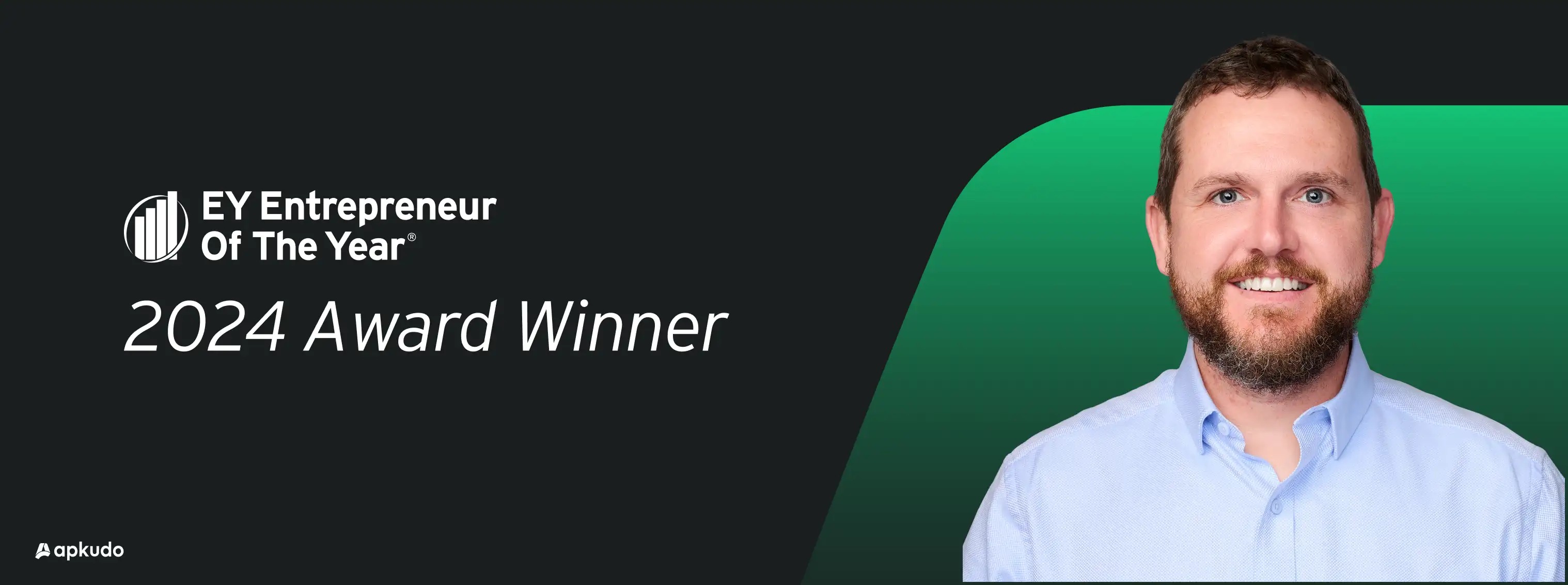
International demand was already pulling. Customers wanted the platform in Europe, Asia, and the Middle East, and beyond phones into computers. Apkudo now lists offices in Baltimore, Dallas, Flensburg, and Sydney. In 2024 it acquired Mobile reCell, adding software-driven recovery of corporate IT assets. The same year, Matthews received the EY Entrepreneur Of The Year Mid-Atlantic Award.
By 2026, Apkudo had appeared on the Inc. 5000 for four consecutive years. The latest ranking placed it at No. 3,677 with 73 percent three-year growth. Lists are blunt instruments, but repetition says something useful here. The company kept growing while it broadened the definition of its work.
Baltimore, by way of Sydney
Matthews is a native Australian who built the company in Baltimore. The route matters. His career moved through web gaming, mobile virtualization, consulting, and embedded systems before Apkudo. He had worked at Open Kernel Labs, and his public patent record includes inventions in field testing and robotic interaction with mobile devices. The founder persona came with an engineer's appetite for mechanisms.
One of those patents describes a robotic tester designed to approximate human movement: multiple implements interacting with a phone while its holder moves. It is a telling artifact. The goal was never merely to poke a screen faster. It was to reproduce enough of the physical world to make the measurement useful. Another invention coordinated field-testing results across many phones and users. Long before “device passport” became the company's organizing phrase, Matthews was working on ways to turn scattered encounters with hardware into structured evidence.
Baltimore supplied a different kind of logic. In 2013, Matthews praised Maryland for having industries with “problems that need solving.” It was a wonderfully unfashionable case for a startup city. No mythology, no weather report, just customers with difficult work. Apkudo kept its headquarters there even as its workforce and customer base spread.
He also joined the early leadership of the Application Developers Alliance, which brought developers, publishers, and major technology platforms into the same conversation. Matthews argued then that privacy and security demanded clearer principles because mobile apps touched people more quickly and intimately than older software had. The topic was different; the instinct was recognizable. Bring participants together, name the standards, and make trust something an ecosystem can practice rather than merely advertise.
That preference for useful difficulty appears in how former colleagues describe him: driven, tenacious, technically inventive, transparent, and inclined to push one step further. His own public language is energetic but collective. He thanks teams, customers, standards bodies, carriers, and partners. His habitual sign-off, “Onwards/upwards,” sounds less like a destination than a maintenance schedule.
A memory worth carrying
The circular economy is often drawn as a perfect loop. Devices flow neatly from use to return, then repair, resale, and use again. Reality resembles a desk drawer tipped into a warehouse. Models are mixed. Batteries age. Parts change. Owners forget passwords. Labels peel. Databases disagree. A foldable phone introduces new hinges, surfaces, and failure modes just when the system has learned the old shapes.
Matthews's answer is not to make the mess sound simple. It is to give every participant better evidence. Recent Apkudo work extends automated assessment to foldables, tablets, and flip devices and connects those results to the Device Passport. The company is also participating in work around device homologation, placing verified information at the start of a device's commercial life rather than reconstructing it at the end.
A passport is an apt metaphor because it does not decide where its holder goes. It makes identity and history portable enough for others to decide with confidence. For devices, that confidence can separate a second life from a premature dismantling, or a fair price from an argument at the returns counter.
Matthews began by asking phones to reveal how they behaved. Fifteen years later, the question has expanded: where have you been, what condition are you in, and what should happen next? A device may be mute. Give it a good enough memory, and the answer can still travel.